Hybrid Architectures Combining Rule Engines and Generative AI
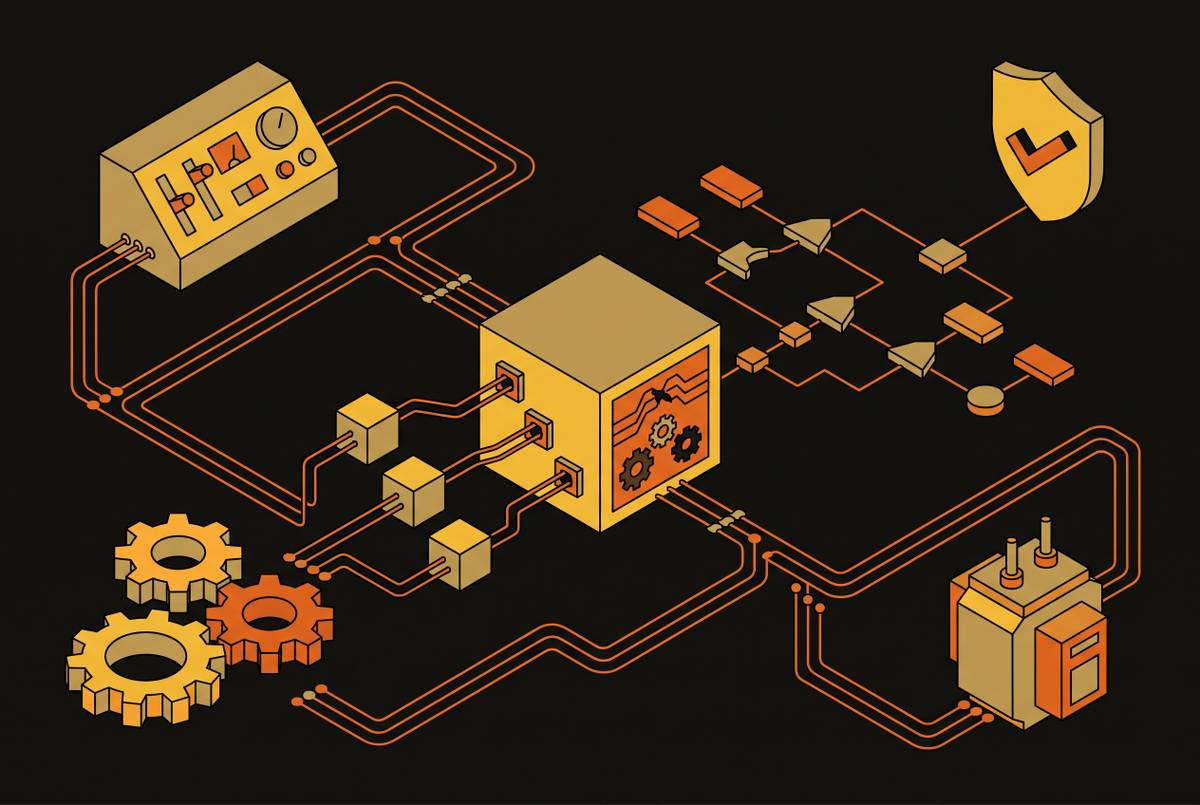
Generative AI handles ambiguous tradeoffs while rule engines enforce non-negotiable constraints.
AI training clusters now run at 40 to 100+ kW per rack. Legacy enterprise facilities were built around 5 to 10 kW per rack. That gap is not a small adjustment to existing electrical and cooling plans, it forces a full rethink of how power gets distributed and how heat gets removed. By 2027, average rack density should climb from 8 kW to 30 kW, because AI-dedicated facilities now get built as the rule, not the exception. At those densities, GPU workloads swing hard between idle and peak, and these swings happen fast, so control systems need to respond within minutes, a pace no manual workflow can hold.
This shift has produced two separate automation problems that now live side by side. One problem demands precision with zero tolerance for approximation: power budgets, cooling thresholds, code compliance. The other demands flexibility and language-level reasoning: configuration synthesis, natural-language design briefs, layout trade-offs that depend on context. These are structurally different kinds of work, not two points on the same scale of difficulty, and that structural difference is why hybrid architecture is the correct engineering response to modern data center design, not a trend being layered on top of it.
Suitability of Rule Engines and Generative AI
Rule engines and generative AI fail in opposite directions. Understanding that asymmetry is the starting point for building anything hybrid out of them.
A deterministic rule engine applies if/then logic and checks constraints one at a time, producing a clean pass or fail. It is reliable because it cannot improvise. That reliability comes with a cost: it is brittle. A rule engine breaks cleanly the moment it hits a condition outside its defined rules, it cannot weigh one trade-off against another, and it needs a human to go back and update it whenever conditions change.
Generative AI runs the opposite way. It generalizes to situations it has not seen before, and it can handle conditions that are not binary, like balancing cost against cooling efficiency against spatial efficiency. That flexibility brings hallucination risk and less predictability. Discriminative AI systems sit in between: they work well in limited state spaces, where a training dataset can describe the complete scenario, and they break down once real conditions exceed what that dataset captured.
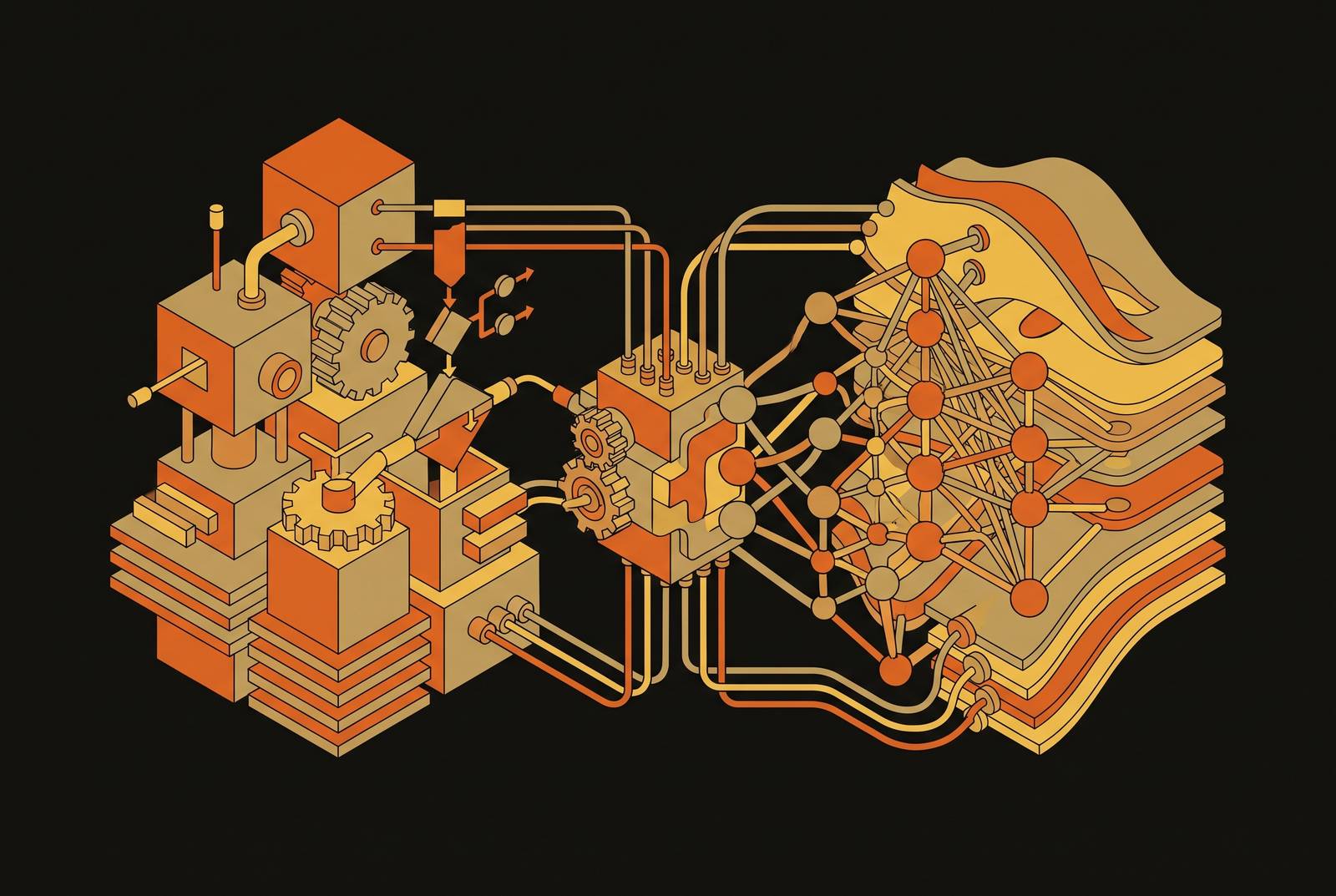
The hybrid response follows directly from these two failure patterns. Generative models propose options and synthesize configurations out of language-rich inputs. Rule engines validate, gate, and enforce the constraints that no one can negotiate away. This is the structurally correct assignment of each tool to the problem it can actually solve.
Generative AI proposals that rules alone cannot generate
Some data center problems have many interacting variables, and they have no single correct answer. Generative models can do work on these problems that rule-based logic cannot do.
Data hall floor-plan generation shows this clearly. A compact layout might cut cost but hurt cooling performance. A wider service corridor might help operations but reduce spatial efficiency. Moving a data hall touches power routing, cooling distribution, service access, code separation, operational flow, and future growth capacity, all at once. A floor plan is a decision matrix with competing variables pulling in different directions, and a rule engine can check whether a finished plan meets its constraints, but generating the plan is a different task altogether that requires generative reasoning.
ChatTwin demonstrates what this looks like in practice. It uses a large language model to generate data center network configurations by parsing natural-language operational briefs, and it reaches a successful construction rate of 87%, saving considerable engineering time. That number matters because it shows that language-level reasoning over ambiguous input can produce real, measurable gains in configuration work, not just a demo.
DCoPilot works a related angle. It uses an LLM to symbolically generate structured reward forms for data center control policies, so engineers do not have to hand-build reward shaping, which could not keep pace with how often operational conditions change. Translating a specification into a working policy is language-rich, context-dependent work, and that is exactly the kind of translation generative AI is suited for. In both cases, the generative component handles the translation from an ambiguous specification into structure. What comes after, the checking, belongs to the rule engine.
Why the rule engine layer is not optional when generative output touches critical systems
An 87% construction success rate is a strong result for a productivity tool. It is a serious problem when a system configures critical infrastructure, because no deterministic check stands between the output and production. If you leave it unguarded, that substantial failure rate turns into a live risk as soon as the output reaches operational systems.
The stakes here are not hypothetical. In October 2023, a planned cooling system upgrade at an Equinix Singapore data center led a third-party contractor to send a signal that incorrectly closed the chilled-water buffer tank valves. The incorrectly closed valves caused overheating and disrupted bank services. That is what happens when a configuration change reaches operation without a layer built to catch it first.
The rule engine in a hybrid architecture is the designed boundary that decides which outputs are allowed to reach production and which get rejected or sent back for revision. Power budgets, code compliance thresholds, thermal safety margins, and cable routing constraints are binary conditions: met or violated, nothing in between. Generative output that crosses into that territory needs to be caught by a deterministic check, not by a statistical guess at how likely it is to be correct.
The accuracy ceiling on LLM extraction from IFC BIM files makes the same point from a different angle. Even the best-configured models hit a limit that is not sufficient for unsupervised use in safety-critical workflows, and cross-format generalization from IFC to formats like Revit RVT or ArchiCAD PLN has not been tested. Rules are the mechanism that makes generative output usable in places where being wrong has consequences.
The boundary between AI and rules in practice
The boundary between AI and rules does not sit at a fixed layer in the architecture. It sits at the point where a decision shifts from a trade-off among competing options to a matter of compliance with a fixed requirement.
On the AI side of that boundary, you get layout options synthesized from natural-language briefs, clash register items scored by their likely structural or schedule impact so not every clash carries equal urgency, operational specifications translated into structured reward forms, and configuration candidates generated out of inputs that are inherently ambiguous. The rules side handles power budget enforcement, cooling envelope compliance, cable routing constraints, code separation requirements, schema validation on BIM extractions, and safety threshold checks on thermal and electrical output.
DCoPilot's architecture shows this boundary built directly into a working system. It operates through three coordinated phases: simulation scale-up, which stress-tests reward candidates; meta policy distillation, which trains a hypernetwork conditioned on SLA and scene embeddings; and online adaptation, which generates policies in zero-shot fashion in response to updated specifications. Across five control task families spanning diverse data center components, DCoPilot achieves near-zero constraint violations and outperforms baseline approaches. That result holds because constraint enforcement is built into the evaluation loop itself, not bolted on afterward as a check.
The clearest sign the boundary has been drawn in the wrong place is when generative output reaches a downstream system, BMS, EPMS, DCIM, or construction documentation, and produces a constraint violation that should have been caught before handoff. The opposite failure is just as telling: a layout or configuration question with no single right answer gets reduced to a binary pass/fail check, collapsing a legitimate trade-off into a false stamp of compliance.
What breaks when teams blur the boundary in either direction
Work assigned to the wrong engine fails in two distinct patterns, and you can see both in current data center delivery.
The first happens when you apply rules to a problem that needs trade-off coordination instead. A rule engine will pass a layout that is technically compliant but operationally poor, because compliance is all it was built to check. Or it rejects every option on the table because none satisfies every constraint at once, so the design process stalls and the team cannot find the best available compromise.
The second happens when generative output reaches critical-systems configuration with no deterministic check in front of it. If the validation layer is missing, that substantial documented failure rate on LLM-generated network configurations is no longer an abstract number, and it turns into a live risk.
A governance gap makes both failure modes worse. Deploying agentic systems in production calls for strong governance: clear data access controls, observability into what an agent actually did and why, and agent registries with workflow versioning. If teams run AI in design workflows without those structures in place, they cannot tell which boundary a failure crossed, so they cannot fix it.
Fragmented tooling makes boundary-blurring more likely. When power, cooling, cable routing, and documentation each live in separate tools with no built-in way to propagate a change between them, teams end up improvising the connections themselves. Those improvised connections are where you end up applying the wrong engine to the wrong problem.
The hybrid interlocks in critical-systems coordination: power, cooling, cable, and fiber
Critical-systems coordination is where the hybrid pattern carries the highest stakes, because a change in one system forces consequences across all the others. Power, cooling, cable, and fiber routing are governed by different engineering disciplines, different tools, and different rule sets, with no native mechanism connecting them.
A rack move is the clearest case. Moving one rack triggers downstream effects on power path, cooling zone assignment, cable routing, fiber routing, load schedule, and construction documentation. You must enforce the constraints on each of those without exception, but each also presents trade-offs that a generative system can weigh.
Google DeepMind's autonomous cooling AI cut data center cooling energy consumption by 40%, with a measurable drop in overall PUE. AI got that result because it optimized within a control envelope that rules defined, rather than replacing the building management system's logic. Schneider Electric and NVIDIA's joint AI-optimized reference architecture, supporting rack densities up to 142 kW, meaningfully reduced cooling energy usage the same way: AI finding the best answer inside boundaries that rules had already set.
Both results depend on the same division of labor. AI finds the optimum inside the envelope. Rules define the envelope and hold the line on it. The hybrid breaks down when the data feeding it is incomplete, when a rack move updates the power model but not the cooling zone assignment, or updates the cable schedule but leaves the fiber routing untouched. In that case the rule engine has nothing complete to validate against, and the AI has nothing complete to reason from. The failure is a consequence of fragmented data, not a flaw in either engine.
The hybrid's extension through BIM to operations handoff
A hybrid architecture that stops at the design phase produces structured, validated output that then gets reassembled by hand at handoff, recreating the exact fragmentation problem it was supposed to solve.
BIM functions as the coordination backbone for data center construction: clash detection, MEP coordination, prefabrication planning. Its limitation is that critical calculations and validations routinely happen outside the BIM tool itself, in spreadsheets, which leaves the model and the underlying data layer out of alignment with each other.
Generative extraction from BIM files has its own ceiling here. LLM extraction from IFC files reaches 55 to 57% accuracy even with the best-configured models, and generalizing that process to other formats like Revit RVT or ArchiCAD PLN has not been tested. Rule-engine guardrails, format validation, schema enforcement, constraint checking, need to sit between generative BIM extraction and anything that reaches operational use. AI still earns its place here: analyzing a clash register and scoring issues by their likely structural, schedule, or cost impact, instead of treating every clash as equally urgent, is exactly the trade-off work that belongs on the AI side.
Three operational systems sit at the finish line of this process. BMS handles facility-level controls. EPMS covers the electrical path from utility to rack. DCIM tracks IT assets, rack space, power capacity, and network connectivity in the white space. Each needs structured asset data assembled during design and construction, and if that assembly is fragmented, the handoff is incomplete no matter how strong the design-time automation was. DCIM does not replace BMS or EPMS, it consumes their data, and outages happen in the gaps between these systems. Those gaps widen when disconnected processes assembled the structured data that feeds them.
A hybrid architecture's job does not end when the design is validated. It ends when structured, traceable asset data reaches DCIM, EPMS, and BMS without anyone manually reassembling it at each step along the way. ArchiLabs Studio is built around this exact handoff: it connects design through construction through operations in one workflow, so that connection does not have to be rebuilt by hand at every transition.
Requirements of a Well-Designed Hybrid Architecture
The hybrid architecture fails in most current delivery workflows because the data infrastructure meant to connect rules and AI does not exist yet.
Structured data needs to carry its own semantics and lineage across every transition in the process, from layout generation through critical-systems coordination through BIM to final handoff. That continuity is the precondition for deterministic validation to actually work. Without it, a rule engine is checking incomplete information no matter how well it is designed. Every dataset in the chain needs its own semantics, lineage, and guardrails built in, so the system can enforce policy, audit a decision after the fact, and preserve a clear record of how something was built. That embedded context is what makes an autonomous workflow capable of recalling past decisions, adapting to new conditions, and correcting itself.
A functioning hybrid also needs change propagation across systems, so a rack move updates power, cooling, cable, fiber, schedules, and documentation in a single operation rather than cascading into manual rework across five different disciplines. It needs a validation layer positioned between generative output and operational deployment, not a review step added after the fact but an architectural gate that catches constraint violations before they reach BMS, EPMS, DCIM, or construction documentation. And it needs traceability: every RFI answer, design decision, and equipment parameter traced back to the information that supports it, so when the rule engine flags a violation, the team can trace it to its source instead of starting the investigation over from zero.
ArchiLabs Studio is built specifically to provide this kind of connected infrastructure for data center projects, linking layouts, critical-systems engineering, cable routing, documentation, RFIs, and operations-ready handoff inside one workflow, where deterministic rules enforce the constraints that cannot be negotiated and AI takes on the ambiguous, context-dependent work surrounding them. The hybrid architecture this article has traced is finished when structured, traceable data reaches the operational systems that run the building, without being rebuilt by hand at every step along the way.