AI Layout Suggestion vs. Deterministic Constraint Enforcement in Data Hall Design
AI generates design candidates; deterministic rules catch what won't work.
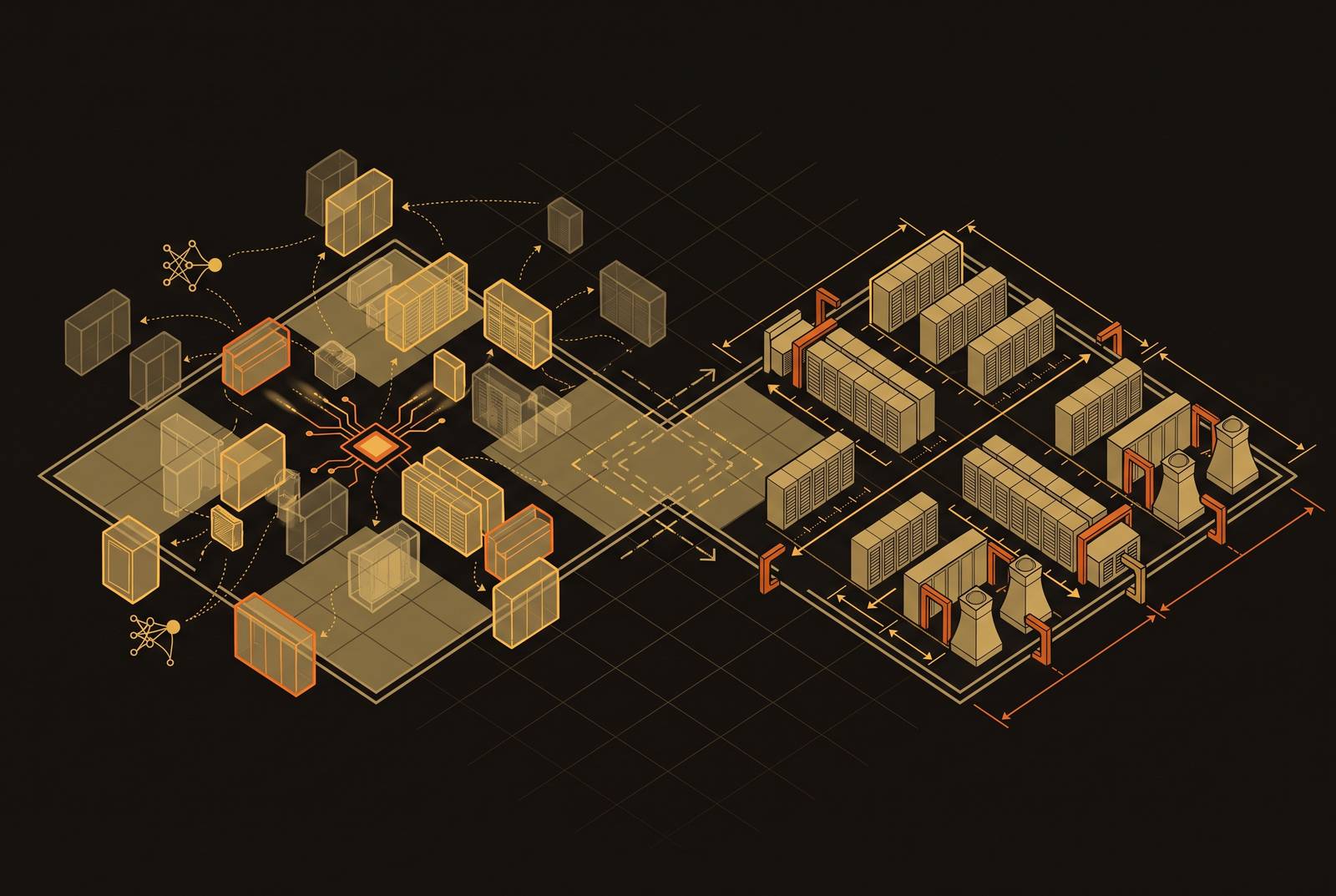
Nvidia's rack densities went from 25 kW to 132 kW in three years. That's the A100 to GB200 curve, and it means every layout decision made in a data hall today has to account for hardware nobody's tested yet. This piece is about the two tools design teams use to handle that: AI layout suggestion and deterministic constraint enforcement. They are not rivals fighting for the same job. They do different jobs, and mixing them up is where projects go sideways.
What deterministic constraint enforcement does in a data hall layout
Deterministic rules take known physical, electrical, and code limits and turn them into pass/fail conditions. Not targets to aim for, boundaries the layout cannot cross. Same inputs, same output, every single time.
In a data hall, these rules come from a handful of places. On the power side: rack-level and outlet-level caps checked against EPMS and PDU data, branch circuit loading limits, protection coordination so a load spike doesn't trip a breaker three panels upstream. On the cooling side: hot-aisle and cold-aisle clearance mandates, minimum separation for liquid cooling manifolds, structural load limits for chilled water lines running overhead or under a raised floor. Cable and fiber routing has its own rule set too: pathway separation to cut down on electromagnetic interference, bend-radius limits, keeping power and data cabling apart. And then there's code: egress clearance, equipment access widths, maintenance zones, often down to millimeter-level tolerance.
Academic modeling backs up what this buys a design team. Integer linear programming layouts that minimize total build cost while satisfying allocation, capacity, and energy constraints have shown real cost reductions in energy-efficient scenarios compared to layouts that ignore those constraints. The exact savings vary by scenario, but the pattern holds: encoding the rule set up front produces cheaper, more defensible layouts than testing for compliance after the fact.
What deterministic enforcement actually guarantees is auditability. Every constraint either passes or fails, and it fails with a specific, traceable reason. That's worth something on a project this expensive.
What it can't do is invent anything. It doesn't propose layouts. It validates or rejects a layout somebody else already put in front of it. Left alone, a purely rules-based system just sits there waiting for a candidate design to check.
What AI layout suggestion does, and what it cannot guarantee
AI layout suggestion fills that gap. Feed it a set of objectives, cooling efficiency, space use, power distribution balance, and it can chew through far more design variations than a person iterating by hand ever could. That's the whole value proposition: speed across a large option space, and occasionally a configuration a human designer wouldn't have thought to try, especially once a hall starts mixing rack types. Air-cooled, rear-door heat exchanger, direct liquid cooling, maybe immersion, all in the same room.
AI sits upstream of enforcement, not downstream. It generates candidates. It does not hand over a validated, buildable design. Every candidate still needs a constraint check before anyone breaks ground on it. Machine learning models can also forecast how a layout behaves under different operating scenarios, which is genuinely useful for spotting how a design responds to a load spike before that design gets locked in.
But there's a ceiling here, and it's not small. Current research on extracting information from BIM models using large language models shows accuracy levels that fall well short of what unsupervised use would require in a workflow where a mistake means a tripped breaker or a fire code violation. Cross-format performance, moving between IFC, Revit, and Archicad file types, is largely untested territory too.
None of this means rule-based systems are flawless on their own. They're brittle in a specific way: when the assumptions baked into a rule set no longer match the data in front of them, they fail, and those failures are notoriously hard to trace back to a cause. That's a real problem, and it's an argument for maintaining rule sets carefully. It is not an argument for handing enforcement over to AI.
The core limit is structural, not a matter of better training data eventually fixing it. An AI tool can propose a 132 kW rack cluster arrangement that looks spatially efficient on screen and still violate branch circuit loading, cooling manifold clearance, or an egress requirement, unless something deterministic checks it before anyone treats it as final. The choice comes down to which part of the problem needs a guaranteed right answer and which part benefits from having options, analytical tools can be deterministic, model-driven, or hybrid depending on that split. That's a design decision. It shouldn't default to whichever tool is more fashionable this year.
Where the boundary between suggestion and enforcement must be drawn in practice
The right question isn't how much AI to use. It's which decisions need a guaranteed correct answer, and which ones benefit from having several good answers to pick from. That question sorts the work cleanly.
Some decisions have zero tolerance for optionality. Power path validation: branch circuit loading, UPS capacity allocation, outlet-level caps checked against PDU and EPMS data. Get this wrong and equipment trips or overheats, full stop. Cooling clearance falls in the same bucket: hot-aisle and cold-aisle separation, manifold routing clearance, structural load compliance for the piping overhead. Cooling alone typically eats 30 to 40 percent of a facility's total electricity draw, so an error in this layer doesn't just risk downtime, it burns money every hour it goes uncaught. Cable and fiber pathway separation belongs here too, along with code compliance items like egress width and fire suppression zones. None of these are negotiable, and none of them should ever touch a probabilistic tool.
Other decisions are exactly where AI earns its keep. Row orientation and rack grouping in a hall that mixes high-density liquid-cooled clusters sitting alongside lower-density air-cooled racks creates a combinatorial mess too large to iterate through by hand. Cooling topology at the early design stage, overhead distribution or below the raised floor, benefits from AI surfacing the tradeoffs of each option before anyone pours concrete around a decision. Scenario modeling for future hardware generations fits here as well: since teams now have to design one or two GPU generations ahead of what's actually shipping, AI can generate candidate layouts for a projected 240 kW rack and let the deterministic rule set test against it before that hardware even exists. Space utilization, when several layouts are all equally compliant and the only real difference is efficiency, is AI's territory too.
The workflow that actually works runs in sequence. AI generates candidates. Deterministic rules validate each one against power, cooling, clearance, and code. Anything that fails goes back with a specific reason attached, not a vague confidence score. What survives goes to the designer for final review, and once a layout is picked, changes cascade automatically through the power schedules, cable routes, and documentation.
Flip the assignments and things go wrong fast. A probabilistic model that "usually" respects a cooling clearance will, sooner or later, produce a layout that doesn't, and because the output looks like a finished design, nobody catches the violation until fabrication or commissioning. Go the other direction and hand a purely rule-based system a hall with four rack types and three cooling topologies, and it either times out chewing through the option space or plays it safe and leaves capacity on the table nobody needed to sacrifice.
How power, cooling, and cable coordination collapse when the boundary is ignored
Power and cooling still get managed as separate functions in a lot of shops, run by different teams, on different tools, sometimes through different vendors. That separation is the root cause of poor coordination, and it means a layout change made in one domain does not automatically appear in the other.
Consider what a single rack move actually touches. Power path: branch circuit loading, PDU outlet assignment, EPMS capacity. Cooling: manifold connection point, airflow balance, CDU load. Cable routing: path length, pathway fill, bend radius. Documentation: schedules, single-line diagrams, as-builts. Move one rack six feet and every one of those needs to update.
That is exactly where an AI suggestion tool becomes dangerous when it lacks a deterministic layer to check its output. If the tool proposes a rack relocation and nothing checks it against cooling clearance and power caps right then, those violations stay hidden until downstream engineers, working in their own separate tools, stumble onto them later. By that point the design is already half-committed, and unwinding it costs real money.
High densities and sudden load swings put real stress on distribution systems that weren't built with this kind of volatility in mind. Managing rapid load changes without tripping protection or overheating equipment demands precise, rule-bound control, not something a probabilistic suggestion engine should be steering.
Liquid cooling adds another layer of physical stubbornness. Chilled water loops, stainless steel piping, structural systems rated for loads far heavier than a traditional air-cooled hall ever carried, all of it has to route around rack positions. If those positions were optimized purely for floor space rather than manifold access, the piping simply won't fit the way the layout assumed it would. Newer platforms handle this correctly by coordinating data across EPMS, DCIM, and intelligent PDUs to enforce power caps at the rack and outlet level, prioritize critical loads, and shed nonessential ones when needed. That's deterministic enforcement working with live operational data, not a suggestion engine guessing at what might work.
There's a paper trail consequence too. Every RFI answer, every design decision, every equipment parameter that shifts a rack's position needs to trace back to the constraint that drove it. A layout built by an AI suggestion tool that lacks a deterministic layer to check its output leaves no record of why any rack sits where it sits. Six months later, nobody can answer that question with confidence.
What a connected layout workflow looks like when both tools are doing their jobs
None of this works unless decent data drives it. Teams with more mature BIM practices operate from a shared source of truth, models that carry more intelligence and workflows that behave more predictably. The better and more trustworthy that data environment, the more value both the AI layer and the deterministic layer can pull out of it.
A workflow built around that foundation runs in four stages. First, AI-assisted exploration: given site constraints, a power budget, and a rack library that might include high-density liquid-cooled clusters sitting next to lower-density air-cooled units, the tool generates candidate layouts optimized across several objectives at once. The designer reviews options, not individual rack placements one at a time.
Second, a deterministic validation pass. Every candidate runs against the full rule set: power path loading, cooling clearance, cable pathway fill, code compliance. Failures come back with a specific reason attached, never a probability score.
Third, change propagation. Once a layout is selected and something changes later, a rack type swap, an added row, a revised cooling topology, the deterministic rules push that change through power schedules, cable routes, structural loading, and documentation automatically. Nobody re-enters the same data three times in three different tools.
Fourth, an operations-ready handoff. The structured data underneath deterministic enforcement, rack positions, power assignments, cooling connections, cable paths, is the same data DCIM, EPMS, and BMS systems need the moment the facility goes live. A layout enforced deterministically the whole way through arrives at turnover with its asset data already structured, instead of someone extracting it by hand out of a stack of PDFs.
This matters even more for modular and prefabricated builds, where fabrication needs a model, not a drawing set. Deterministic enforcement inside the layout tool is what makes a model fabrication-ready in the first place, because compliance is already documented in the model's data rather than something someone eyeballs and hopes is right. Rules-based automation can dramatically compress design cycle time, but that speed only occurs when the rule set is encoded ahead of time. That's the argument for treating the deterministic layer as infrastructure a company builds once, not a line item bought fresh for every project.
Platforms built around this exact split are starting to show up in practice, ArchiLabs Studio among them, connecting layout generation, critical-system coordination, cable routing, documentation, and RFI tracking inside one workflow. AI handles the creative, iterative exploration. Deterministic rules handle everything where precision and compliance aren't up for discussion. Structured data drives all of it, so nothing gets lost on the way to handoff.
The skill that separates teams who will keep pace with the density curve from those who won't
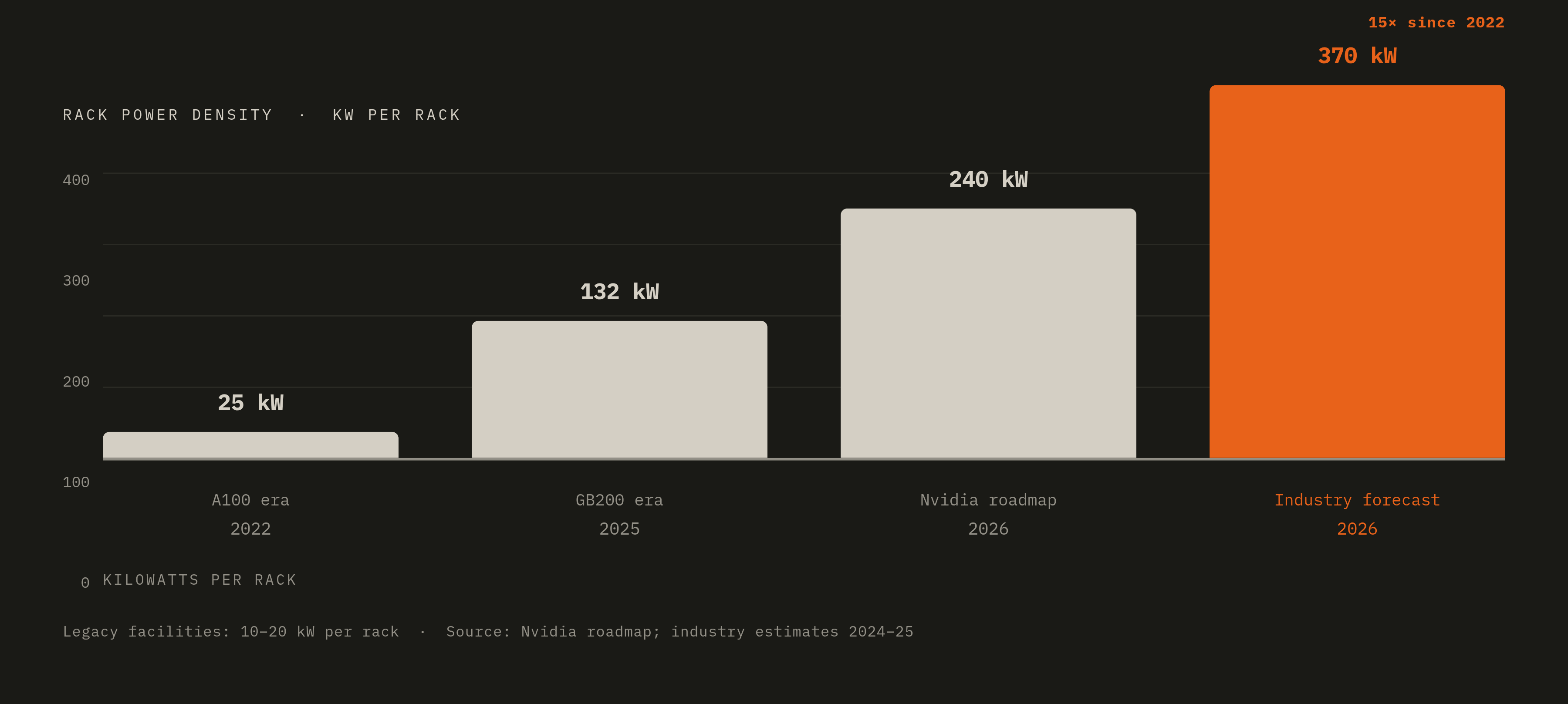
Rack densities aren't leveling off. Nvidia's roadmap alone has pushed from 25 kW in 2022 to a projected 240 kW by 2026, and some industry forecasts put next-generation AI racks as high as 370 kW that same year. Facilities built for 10 to 20 kW racks are now being asked to house clusters that blow past 100 kW, heading toward 300 kW and beyond. And a growing share of the servers going into data centers right now are built specifically for AI workloads, which means this curve isn't a niche concern anymore. It's what most mainstream designs now have to contend with.
The old approach, drift slowly from 3 kW to 10 kW over a couple of decades, testing and adjusting across several hardware refresh cycles, doesn't exist anymore. There's no equivalent runway. Design teams now have to plan for densities a generation or two ahead of anything they've actually deployed, and with AI-ready builds running $20 million or more per megawatt against $10 to 12 million for a standard facility, a layout mistake at this scale isn't a rework, it's a budget event.
The skill that separates the teams keeping pace from the ones falling behind isn't picking AI or picking deterministic rules. It's knowing, decision by decision, which one belongs where, and building a workflow where both are doing their job at the same time instead of stepping on each other. That's not a philosophical stance. It's the only approach that survives contact with a density curve moving this fast.