Constraint Propagation in Engineering CPQ Systems
How constraint solvers catch invalid product configurations before they reach engineering.
CPQ stands for configure, price, quote. The software helps companies configure complex products or services to a customer's exact requirements, price them accurately, and turn out a quote fast. Constraint propagation is the piece of that software that makes it actually work when the product is complicated: change one setting, and the system automatically narrows or resolves every parameter that setting touches, catching invalid builds before anyone downstream ever sees them.
That distinction matters more than it sounds like it should. In engineer-to-order and configure-to-order businesses, where products carry hundreds of interdependent options, a sales rep or estimator can't hold the whole dependency tree in their head. Without automation, mistakes slip past sales and land on engineering's desk, or worse, procurement's. Cincom's 2025 industry overview puts the global CPQ market at roughly USD 3.41 billion, growing at a 12.3% compound annual rate from 2025 to 2030. That growth reflects product complexity outrunning what a spreadsheet or a human memory can track. It's product complexity outrunning what a spreadsheet or a human memory can track. Manufacturing, construction, medical devices, specialty vehicles: these industries share one thing. In each of them, a valid configuration and an engineering-sound configuration are the same object. You can't quote something that can't be built.
What constraint propagation does inside a CPQ engine
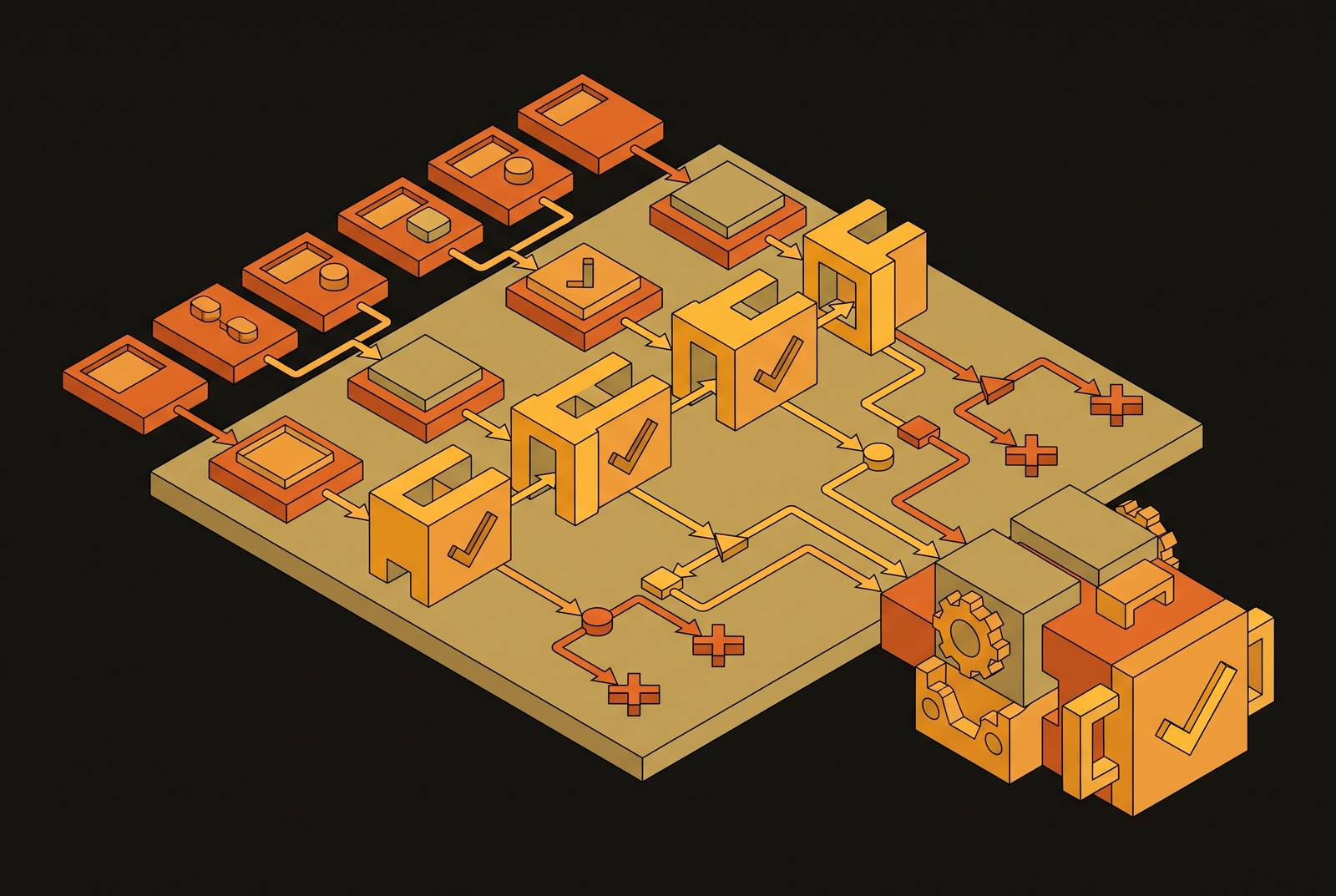
At its core, a constraint engine runs an algorithm across a set of interdependent variables. Change one, and the engine recalculates the feasible range for every variable connected to it. Not just flags a problem after the fact, recalculates the actual space of what's still possible.
It computes which values are now infeasible and the live status of every constraint across the configuration. The fine-grained evaluation, especially in engineering settings, usually gets handed off to constraint-based systems and CAD tools built for that kind of math. When something breaks, or a variable's feasible range shrinks to nothing, the engine surfaces that immediately. Before a human ever opens the file.
That's a different animal from if-then rule scripting. Rule scripts require someone to anticipate every case in advance, which is fine until the product has thousands of option combinations and somebody missed one. A true constraint solver instead models the product itself, its physical and logical limits, and guarantees mathematically that whatever configuration comes out the other end is valid. Cpq.se's practitioner comparisons describe this as Tacton CPQ's approach for complex engineered goods like cranes, trucks, and industrial machinery: rule-scripted tools tend to break under that complexity, constraint solvers hold.
This isn't AI, not a recommendation engine, not a probabilistic guess dressed up as an answer. Constraint propagation is not AI, not a recommendation engine, not a probabilistic guess dressed up as an answer. It's a formal, deterministic process. The same approved inputs produce the same outputs every single time, because the logic runs off governed metadata and explicit rules, not a trained model making its best guess. That repeatability is exactly why engineering teams trust it. Changes to the underlying constraint model are reviewable, auditable, and don't drift.
How a parameter change cascades through dependent variables
Everything starts with one trigger. Someone sets or changes a single parameter, rack power density, a cooling topology, a voltage level, a structural load limit. Doesn't matter what kind of parameter it is.
The engine immediately recomputes every variable with a declared dependency on that one. Some get narrowed, fewer valid options remain than before. Some get fully resolved down to a single value. Others get flagged outright as violated. From there, the cascade keeps going, layer by layer, through the whole dependency graph. A change in power draw narrows which cooling systems are still viable, which constrains allowable floor loading, which limits structural selection, which in turn limits where equipment can physically sit. No person has to step in between any of those layers for the logic to keep moving.
What gets eliminated along the way: anything physically impossible, anything that busts a capacity limit, anything that violates a safety or redundancy rule, anything that would force an engineering rework nobody planned for. What survives and reaches the engineer or the procurement team is a configuration space the engine has already checked for internal consistency. Engineering reviews a design that works. Not a punch list of conflicts somebody else has to untangle by hand.
Cincom's 2025 overview attributes 10 to 15% shorter sales cycles and deal sizes up to 20% larger to this kind of automated validation and proposal generation. In engineering-heavy settings, most of that speed gain traces back to one thing: killing the back-and-forth that invalid configurations generate in the first place. Every round of "actually, that won't fit" costs a day, sometimes a week.
There's a staffing angle here too. Salesforce-sponsored research published on Harvard Business Review found nearly 80% of employees said automation freed up time for deeper client relationships, harder projects, and new skills. Translate that into engineering CPQ: constraint propagation takes engineers off configuration-policing duty and gives that time back for the work only an engineer can actually do.
Where constraint propagation fits in the CPQ vendor landscape in 2026
Cpq.se's practitioner framing, updated in July 2026, makes a useful point: there's no single best CPQ vendor. There are two separate shortlists, and which one applies depends on where the complexity actually lives, in the deal or in the product.
For product-complex manufacturers, the relevant names are Tacton, Configit, Epicor CPQ, Configure One (now under Revalize), Hive CPQ, and Experlogix, with Cincom sometimes in the mix, plus SAP or Oracle where the ERP or CRM relationship makes that the practical choice. For commercially complex sellers, where the deal itself, not the product, is the hard part, the list runs Salesforce Agentforce Revenue Management, Oracle CPQ, SAP CPQ, DealHub, Conga, and ServiceNow. Conga finished acquiring PROS B2B's pricing business on February 2, 2026. ServiceNow entered CPQ through its Logik.ai acquisition, announced April 3, 2025 and closed in the second quarter of that year.
Constraint-solver depth varies a lot across this list, and this section goes vendor by vendor.
Tacton CPQ runs on an explicit constraint-solver model designed to produce only valid configurations, and it's built for genuinely complex engineered products like heavy industrial machinery. Gartner named it a Leader in the 2026 Magic Quadrant for CPQ, and it ships a named AI feature, the AI Product Modeling Assistant. Configit works more like a configuration backbone, with CPQ sitting as one application layered on top; it positions itself as an enterprise-wide source of configuration truth and ships an AI feature called Ace Prompt. Epicor CPQ, formerly KBMax, specializes in manufacturing with visual and 3D configuration tied into Epicor's ERP, and includes AI-assisted configuration. Revalize's Configure One serves mid-market manufacturers, with light public detail on any AI capability. Hive CPQ covers manufacturers and dealer networks, strongest in one major region but expanding globally, and ships Hive AI. Experlogix targets Dynamics and Salesforce shops in the mid-market and enterprise tier, with AI productivity features listed publicly. Cincom CPQ specializes in medical, insurance, and complex services, also light on public AI detail.
On the enterprise side, Oracle CPQ, descended from an earlier vendor it acquired, is one of the most mature platforms in the category. A recent release added a guided Configuration AI-Assist Agent, and Gartner named it a Leader for the ninth straight year in the 2026 Magic Quadrant, a track record that fits large organizations with heavy approval chains already on the Oracle stack. SAP CPQ is the default pick when SAP already runs the ERP, carrying deep variant-configuration heritage. SAP's own documentation notes the SAP CPQ to CX AI integration is obsoleted as of release 2605, so it's worth asking any SAP rep exactly what AI ships inside CPQ itself, not the surrounding suite. Salesforce Agentforce Revenue Management is strongest in subscription pricing, approvals, and deal workflow, but heavy engineering constraints usually need a workaround or a third-party configurator bolted on; legacy Salesforce CPQ is still available to existing customers, though it's in a maintenance phase with no new feature work. DealHub fits fast-moving B2B sales teams in the mid-market, with its own AI feature set. ServiceNow, through Logik.ai, brings CPQ into a workflow-platform context, suited to enterprises already living inside ServiceNow.
The market shifted in 2026 in a specific way: AI-assisted quoting stopped being a slide in a sales deck and started shipping as real, usable features across most of this field. Conga acquired the PROS B2B business. ServiceNow pulled CPQ further into workflow-platform territory through Logik.ai. For anyone evaluating these tools on constraint depth, a named AI feature tells you nothing about whether the underlying engine can actually solve constraints the way an engineered product demands. Every vendor on this list should be made to run its engine against your actual product model, not a demo script written to make the tool look good.
This is also where a platform like ArchiLabs Studio sits differently from the rest of this list. It's purpose-built for data center engineering specifically, not general manufacturing, but it runs on the same underlying principle: AI handles the parts of the work that benefit from flexibility and language, deterministic rules handle the parts where precision can't bend, and structured project data ties the two together. The constraint logic there governs power paths, cooling topology, cable routing, and equipment placement, not abstract option trees on a sales screen.
Why data center engineering stress-tests constraint propagation harder than most industries
Data center construction costs have climbed substantially between 2020 and 2025, and AI-optimized facilities run well above standard per-megawatt baselines, according to widely cited industry coverage. At that cost basis, an engineering mistake is a financial event with a project number attached to it. It's a financial event with a project number attached to it.
Part of what makes this domain so unforgiving is how deep the dependency graph actually runs. Power delivery, cooling topology, cable routing, structural loading, redundancy architecture: none of these sit independently. They're tangled together. Change the rack power density and it cascades into cooling selection, then floor loading, then cable tray sizing, then UPS and PDU configuration, then every document that references any of it.
The shift toward AI-optimized racks has made this worse, not incidentally worse, structurally worse. These racks draw substantially more power than traditional deployments, enough that older design rules, built around perimeter cooling and raised-floor assumptions, don't hold anymore. Constraint sets built for the last generation of hardware don't just need extending. They need rebuilding.
Coordination compounds the problem further. Power routing has to reconcile data across EPMS, DCIM, and intelligent PDUs to enforce power caps at the rack and outlet level. Cooling installation often runs in the same physical space and same timeline as power work. Long-lead equipment, generators, switchgear, transformers, cooling systems with lead times stretching many months, means schedule constraints are now tangled up with engineering constraints too, not sitting off to the side.
Rework tells the real cost story. Industry research puts average rework at up to 12% of total project value, and a meaningful share of that traces back to work performed against incomplete or unconfirmed specs. In a data center build, a clarification that looks minor on paper can still block electrical energization or integrated systems testing, turning a small question into a high-risk delay. And none of this happens in a labor market with slack to absorb it: the AGC's 2024 Workforce Survey found 94% of firms reporting a labor shortage. Piling manual tracking onto every open configuration question is a direct cost nobody can spare the headcount to pay.
Where constraint propagation breaks down in practice
The engine is only as good as the constraint model behind it. Propagation can only run over relationships someone actually defined. An incomplete or wrong constraint set will happily produce a configuration that's valid by the engine's own logic and wrong by the physical world's.
Geometry causes its own kind of failure. In automated BIM pipelines, non-orthogonal shapes tend to break robustness in ways rectilinear layouts don't. Input models usually get polygonized in the process, which introduces small gaps and discontinuities between walls and floors, and those gaps degrade whatever graph representation gets built from them downstream. Propagating constraints across geometry is a genuinely harder problem than propagating them across a clean parameter space.
Then there's the human side, which no spec sheet captures. Even where the technical capability is solid, adoption gets slowed by organizational inertia, disrupted workflows, and plain resistance to change among the people who have to use the tool daily. A constraint engine that teams route around instead of working through produces exactly the invalid configurations it was built to catch. The tool didn't fail. The org chart did.
BIM itself deserves a specific callout here, because it gets treated as a configuration engine when it isn't one. BIM is a visualization and coordination tool. It doesn't natively enforce constraint propagation across interdependent systems like power path, cooling topology, and cable routing. And a BIM model, on its own, doesn't produce the structured asset data that DCIM, BMS, and EPMS need at handoff. Getting there takes a deliberate data enrichment step. Nobody gets that for free just by modeling in 3D.
That handoff point is where constraints enforced during design can quietly go missing. BMS handles facility-level HVAC and environmental controls. EPMS specializes in electrical distribution and metering. DCIM unifies IT and facility data across both. All three systems need structured, constraint-consistent data delivered to them at handoff, or the redundancy and capacity assumptions baked in during design become invisible the moment the facility goes operational. Without that structure, a facility management system that's supposed to integrate directly with DCIM, BMS, and EPMS, routing alarms into work orders automatically, has nothing to work with. It needs full maintenance histories and asset-level audit trails, and unstructured handoff data simply doesn't carry that.
One more boundary matters here, maybe the most important one. AI is good where flexibility and language matter. Deterministic rules are for where precision and safety can't be negotiated. Blurring that line, letting probabilistic inference touch a parameter that needs a guaranteed answer, is a mistake in the design philosophy itself. It's a mistake in the design philosophy itself.
What constraint propagation requires to work end-to-end in data center delivery
None of this runs without structured data first. Constraint propagation has nothing to operate on if equipment specs are sitting locked inside manufacturer PDFs, spec sheets, submittals, product data sheets that nobody's extracted. That information has to flow directly into models, schedules, and validation rules, or the engine is working blind.
It also has to work as a connected workflow, not a walled-off tool competing for attention. Automation should plug into the systems teams already trust and use daily, not ask them to abandon those tools for something new and disconnected. G2's 2024 manufacturing trends report flagged design-to-CPQ integration, automating CAD drawing generation straight out of the configuration, as a defining trend for exactly this reason. The same logic carries directly into engineering CPQ for data centers: manual re-entry between design and configuration is where errors and delay both live.
Traceability isn't optional either. Every RFI response, every design decision, every equipment parameter needs a clear line back to whatever justified it. Constraint propagation that can't be audited, where nobody can trace a decision back to the rule that produced it, fails the compliance bar that critical-facility delivery demands. It's table stakes for a building that has to pass inspection and stay operational for decades. It's table stakes for a building that has to pass inspection and stay operational for decades.
The real finish line is operations-ready handoff, not construction completion. Structured data objects for every named asset, carrying attributes that DCIM, BMS, and EPMS can actually use, mark the difference between an "as-built" package and a facility that's genuinely ready to run. Constraint propagation that stops enforcing validity the moment construction wraps has done half the job and abandoned the other half.
So the real test for any CPQ or design-automation platform in this space comes down to a short set of questions. Does it keep AI and deterministic rules in their correct lanes? Does a single rack-level change cascade cleanly through power, cooling, cable routing, schedules, and sheets without someone reworking it by hand? Does it hand DCIM, EPMS, and BMS structured asset data they can use directly, or does it dump that integration problem on whoever's running operations after the ribbon-cutting?
ArchiLabs Studio was built around exactly that test. It connects layouts, critical-systems engineering, cable routing, documentation, RFIs, and operations-ready handoff inside one workflow, governed by the same logic running through this entire piece: AI where speed and flexibility genuinely help, deterministic rules where precision and compliance can't bend, and structured data carried through every step so nothing gets lost between the design table and the day the facility goes live.