Spec Extraction From Manufacturer Datasheets Into CPQ Rules
Automate datasheet data entry to stop manual re-keying errors and rule misalignment.

The manual re-entry loop from trapped datasheet data
Manufacturer datasheets hold the exact numbers a CPQ system needs to build valid product configurations: power draw, thermal output, weight, rack height, operating range. Those numbers sit locked inside PDFs with no shared layout, no shared units, no shared labels. So teams end up typing them into spreadsheets by hand at every stage of a project. Manual re-entry is the wrong default, full stop. This piece walks through what makes the data hard to pull out, and what changes once extraction and validation work together instead of leaving the job to a person with a highlighter.
Without automation, the default path is manual re-entry. An engineer opens the PDF, reads a value, types it into a spreadsheet or a configuration tool, and repeats that same motion every time a product gets added, updated, or swapped out for a substitute part.
Every keystroke in that loop is a chance to get it wrong. Digits get transposed. Someone grabs a number off a superseded datasheet revision without realizing a newer one exists. Unit conversions get botched, and nothing downstream catches it because nothing downstream is checking.
In data center design, the numbers at risk aren't cosmetic. A bad power draw figure works its way into circuit sizing, panel schedules, and UPS capacity math. A bad weight figure throws off floor-loading calculations and can hold up structural sign-off. Research on manufacturing datasheet extraction, published through Springer, points to the same pattern: manual processing cuts down the usability of the information and creates a real bottleneck when teams try to connect it to modern ERP systems.
The same spec gets typed in five separate times, and that's what actually costs money. The spec gets typed once into the layout tool. Once into the power model. Once into the CPQ configurator, once into the submittal package, once into the DCIM asset record. Each entry happens on its own, so each one can drift from the others in a different direction. No single mistake sinks a project. But multiply that across hundreds of equipment line items on a real build, and the mismatched configurations turn into engineering rework, RFI volume, and change orders that hit the field because nobody caught the drift early enough. An extraction-to-rules pipeline closes that gap by pulling the value once, checking it once, and letting it flow everywhere else on its own.
Where CPQ rules need to come from
CPQ software, short for Configure, Price, Quote, exists to replace manual engineering checks with rule-based logic. The rules are supposed to stop an invalid configuration before a quote ever goes out the door.
In data center and critical-infrastructure work, those rules encode real physical limits. A rack configuration that exceeds floor load capacity should get blocked automatically. A power draw that exceeds the available circuit ampacity should throw a flag before the bill of materials locks in. A rule is only as good as the number feeding it, though: if the power draw value came from a manually transcribed PDF and it's wrong, the rule waves through a configuration it should have stopped.
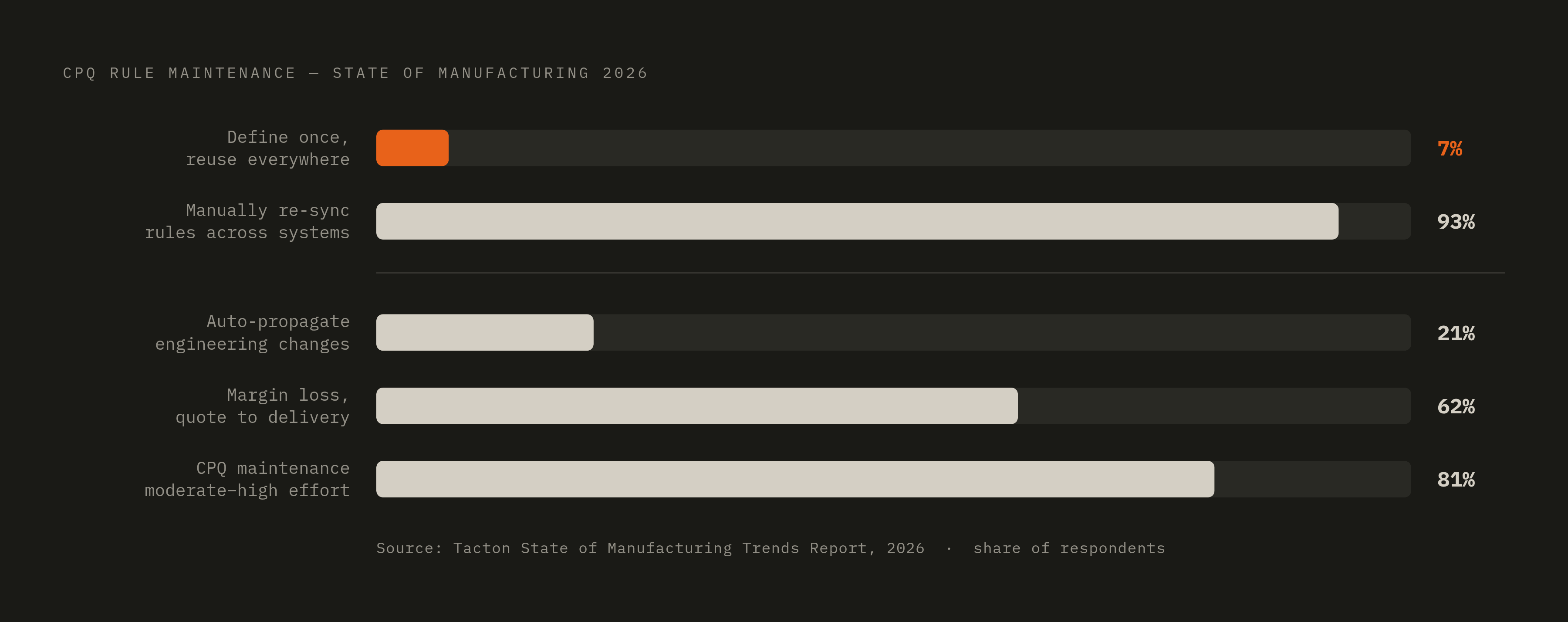
Tacton's State of Manufacturing Trends report puts a number on how bad configuration-rule sourcing actually is: only 7% of manufacturers define configuration rules once and reuse them everywhere. The other 93% manually re-sync rules across systems, burning engineering hours and opening the door to divergence between one system's rule set and another's. More than a third of manufacturers say they deal with frequent change orders and struggle to generate valid engineering and manufacturing bills of material straight from a configured quote, a downstream symptom of a data problem that started upstream. Only 21% automatically propagate engineering changes across sales and production systems, and 62% report at least moderate margin loss between quote and delivery.
The rule-sync failure and the datasheet-extraction failure are the same failure, seen from opposite ends of the pipeline. Specs get trapped in PDFs, so rules get maintained by hand, so rules drift, so configurations get generated that don't survive engineering review.
What makes datasheet extraction tractable now: AI-assisted parsing
Older parsing tools worked by pattern matching: look for the word "power," grab the number sitting next to it. That approach breaks the moment a new manufacturer uses different wording or lays out the page differently. The real advance in newer tools is that they read for meaning instead of position. Language-aware models learn what a spec field means in context even when the label, the placement on the page, and the formatting all shift from one datasheet to the next.
That's what solves the vendor mess that broke earlier tools. The model generalizes across vendors instead of needing a custom parser tuned for each one. Springer's research frames the goal the same way: extraction succeeds when it produces structured output, something like a JSON schema, that correctly identifies, classifies, and links product attributes together in a form downstream systems can actually use.
In PCB and hardware engineering, Energent.ai has reported 94.4% accuracy on the DABstep benchmark for pulling electrical specs into structured formats. That's a vendor's own number, and it shows roughly where AI extraction performance is in engineering domains that look a lot like this one.
For data center gear, servers, PDUs, UPS units, cooling units, switches, the fields that matter are well defined: power draw at idle and peak, thermal dissipation, weight, rack unit height, operating temperature and humidity range, physical footprint. These are bounded, typed values, and that's exactly the condition where AI extraction does its best work. The model knows what it's hunting for even when the document itself never labels it clearly.
None of this makes AI extraction infallible. It produces a confident reading with a confidence score attached, and a confidence score is a hedge, not a guarantee. That's why it can't be the only layer doing the work.
Why deterministic validation rules must follow AI extraction
AI and deterministic rules aren't two ways of doing the same job. They split the work along a clean line, and blurring that line is where teams get burned. Trusting one side blindly breaks the pipeline: trusting AI alone lets a misread ship straight into a quote, while trusting manual rules alone puts you back in the re-entry loop that started this whole problem.
AI handles extraction and interpretation: reading a messy PDF, figuring out what a given field actually means, mapping it onto a schema, flagging anything ambiguous along the way. Deterministic rules take over from there, checking whether a value falls within acceptable bounds, whether it lines up with related specs, whether it's safe to hand off to configuration logic.
Picture it in practice. AI pulls "peak power draw: 6.8 kW" off a server datasheet and slots it into the power_draw_peak field. A deterministic rule then checks whether 6.8 kW makes sense for that class of equipment, and if it falls outside the plausible range, it kicks the value back for a human to look at. That single check catches two different kinds of mistakes at once: an AI misread, and a genuine typo or anomaly sitting in the original datasheet.
For data center design, a wrong value slipping through into CPQ logic can produce a rack configuration that overshoots available circuit capacity, a cooling spec that ignores the real thermal load, or a floor-loading number based on a transcription slip nobody caught. Safety-critical limits need to be enforced by rules, full stop, not left to a probabilistic model's best guess. That's the foundational split in how this pipeline has to be built.
So the pipeline runs through two gates. AI extraction produces a structured candidate value, and deterministic validation passes it, flags it for review, or rejects it outright, before it ever touches the live rule set. That structure also makes the whole system auditable: every value that lands in CPQ logic carries a traceable origin, the source document and page, plus a record showing which rule evaluated it and what it decided.
What the extraction-to-rules pipeline looks like end to end
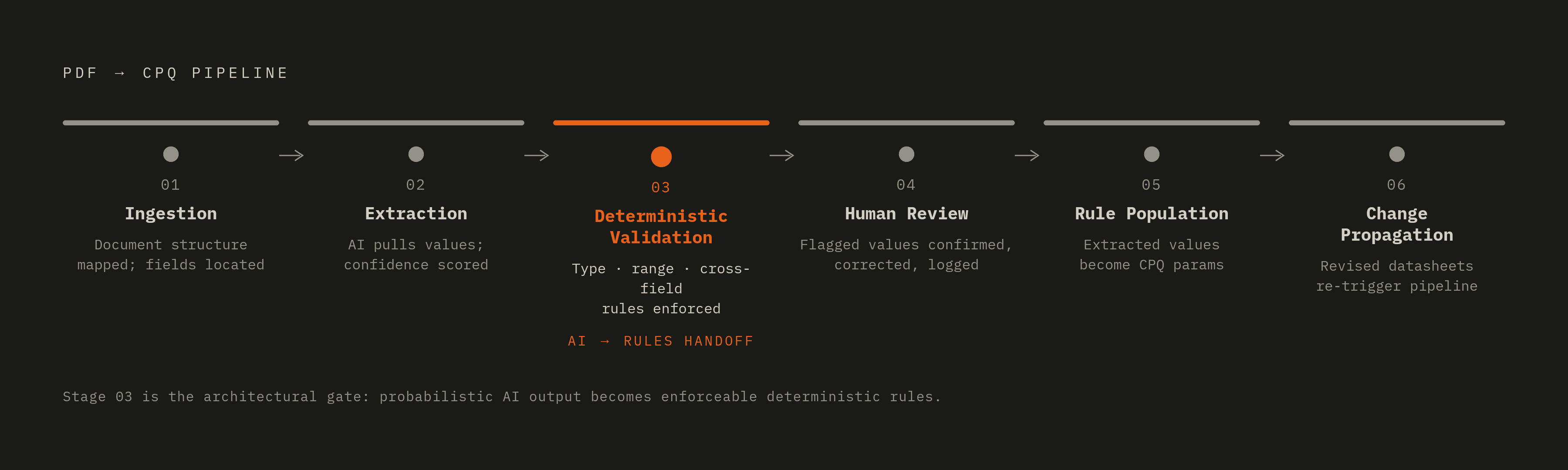
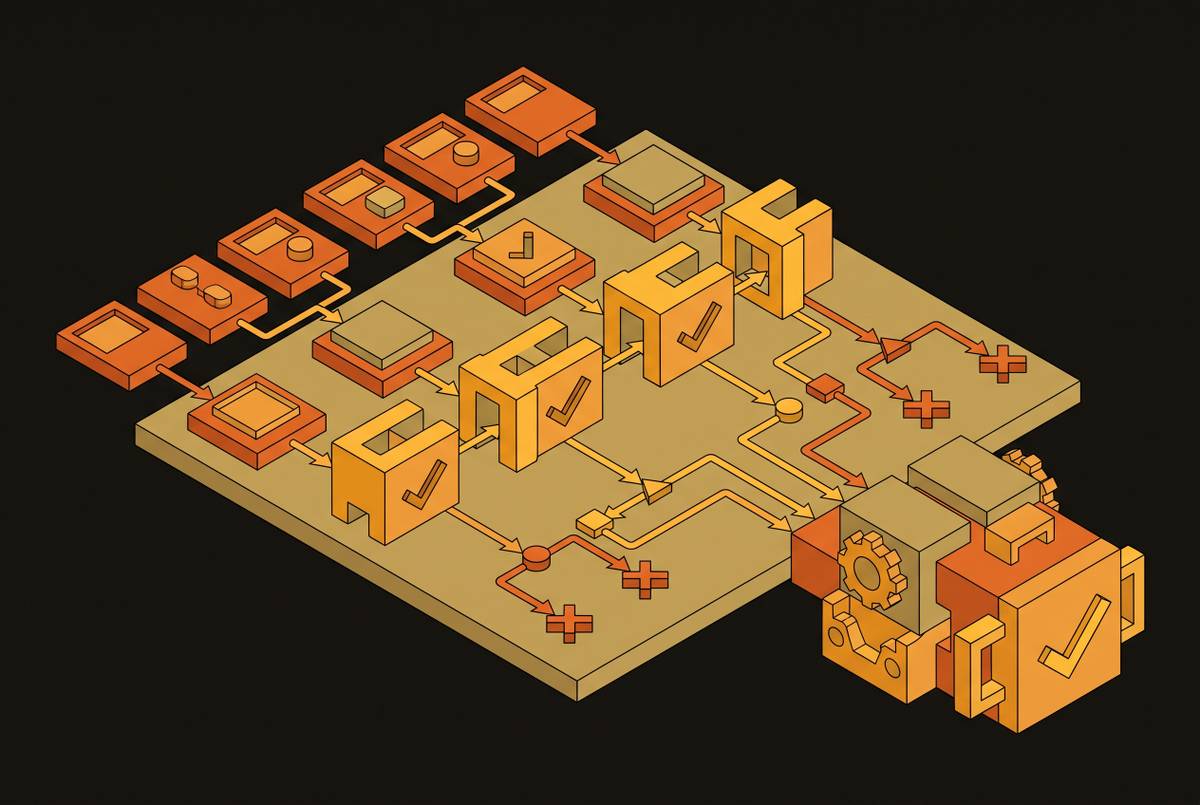
Stage one is ingestion. Manufacturer PDFs go into the extraction layer, and the system maps out document structure (tables, sections, footnotes) and locates the candidate spec fields hiding inside.
Stage two is extraction and schema mapping. AI models pull values and map them onto a standard schema: power_draw_idle, power_draw_peak, weight_kg, rack_units, thermal_dissipation_btu, operating_temp_max, each one tagged with a confidence score.
Stage three is deterministic validation. Rules check type (is this actually a number?), range (does this sit within the plausible band for this equipment class?), and cross-field consistency (does thermal dissipation line up with power draw at a reasonable efficiency?).
Stage four brings a human into the loop. Anything below a confidence threshold, or anything a validation rule flags, gets surfaced for an engineer to confirm, correct, or escalate, and that decision gets logged.
Stage five is rule population. Confirmed values become first-class parameters inside CPQ configuration logic. A rack configuration rule now points to extracted_power_draw_peak instead of a number someone typed in from memory months earlier.
Stage six is change propagation. When a manufacturer puts out a revised datasheet, the pipeline re-extracts, re-checks, and flags whatever rules that change touches, rather than waiting on an engineer to notice the revision on their own and go update every downstream reference by hand.
That ongoing sync is the real payoff. Once it's running, specs inside CPQ rules stay current with what the manufacturer actually publishes instead of drifting quietly out of date. Springer's research notes that structured extraction, once it works, opens the door to automated knowledge base construction and stronger RAG systems for industrial use. What's described here is the data center-specific version of that same capability.
CPQ platforms that handle complex engineering constraints and spec data flow
Not every CPQ platform is built to hold engineering-grade constraints, and picking the wrong one wastes the extraction work. Some platforms are built for pricing governance. Others are built around constraint-based engineering logic. That split matters a lot once extracted spec data needs somewhere to go, with the global CPQ market growing steadily and manufacturing among the most active verticals by adoption. This is not a footnote decision.
For engineered-to-order and critical-infrastructure work, a handful of platforms come up consistently. Epicor CPQ (formerly KBMax) brings rules-based engineering automation plus CAD automation for tools like SolidWorks, AutoCAD, and PTC Creo, along with BOM generation, and fits mid-to-large manufacturers running highly configurable products with tight ERP ties. Cincom CPQ is built for complex, configurable, engineered products, with a rules engine suited to complicated product structures and solid integration across CRM, ERP, and PLM. Tacton CPQ is oriented toward complex manufacturing environments, and its 2026 research on configuration-rule maintenance and engineering change propagation reflects deep familiarity with that space. Oracle CPQ handles rules-based configuration for configure-to-order and engineer-to-order cases with strong guided selling and pricing governance inside the Oracle ecosystem, though it doesn't generate CAD files or manufacturing BOM output on its own without an ERP or PLM connection. Conga CPQ (formerly PROS Smart CPQ) is aimed at B2B environments where configuration and pricing complexity intersect.
A few other platforms take a different angle. Qwoty uses AI to pull requirements straight out of emails, PDFs, Excel files, and images to build structured quotes, and it fits mid-market manufacturers where the real bottleneck is quote-processing time rather than deep engineering validation. SmartCPQ is oriented toward industrial manufacturing environments where compatibility rules and engineering validation are central to the quoting process. Zoovu focuses on consolidating product data and configuration logic into a unified source so that specs, options, and rules stay consistent across channels.
For data center design and delivery teams, the right platform is one built around the specific disciplines of that work rather than a general-purpose CPQ engine, so that extracted specs feed directly into the engineering and documentation workflows where they actually get used.
The extraction pipeline is only worth as much as the platform receiving its output, and teams underrate that constantly. A spec value that lands in a rules engine enforces itself at every configuration going forward. A spec value that lands in a spreadsheet enforces nothing. Tacton's 2026 report found that 81% of manufacturers describe CPQ model maintenance as moderate to very high effort, which is exactly the problem the extraction pipeline goes after: rules update when the datasheet updates, not whenever an engineer happens to notice. The same report found 79% of manufacturers are investing in or exploring AI in 2026, up from 64% the year before, with the top expected use cases being automating complex configurations (56%), cutting quoting errors (48%), and speeding up quote response times (47%). An extraction-to-rules pipeline sits right in the middle of where manufacturers say they expect the payoff.
How accurate spec flow changes data center equipment configuration
Rack densities in new data centers now run 15 to 50 kW per rack, and Deloitte projects next-generation AI infrastructure could push that as high as 370 kW per rack. At those densities, a power draw error stops being a rounding issue anyone can shrug off. It changes circuit sizing, cooling capacity, and structural loading calculations directly.
MEP systems now account for roughly 75% of the Guaranteed Maximum Price on AI-focused data center projects. A configuration error tied to power or cooling doesn't just cost engineering rework hours in that context. It moves the construction budget itself.
Once extracted specs feed straight into CPQ or design-configuration logic, the picture changes in a few concrete ways. A rack configuration that would blow past available circuit capacity gets blocked before it ever reaches the construction document phase. Cooling load calculations update on their own the moment an equipment selection changes, instead of waiting for a mechanical engineer to manually re-run thermal models by hand. Floor-loading checks use the actual manufacturer-sourced weight rather than a number carried over from a past project out of habit. Long-lead procurement, generators, transformers, switchgear, often running 12 to 18 months out, gets based on confirmed power draw figures instead of early estimates that might get revised after the purchase order is already signed.
The direction the industry is heading shows up in efforts like the Google/OCP Open Data Center Spec (version 0.5.0, effective February 2026), which lays out standardized, versioned infrastructure specifications covering row power density requirements and cooling ratios. Standardization at that level only pays off if the specs feeding it are accurate at the source, and that accuracy has to start with extraction, not end there. Extraction gets the number out of the PDF. Validation makes sure it's the right number. Everything downstream, the rule that blocks the bad rack config, the budget that doesn't blow past its planned spending limit, the procurement order that doesn't need re-cutting six months in, depends on those first two steps happening correctly.