Redundancy and Failover Logic in Data Center CPQ Configurations
How CPQ software must enforce redundancy rules to prevent costly data center misconfigurations.
CPQ stands for configure, price, quote. It's the software layer that turns a design intent into a deliverable, approved configuration, without someone stitching together three spreadsheets and a prayer. In most industries, when CPQ gets something wrong, the cost appears as a bad price on an invoice. In data center delivery, a CPQ error is an engineering gap, and it can survive all the way into poured concrete before anyone notices.
That's the real risk. A configuration that looks fine on the quote sheet, checks the right boxes, matches the right tier label, can still encode the wrong redundancy assumptions, and those wrong assumptions are what produce the real risk. It gets signed. It gets procured. Steel goes up. Ductwork gets hung. Only later, sometimes only during a live failure, does someone discover that what got built isn't what got promised.
The stakes aren't abstract. Per the 3EX Hosting 2026 guide, 60% of data center outages between 2019 and 2022 cost enterprises over $100,000. TierPoint cites SolarWinds figures putting downtime at $427 to $9,000 per minute, depending on the facility and workload. Those numbers ride entirely on whether the redundancy logic buried in a quote actually matches what gets built.
Meanwhile, the CPQ market itself is growing fast. It's valued at $4.07 billion in 2026 and is projected to hit $14.66 billion by 2035, a 16.5% compound annual growth rate. That's a lot of adoption. But market size says nothing about whether the rules inside these systems are fit for critical-facility engineering. Plenty of CPQ platforms are excellent at pricing logic and terrible at knowing the difference between N+1 and N. This piece is about what it actually takes to get that right.
What the Uptime Institute tier system requires CPQ to enforce
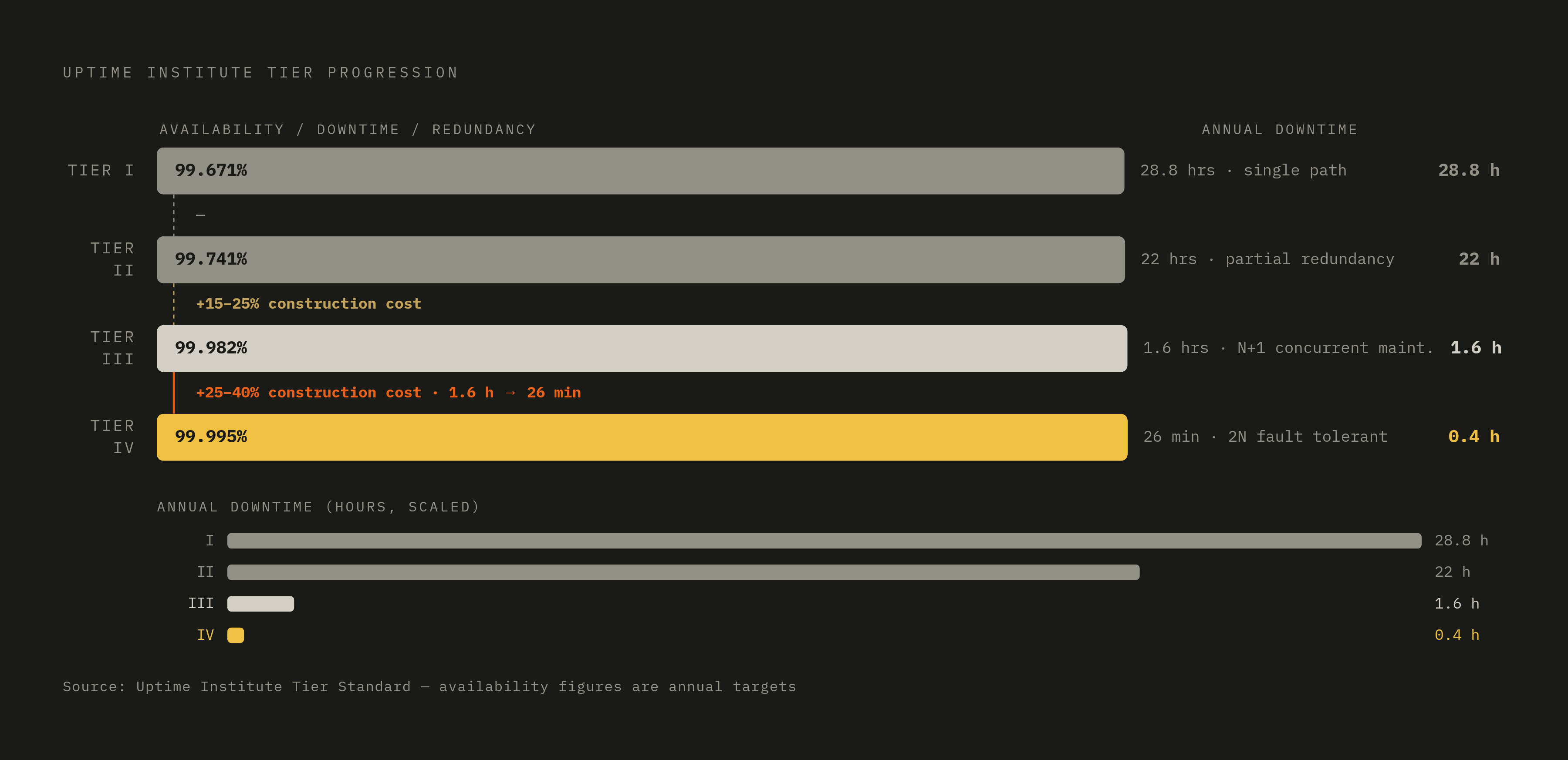
The Uptime Institute Tier Classification System is the international benchmark for data center performance, and it remains a widely used reference point for operators and clients, as reflected in Socomec's tier benchmarks. The four tiers aren't marketing labels. Each one maps to a specific availability ceiling and a specific redundancy architecture, and CPQ has to treat that mapping as a hard constraint, not a helpful suggestion.
Here's what the tiers actually require, per Socomec's benchmarks:
Tier I: 99.671% availability, 28.8 hours of downtime allowed per year, no redundancy, a single path for power and cooling. Tier II: 99.741% availability, 22 hours downtime, partial redundancy with some backup components. Tier III: 99.982% availability, 1.6 hours downtime, N+1 redundancy with concurrent maintainability across multiple independent distribution paths. Tier IV: 99.995% availability, 0.4 hours (26.3 minutes) downtime, 2N or 2N+1 fault tolerance with duplicated critical components.
The jump between tiers isn't just a reliability upgrade. Per the iRecruit 2026 benchmark source, moving from Tier II to Tier III adds 15 to 25% to construction cost. Tier IV adds another 25 to 40% on top of Tier III. So tier selection is a budget decision as much as an engineering one, and CPQ has to carry that cost logic forward automatically, tied to whatever tier gets selected.
Redundancy versus resiliency is a distinction that matters. Redundancy means specific components are duplicated. Resiliency means the whole system behaves correctly under failure, as a connected whole. A CPQ rule-set that only counts components, five UPS units instead of four, can satisfy redundancy criteria on paper while completely missing a resiliency gap sitting one layer down. Tier classification sets the outer boundary of what's required. The N-model topology is the actual mechanism that fills that boundary in, and that's where the real configuration risk lives.
Translating N+1, 2N, and 2(N+1) into deterministic configuration constraints
Every N-model designation needs to become a specific, binary rule inside the configurator, not a general guideline someone eyeballs during design review.
N means the minimum capacity required to run at full IT load, with no backup at all. Any single failure causes downtime. CPQ should flag N as non-redundant outright, and it should never be allowed to price out as valid for facilities requiring meaningful redundancy.
N+1 means one extra component beyond the minimum. If the load requires four UPS units, the configuration needs five. That's not a nice-to-have; it's a hard minimum count, enforced per subsystem.
2N means a full duplicate system, required at Tier IV. This is where CPQ logic gets harder to write correctly, because 2N has to be enforced structurally, across power, cooling, and network paths at the same time, not validated one component at a time in isolation.
2(N+1) stacks both: dual systems, each with its own N+1 redundancy built in. It delivers the highest availability, and it's also the hardest constraint set to encode correctly, because the redundancy compounds across every subsystem simultaneously.
Hybrid designs make this messier still. A facility might run 2N on its mission-critical subsystems and N+1 on everything else, and that's a legitimate, common design choice. But it's also the highest-risk pattern for CPQ, because rules have to be scoped subsystem by subsystem. Apply a global rule instead, and a less-critical component's N+1 rating can get silently inherited by a path that was supposed to be 2N.
Consider the five-nines benchmark: 99.999% uptime allows only 5.26 minutes of downtime a year, per the 3EX Hosting 2026 guide. A misconfiguration that quietly delivers Tier III performance on a deal sold as Tier IV doesn't shave a little off that margin. It erases it.
None of this should be left to probabilistic judgment. N-model constraints are binary, pass or fail, yes or no. They need to be encoded deterministically. AI-assisted guided selling has a real role to play, surfacing trade-offs, flagging options, helping a configurator understand what a density change might cost. But the final constraint check, the thing that decides whether a quote is actually valid, has to be rules-based. Where AI belongs, and where it absolutely must not substitute for a deterministic check, is the central architectural decision in this whole domain.
The subsystems where failover logic is most likely to break down in a quote
Power path carries the highest stakes by a wide margin. Electrical systems account for 40 to 60% of total infrastructure cost, per the DC Deployed design guide, which makes power the subsystem where a CPQ mistake does the most damage, both financially and operationally.
Failover in a power path isn't one event, it's a sequence: ATS transfer, generator auto-start and synchronization, UPS bypass. CPQ has to encode the full chain, not just confirm that backup hardware exists somewhere on the equipment list. Power issues cause 43% of all serious data center failures, and UPS failure, driven by aging batteries, control errors, overload, and skipped maintenance, is a leading contributor within that category. That means UPS redundancy rules need to run more conservative than the rules for other subsystems, not sit at the same default N+1 baseline.
Timing matters too. ATS transfer speed needs to hit 10 milliseconds, per the 3EX Hosting 2026 guide, the threshold below which server power supplies won't even register the interruption. A configuration routed through an ATS not rated for that speed is non-compliant, full stop, even if the component count on the quote looks perfect.
Cooling redundancy follows a similar logic but gets missed in different places. N+1 CRAC or CRAH setups with lead/lag switching and chiller staging are standard practice, but CPQ rules need to confirm standby units sit on separate power feeds, not just that they're listed in inventory. Cooling towers and other heat-rejection equipment carry the same redundancy obligation as the units inside the hall, and a quote that specifies redundant CRAH units alongside a single cooling tower has buried a single point of failure in plain sight. High-density halls need 2N chilled-water pumps or dual refrigerant circuits, a constraint that has to scale automatically as density parameters change inside the configuration, not get set once and forgotten.
Network and fiber paths fail in a particularly sneaky way. A facility with a single fiber path to the outside world has one point of failure that no amount of internal redundancy can fix. CPQ needs to validate physical entry diversity, not carrier diversity on a spec sheet. Two carriers sound redundant until both run through the same conduit into the same building entry point. The same shared-dependency problem occurs when redundant network gear draws power from a single UPS or PDU. On paper, the path count looks doubled. On the ground, it collapses at one physical junction.
Cross-subsystem conflicts are the hardest to catch because no single subsystem check will surface them. Chilled water piping and CRAH units competing with electrical busways for the same overhead space, cable trays blocking return air paths, these are real configuration failures that a siloed CPQ tool simply won't see, because it validated power, then cooling, then cable, each in its own lane. A facility isn't a parts list. It's a connected topology, and the rule architecture has to treat it that way or the sign-off means nothing.
How AI workloads are invalidating the density assumptions baked into legacy CPQ rules
Rack density has moved fast, and a lot of CPQ rule-sets haven't caught up. New facilities now run 15 to 50 kW per rack, compared to the 5 to 8 kW that was common just five years ago, per CMIC Global's construction trends data. Any legacy CPQ logic still calibrated to the older range is structurally wrong for what's actually getting deployed today.
AI and GPU clusters push that further. NVIDIA H100 or B200 configurations often draw 30 to 40 kW per cabinet, and at those densities, the margin for error during a power failover shrinks close to nothing. Traditional capacity planning assumed short spikes, brief bursts of demand that the system could ride through on thermal inertia and a little headroom. AI workloads pull sustained draw instead: continuous load on the power side, continuous heat rejection on the cooling side. A CPQ rule built on peak-tolerance assumptions will generate a configuration that passes every check on paper and is physically undersized the day it goes live.
This is exactly where the Tier III versus Tier IV question gets murky for high-density AI halls. CPQ rules need to be explicit about it: density thresholds should trigger automatic escalation of tier requirements, rather than leaving that judgment call sitting with whoever's running the sales configurator that day.
Time makes the stakes worse. Equipment lead times now average 42 weeks, per the 3EX Hosting 2026 guide, so a configuration error caught after procurement isn't something a project timeline can absorb. It has to be caught before the purchase order goes out.
Air cooling becomes increasingly unviable as rack densities climb toward and beyond the higher end of current deployment ranges. Above that, direct-to-chip or immersion cooling becomes necessary, and that has to be a hard constraint inside CPQ, triggered automatically by density, not a product option a configurator might or might not remember to select.
What a connected configuration engine looks like when the rules are encoded correctly
The core requirement is cascading logic. Change the rack density, change the tier, change the cooling strategy, and that change needs to propagate automatically through power, cooling, cable, and pricing, without someone re-entering it by hand at every layer downstream.
If moving a rack means manually reworking power calcs, then cooling calcs, then cable schedules, then the pricing sheet, that workflow hasn't solved the fragmentation built into CPQ. It's just relocated the fragmentation to a later stage in the process, where it's harder to catch.
Deterministic constraints need to handle everything that must never be wrong: N-model minimums, ATS ratings, physical path diversity, cross-subsystem dependencies. These are pass/fail checks, encoded as rules, full stop, not suggestions an AI layer surfaces for someone to consider. AI-assisted guidance earns its place earlier in the process, helping surface trade-offs between tier levels and their cost implications, flagging when a density input is approaching a constraint boundary, steering a configurator toward selections that will actually pass validation. But before anything gets quoted, it has to hand off to a deterministic check.
ArchiLabs Studio is one example of what this looks like operationally. It takes owner criteria, rack targets, density, redundancy class, and cooling strategy, and encodes all of it into a single structured starting point. From there, it generates data hall layout options, places equipment, and routes power, cooling, cable tray, and fiber through automated design recipes, producing plans, elevations, pricing, validation, and construction-ready drawings as one connected workflow instead of a chain of disconnected hand-offs.
Every parameter set during configuration, UPS string count, ATS rating, fiber entry diversity, chiller redundancy class, needs to stay traceable back to the engineering decision that set it. A configuration nobody can audit isn't a deliverable. It's a liability sitting quietly in the project file.
The finish line isn't the signed quote. It's the operations handoff. Redundancy parameters validated at quote time need to flow forward into DCIM, EPMS, and BMS as structured asset data, not get re-typed by hand from a PDF weeks later. CPQ output is only actually complete once the operations team can read the exact same redundancy logic the design team built in.
A practical audit of what current CPQ configurations most often get wrong
A few checks to run against any existing CPQ setup, in order of how often they get missed:
UPS redundancy weighting. Given that UPS malfunctions account for 43% of serious failures, does the configuration specify a more conservative redundancy level for UPS than for other power components, or does a flat N+1 rule apply everywhere regardless of failure probability?
Physical path diversity versus logical carrier diversity. Does the system confirm that redundant fiber paths enter through physically separate conduits and separate building entry points, or does it stop at confirming two carrier names on a form?
Density-triggered escalation. Does exceeding the air-cooling threshold automatically escalate power and cooling redundancy requirements, or can a high-density configuration pass validation running on air cooling alone?
Cooling tower coverage. Does redundancy checking extend out to cooling towers and external heat-rejection equipment, or does it stop at the in-hall CRAH and CRAC units?
Shared single points of failure. Does the configuration flag redundant components that share a common UPS, PDU, or physical pathway, the exact shared-dependency pattern identified in the Turn-Key Technologies research, or does each subsystem get validated in isolation, blind to what the others are doing?
Tier-price linkage. Does changing the tier level automatically recalculate the full cost model, including that 15 to 25% jump from Tier II to Tier III and the 25 to 40% jump from Tier III to Tier IV, or does someone have to remember to update pricing by hand?
Handoff completeness. Once the quote is final, do the redundancy parameters carry forward into DCIM, EPMS, and BMS as structured data, or do they dead-end as a PDF that operations has to manually retype?
Run through all seven, and a pattern becomes visible fast. The failures aren't usually about a wrong rule sitting in the system. They're about a rule that never got written down at all, because somewhere along the way, the tool treated it as implicit, something a human would obviously catch. That assumption is exactly what breaks.