Modeling Physical Clearance and Spatial Constraints in CPQ
Physical clearance rules must lock in CPQ before designs fail downstream.
What "spatial constraints" means in the context of rack and hall configuration
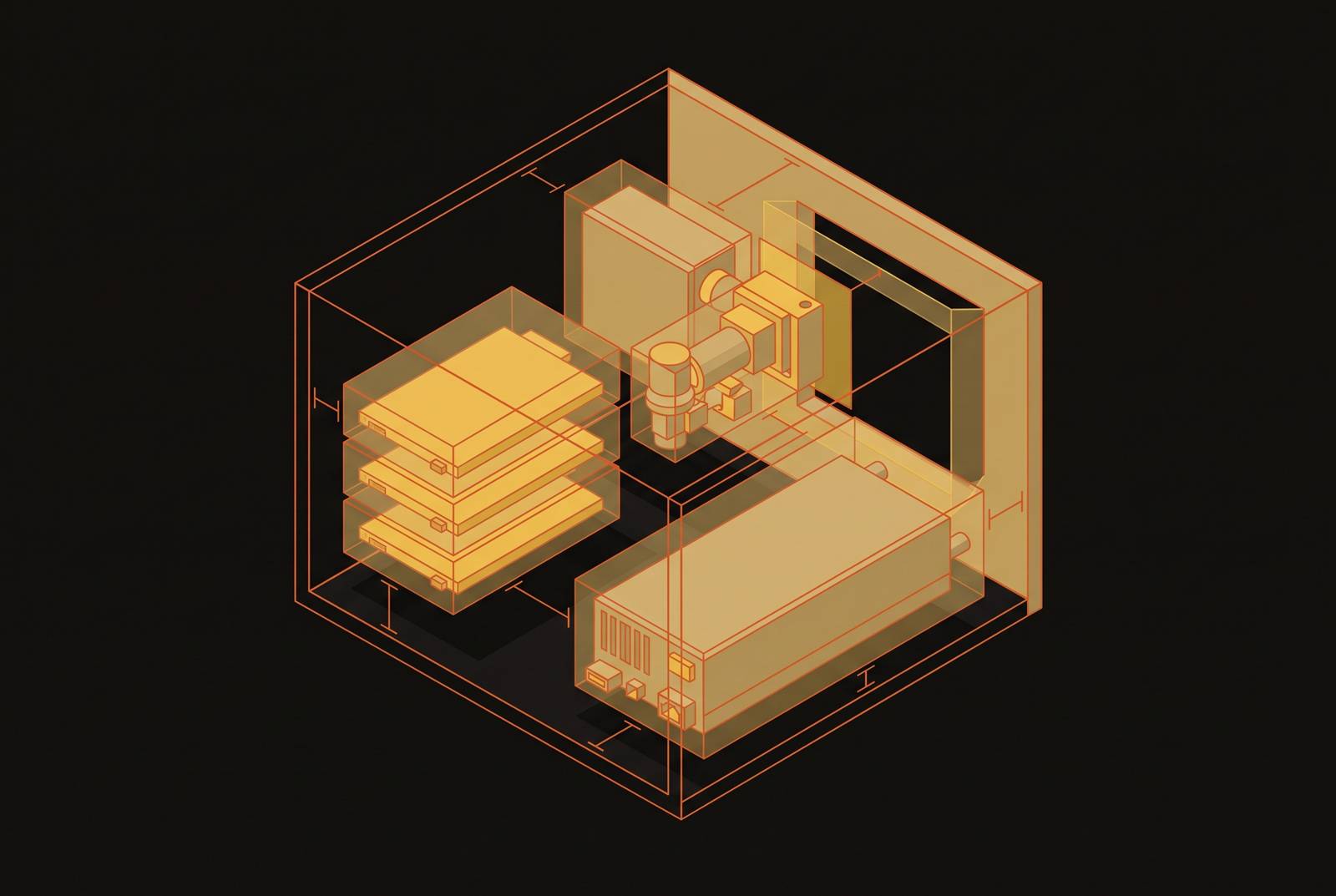
Rack depth is a hard limit, not a matter of taste. A 1200mm rack fits current server depths while still leaving room for cable bend radius, an airflow plenum, and 0U PDU clearance. A 1000mm rack can technically hold the same hardware, but there's no room left over for proper rear termination. Two configurations can look interchangeable in a sales catalog and land completely differently once cooling and cable routing enter the picture.
Aisle width works the same way, and the consequences spread further. Hot-aisle and cold-aisle widths shape how well containment works, limit how much room techs have to service equipment, and decide whether the layout meets code for emergency egress. Shrinking the aisle to squeeze in more racks changes the heat-rejection math. That's a constraint that needs enforcing at the configuration stage, not caught later by someone walking the floor with a tape measure.
Thermal envelope matters just as much. Every equipment configuration produces a heat load, and that load has to be matched by a cooling system with its own footprint requirements: CDU placement, piping routes, distance from electrical gear. Service access clearances follow the same logic. Equipment that needs front and rear access sets a minimum aisle size, and that minimum depends on which equipment got picked, not some number pulled off a generic spec sheet.
Cable routing carries its own physical rules. Fiber runs overhead, copper power feeds run underfloor, and pathways should stay meaningfully under max fill so airflow isn't choked off. Power and data need physical separation to avoid EMI. Once a rack configuration locks in cable type, count, and route, the tray geometry and separation rules need to check out as part of that configuration, not get discovered afterward on the floor.
None of these constraints sit in isolation. Rack depth affects bend radius. Bend radius affects tray position. Tray position affects service access, and service access affects aisle width. Treat it as one coupled system, not a checklist of independent fields; the checklist stops lying to you.
Constraint encoding differences between AI-driven and deterministic rule-based approaches in a CPQ context
AI earns its place where the job calls for interpretation: reading a manufacturer's spec sheet that isn't structured, parsing configuration language buried in an RFI, suggesting a few layout options from a set of inputs. Deterministic rules earn their place where the answer has to be exact: clearance minimums, bend radius limits, fill-ratio caps, separation rules, redundancy topology. Those don't bend to interpretation. Treating them like they do is the mistake most CPQ tools make right now: probabilistic tools should never be the ones deciding pass or fail on a physical clearance.
If a tool uses probabilistic inference to decide whether a rack configuration clears a minimum clearance requirement, it's injecting guesswork into a question with exactly two answers: pass or fail. Engineering teams downstream, working in BIM, coordinating power and cooling, will treat that configuration as validated once it clears CPQ. An AI's "this probably clears the requirement" is not the same thing as a rule that actually enforced the check. Confusing the two is where the failure starts.
The break happens at a specific point. A configuration sails through quoting because a language model's guess sounded reasonable, then it fails clash detection the moment it lands in the design environment. That's an expensive place to catch a mistake, especially with equipment lead times that routinely stretch well beyond a year. Every week spent redoing the fix eats directly into schedule.
Deterministic constraint engines already do this work in manufacturing CPQ. Tools designed for manufacturing CPQ encode product rules, block invalid combinations, and hand engineering a bill of materials that's already been checked. Data centers need that same logic extended to spatial rules. The pairing that actually works: AI pulls and sorts equipment parameters out of messy source documents, then deterministic rules check those parameters against spatial and systems constraints before anything gets accepted into the configuration.
Compounding errors across power, cooling, and cable coordination from an unconstrained CPQ output
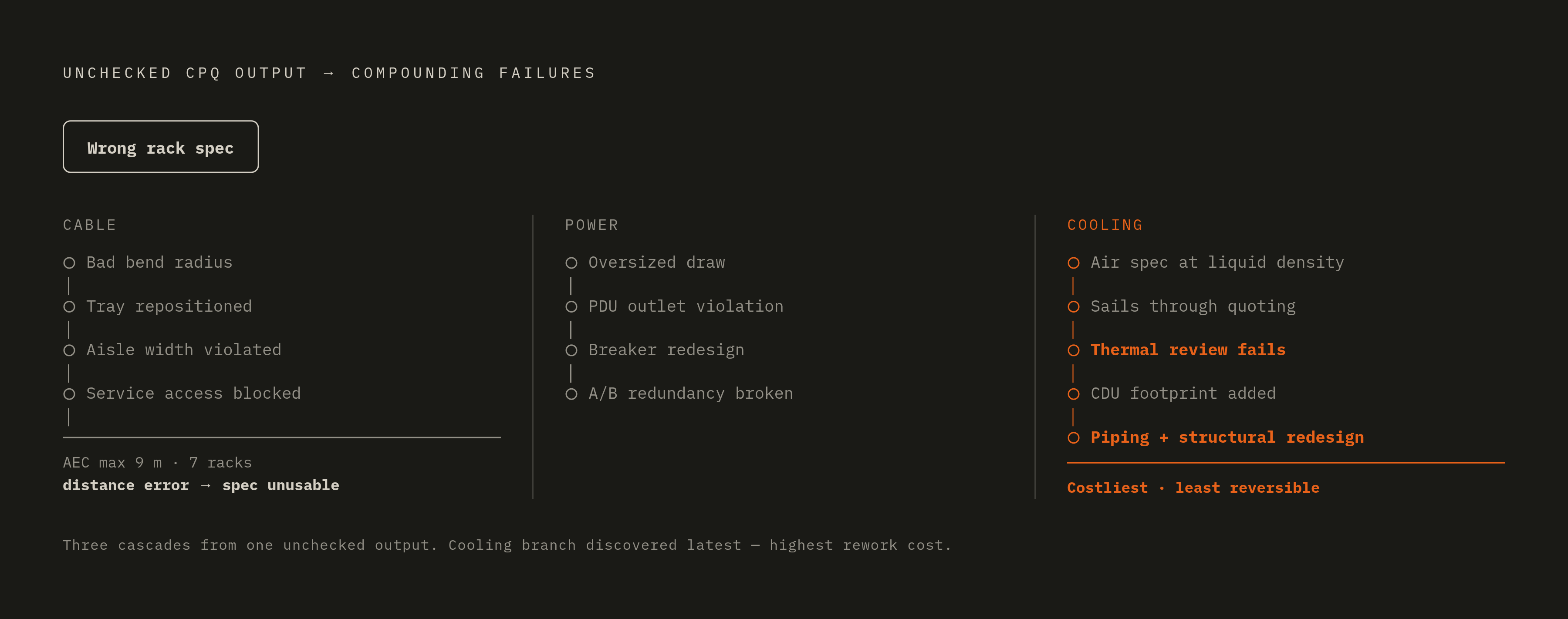
One bad configuration, wrong rack depth, an undersized aisle, a cooling unit that doesn't match the load, doesn't stay contained. It spreads across every system connected to it.
On the power side, a rack configured to draw more than the PDU's outlet-level rating creates a violation that has to get re-engineered at the breaker, the panel, sometimes the whole distribution level. A and B power paths need to be checked against the actual physical position of the racks they feed. Moving a rack without rechecking that path quietly eliminates the redundancy that was supposed to be there.
Cooling has its own version of the problem, and it's the one that costs the most to unwind. As rack loads climb toward the top of the current range, air cooling stops being a workable primary option. A configuration that specifies air cooling at a density that actually needs liquid cooling sails through quoting and then fails the thermal design review. Liquid cooling isn't a drop-in swap: it adds CDU footprint, piping routes, and structural loading requirements tied to the specific equipment chosen. None of that gets bolted on later without a redesign, and pretending otherwise at the quoting stage is how projects lose months.
Cable routing runs into its own limits, too. Active Electrical Cables have been demonstrated reaching up to 9 meters, spanning seven racks. Any configuration that ignores the distance between racks can produce a cable spec that simply doesn't work once it hits the floor. Tray fill ratios and separation rules skipped at configuration time get fixed in the field, usually after the conduit's already gone in, which is the most expensive place on the entire project to fix anything.
Every one of these reworks eats engineering hours that are already stretched thin, in an industry where pay is climbing and turnover stays high. Fix one system, and the others need a recheck too. Catching the error at the CPQ stage means catching it at the one point in the project where the fix still costs almost nothing.
What a CPQ spatial pre-qualification engine validates before a configuration reaches design
A CPQ output shouldn't just be a quote. It should be a configuration that's already been checked against spatial and systems rules and cleared to move into design. Anything less is a price tag with false confidence attached, and treating a quote as a green light without that check is the habit this whole approach is built to break.
Before a configuration passes, the constraint engine needs to check rack depth against server depth, PDU clearance, and cable bend radius together, as one interdependent set. It needs to check aisle width against the service-access needs of every piece of equipment in the configuration, including the tallest and widest items alike. Heat load per rack has to be checked against the cooling spec, including CDU capacity, flow rate, and supply temperature for anything liquid-cooled. Power draw needs checking at the outlet, the rack, and the hall level, against PDU ratings, circuit capacity, and the total power envelope available. Cable type, count, and route length need checking against tray capacity, fill ratio, and bend radius, with power and data separation enforced as a rule, not a suggestion someone skips under deadline pressure. And redundancy topology needs confirming: the A/B path setup actually has to reach the rack positions specified, matching what's drawn from the panel on paper.
Get this structured output right, and it opens doors downstream. BIM import stops needing equipment parameters re-typed by hand. DCIM, EPMS, and BMS handoff carries dimensions, power draw, cooling needs, and cable assignments that were already locked in at configuration time. RFI and submittal answers can point straight back to the parameters that drove the original decision.
Right now, the same equipment parameters get typed into the CPQ tool, then again into the BIM model, then again into the power schedule, then again into the DCIM asset record. Every one of those re-entries is a chance for the numbers to drift apart. A connected workflow checks the constraint once and carries the validated result forward as data other systems can use directly, instead of as a PDF someone has to read and retype.
Spatial constraint data flow from CPQ into BIM, DCIM, EPMS, and BMS without re-entry
Anyone running these systems already knows the handoffs between them are bad. BMS handles facility-level HVAC and environmental control. EPMS covers electrical distribution and energy metering. DCIM tries to unify IT and facility data across both. Each one showed up with its own vendor, its own contractor, its own console. Someone ends up bouncing between screens in swivel-chair operations to answer a question touching more than one system, even though the data that would answer it already existed back at configuration and design. It just wasn't built to move.
Structured CPQ output changes what's possible at each handoff point. For BIM, equipment geometry, clearance envelopes, and system assignments arrive already validated, so the model isn't re-deriving them from a stack of PDFs. For EPMS, outlet-level power parameters, circuit assignments, and draw profiles carry over from the original configuration. Eaton Brightlayer, which brings DCPM, EPMS, and DITPM together on one platform, can take in asset-level electrical data from the validated configuration.
For DCIM, asset records show up with dimensions, thermal load, and cooling assignments already filled in. Leading DCIM platforms depend entirely on the quality of the asset data fed into them at import, and right now that data mostly gets built by hand, one field at a time. For BMS, cooling unit assignments, CDU specs, and thermal zone setups carry forward from the validated configuration. Greenergy Data Centers' use of Siemens Desigo CC for unified BMS visibility shows an integration architecture that only gets better when the upstream data arrives already structured.
DCIM platforms lean on 3D models and digital twin simulation to test what-if scenarios before anything physical changes. Those simulations are only as good as the asset data compiled at configuration, because that's where the data originates. BIM data that reaches turnover incomplete, or cut off from operations, isn't doing what BIM is supposed to do. The handoff into DCIM, EPMS, and BMS is the actual finish line.
ArchiLabs Studio's place as the connective layer between spatial validation and project delivery
CPQ tools enforce pricing logic. BIM tools enforce geometry. DCIM enforces operational parameters. None of them, right now, enforce spatial and systems constraints at the configuration stage and then carry that validation forward into design and operations without someone re-typing everything along the way. That gap is the actual problem, and it's the one most vendors talk around instead of fixing.
ArchiLabs Studio works as a project operating system for data center delivery, connecting layouts, critical-systems engineering, cable routing, documentation, RFIs, and operations-ready handoff inside one workflow. It applies deterministic rules where precision isn't negotiable (clearance, power, redundancy, fill ratio) and uses AI where it actually saves time (spec extraction, layout generation, RFI language). Moving a rack causes the changes to cascade automatically across power, cooling, cable, and sheets, instead of triggering manual rework across four separate systems.
That maps directly onto the challenge of spatial CPQ. Equipment data pulled from manufacturer sources flows straight into models, schedules, and validation rules, closing off the manual re-entry that currently lets CPQ output and design models drift apart. Constraint checks run at the layout and configuration stage, so invalid spatial setups never make it into the BIM and coordination workflow. Asset data at handoff arrives already structured, ready for DCIM, EPMS, and BMS, instead of needing someone to populate operational records by hand.
Every RFI answer, every design decision, every equipment parameter should trace back to the information behind it. A configuration validated spatially at the quoting stage gives every downstream decision that references it a solid anchor to point back to. The constraint layer, the design layer, and the operations layer working off one shared set of structured data, instead of three separate copies drifting apart from each other, is what changes on a project once this is in place.
Practical steps for encoding spatial constraints in a CPQ workflow today
Start with the constraint catalog, before touching the configurator itself. Document the clearance minimums, bend radius limits, fill-ratio caps, and service-access rules that actually govern the equipment in the catalog, pulled straight from manufacturer specs and code requirements.
From there, separate the two jobs clearly. Decide which parameters need deterministic validation (clearance, power, redundancy) and which ones are better suited to automated extraction and suggestion (spec parsing, layout options). Build the rule engine to reject invalid combinations outright, rather than flagging them as a warning someone can click past on a Friday afternoon.
Then check the output format. A validated configuration needs to leave CPQ as structured data that BIM, DCIM, EPMS, and BMS can actually read. Getting that translation right is most of the work, and it's the step that pays back the most once it's done, because everything downstream, design, procurement, commissioning, inherits the accuracy of that one decision.