Rack Move as a Configurator Event That Triggers Cross-Domain Constraint Re-Evaluation
Moving a rack triggers power, cooling, cabling, and documentation checks simultaneously.
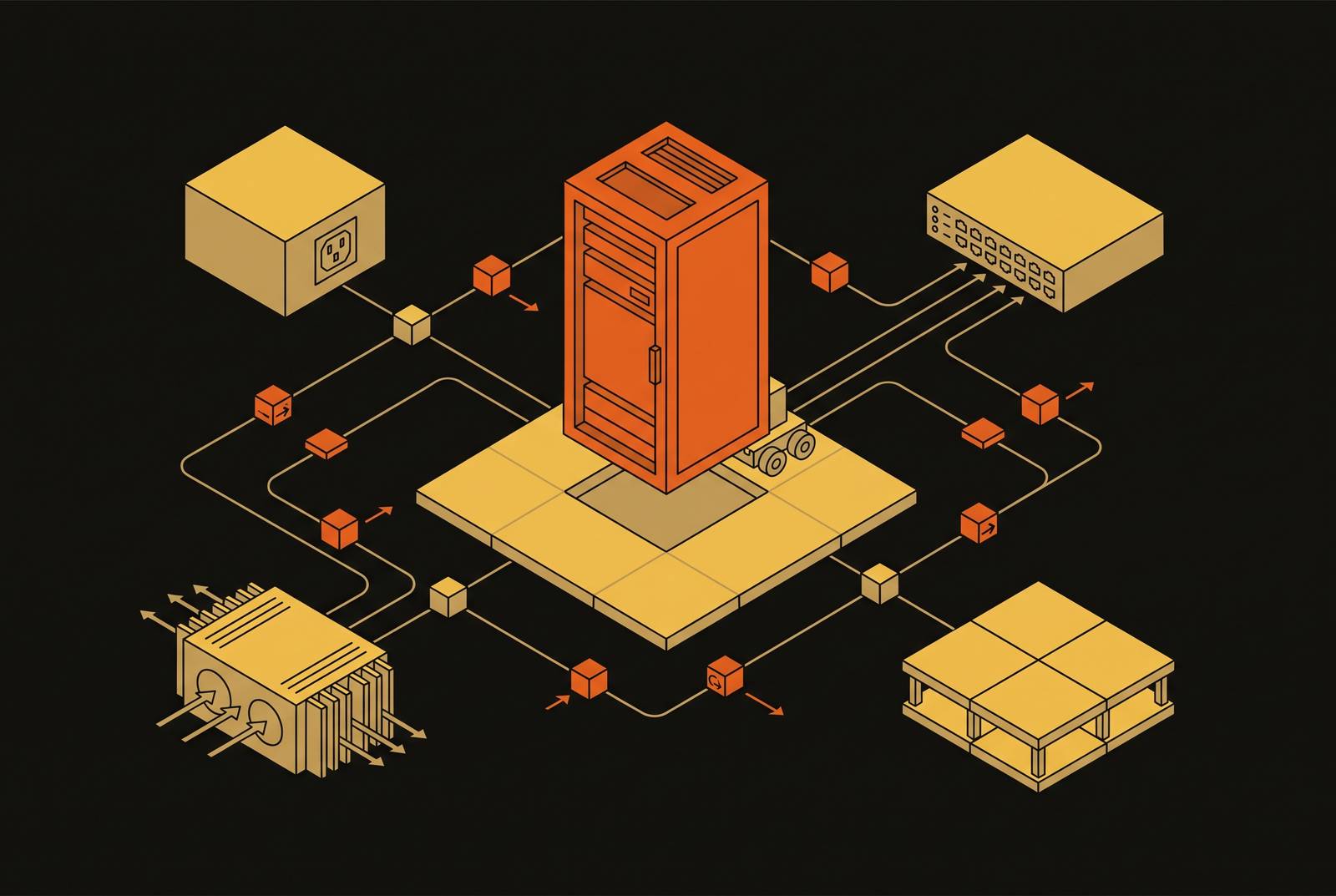
A rack move is a location change and a configurator event because it changes the conditions governing power, cooling, cabling, and documentation at once. Automated change propagation requires a connected workflow that re-evaluates those constraints when the move is initiated, before it is committed. Updating a floor plan or a DCIM location record alone cannot prevent the resulting manual rework.
Why a rack move is no longer a simple location change
A rack move used to mean changing a location and reconnecting services. Today, it can change the mechanical and electrical conditions under which the rack can operate. AI training and inference workloads need far more power per rack than facilities were designed to supply in the past. A rack may fit in a new position while exceeding what the infrastructure serving that position can support.
Schneider Electric SVP and CTO of the Secure Power Division Jim Simonelli framed the problem as rack real estate. Power delivery hardware and liquid cooling components now compete with compute for space inside the same footprint. Black & White Engineering’s 2026 trends analysis says that requests for design loads above 100–200 kW per rack are becoming more common, and that cooling systems, power distribution, and structural layouts are being changed to meet them. That changes the scope of a relocation. The relevant boundaries now extend through four connected domains, namely power, cooling, cabling, and documentation.
How a single rack move propagates violations across four constraint domains at once
The cascade begins with a shared dependency, which is the rack’s position. Power assignment depends on which PDU, panel, or busway segment serves that position. Cooling depends on the infrastructure that can reach it. Cabling depends on the route between its exact coordinates and its connections. Documentation records those relationships, so changing the coordinates invalidates the assumptions behind all four domains in parallel.
Each domain exposes a different part of the same event. In power, the move can leave outlet-level caps and load-shedding logic tied to the old assignment. In cooling, it can place the rack beyond a CDU’s service radius. In cabling, it can invalidate tray assignments and fiber reach calculations, while the drawing shows a new position that the schedules and registers do not yet reflect.
Treating these as sequential checklist items creates the coordination failure. A power review may accept an assignment that a cooling review later makes unworkable, forcing another layout revision. The proposed configuration therefore needs to be checked across all four domains together, with the four floor plan approvals considered as a whole.
What the power domain actually needs to re-evaluate when a rack moves
The new position may put the rack on a different PDU, panel, or busway segment, changing its power path. Outlet-level caps and load-shedding priority must also match that assignment and the workload’s priority. Those controls live outside the floor plan. They are encoded in intelligent PDUs, EPMS, and DCIM, where operators depend on them for safety and resilience.
Higher-voltage architectures make that dependency harder to treat as a simple circuit mapping. The shift to 800 VDC means that facility-level conversion stages must now be coordinated, which traditional rack-move workflows did not cover. These architectures remain incompletely specified, so crossing distribution zones cannot be treated as the equivalent of a move on a legacy 480 VAC system. The move becomes a power design decision. Re-pulling a cable does not establish how the facility-level conversion stages must be coordinated.
The structural gap is between the tool recording the new location and the systems enforcing the electrical constraints. Without a direct data path, a person must take the change in the drawing and apply it to each configuration it affects. Without the move itself triggering the checks, correctness depends on manual coordination, and the relocated rack can operate under the wrong power constraints from day one.
What the cooling domain needs to re-evaluate, and why simulation must precede the physical move
Cooling has the same location dependency as power, but available capacity is only part of the check. Liquid cooling loops are topology-constrained, so the rack must be within reach of the specific infrastructure that serves it. A CDU’s service radius is a hard physical limit. A rack beyond it cannot get the coolant flow it needs, even if the facility as a whole has enough cooling capacity.
Mixed cooling environments make the evaluation more demanding. Mixed rack densities, uneven heat loads, and varying liquid cooling requirements can coexist on the same row. Moving a rack may therefore change both its capacity allocation and the cooling method needed at its destination. The boundary between air-cooled and liquid-cooled zones needs to be checked again. The total capacity of a row cannot show where that boundary needs to be.
At 50+ kW per rack, thermal spikes that cannot be predicted make simulation necessary before the rack is moved. A thermal event has operational consequences that repositioning the rack afterward cannot undo. The cooling diagram must then update in the same event as the floor plan, rather than becoming a downstream task for another discipline. Otherwise, the drawing records a location without establishing whether that location can support the rack.
Why cabling and fiber routing turn a rack move into a procurement and schedule event
Structured cabling paths, tray assignments, and fiber reach calculations all depend on the rack’s exact coordinates. A change to those coordinates may call for new tray routing, different fiber lengths, and another round of coordination across the low-voltage and electrical packages. The consequences extend beyond the drawing. A route that looks acceptable on screen may no longer match what has been ordered.
Busway shows why late discovery can be unrecoverable within the existing schedule. Once a route is frozen and fabricated, it cannot be rerouted quickly. The wait for replacement segments can mean that a layout change delays commissioning by months. The design constraint becomes visible in procurement when replacement segments must be ordered. By that point, identifying the correct route does not remove the wait for it.
Without cross-domain linkage, the engineer reviewing the floor plan may not see those implications. They come to light when the low-voltage contractor checks the changed drawings against what has already been ordered. A late move can also generate RFIs across electrical, mechanical, and low-voltage packages, each appearing to be a separate coordination problem. Their common cause stays hidden. Assessing each RFI in isolation then understates the compounded schedule risk from the single move.
How the documentation and BIM layer fails to propagate the change
BIM can capture the rack’s new geometry without updating the relationships that make that geometry usable. Power schedules, cooling diagrams, and cable registers change with it only when parametric links connect them. Most current implementations lack those links. This is not a limit on BIM as a concept, but a limit on how it is being used. The model records the move without acting as a constraint engine.
Viewer-only BIM makes that gap easy to miss. The geometry changes, but the work breakdown structure has no connection to it, quantities do not update, and commissioning data remains unrevised. At the BIM-to-DCIM handoff, this becomes a reconciliation problem. A digital twin that represents design intent without matching as-built conditions serves only as a visualization tool.
Without encoded re-evaluation rules, every rack move requires a manual re-audit in other tools, often by people who did not make the change. Asset identifiers and parameter definitions are the foundations of those rules. If they are not established early, teams must create them under delivery pressure, increasing the chance of errors at handoff. The remedy is connected automation using BIM data as live structured input, rather than another isolated view of the same geometry.
Where the cascade terminates — operations systems that inherit a physically inconsistent facility
An unresolved design change does not disappear at closeout. Its power caps, cooling relationships, cable routes, and geometry will end up in the systems that run the facility. DCIM, EPMS, and BMS serve different audiences and use different data models, so they do not reconcile automatically. Each can retain a different version of the rack, creating a structural inconsistency between the physical facility and its logical model.
The integration architecture must therefore define ownership of each data point before construction. When a move is found late, that decision has to be made during a handoff that is already under pressure. Cooling exposes a further gap between BMS’s design for facility mechanical systems and the requirements to correlate CDU secondary loop performance with IT workload and provide rack-level visibility. Assigning the problem to BMS does not bridge the divide. Facility and IT teams still have to coordinate the work by hand.
Layered operations architectures spread the dependency across enterprise DCIM for assets, specialized thermal platforms for cooling optimization, EPMS for power quality, and ITSM integration for change workflows. A rack move must propagate through every affected layer, including the asset location field. Partial propagation leaves partial visibility. When critical MEP and liquid cooling data also remains in contractor spreadsheets, the owner inherits an operational liability. An unresolved relocation becomes a lasting discrepancy in the asset register.
How do you automate power, cooling, cabling, and documentation updates after a rack move?
A connected workflow treats the proposed move as a single transaction that evaluates all affected constraints before commitment. The rack’s position is structured data. When that position changes, every rule referencing it re-evaluates against the current system state. The checks cover power path validity, cooling topology reach, cable and fiber routing, and documentation consistency. This is the operational test for automation, rather than whether a platform can edit a location field.
Deterministic rules are needed wherever the answer must be exact. Power cap validation, CDU service radius checking, busway zone membership, and asset ID propagation are not candidates for AI interpretation. AI has a different role. It can interpret specification language from manufacturer documentation, surface likely violations while an engineer defines the move, or suggest routing alternatives.
The move does not complete until every affected constraint has been re-evaluated and either cleared or flagged for resolution. Power schedules update, cooling diagrams regenerate, cable registers revise, and the RFI log receives notice of cross-domain conflicts in the same event. Handoff belongs inside that workflow. DCIM, EPMS, and BMS receive the updated position and dependent parameters as part of the transaction that resolves the design change, rather than through a separate export after construction.
Why catching the cascade at initiation is the only point where rework is avoidable
Detection at initiation costs a decision. Detection after commitment costs the work already tied to that decision, potentially including procurement delays and an inconsistent operations handoff. A busway conflict caught before fabrication is a drawing revision, while the same conflict found afterward requires procurement with a multi-month lead time. At commissioning, that wait holds up a facility already costing money to keep open. The timing changes the nature of the problem.
The same distinction applies to power. A cap violation found before energization is a configuration update, while one left until afterward becomes a safety event. Sequential reviews cannot reliably protect that boundary because one domain’s acceptable solution can violate another’s constraints. The configuration has to be evaluated as a whole before downstream commitments proceed. A rack move is a configurator event because of what it touches, and initiation-point re-evaluation is the structural requirement that prevents those dependencies from becoming cascading manual rework.