Turning Extracted Manufacturer Specs Into CPQ Validation Rules and BIM Object Parameters
Automated extraction turns manufacturer specs into reusable engineering parameters across systems.
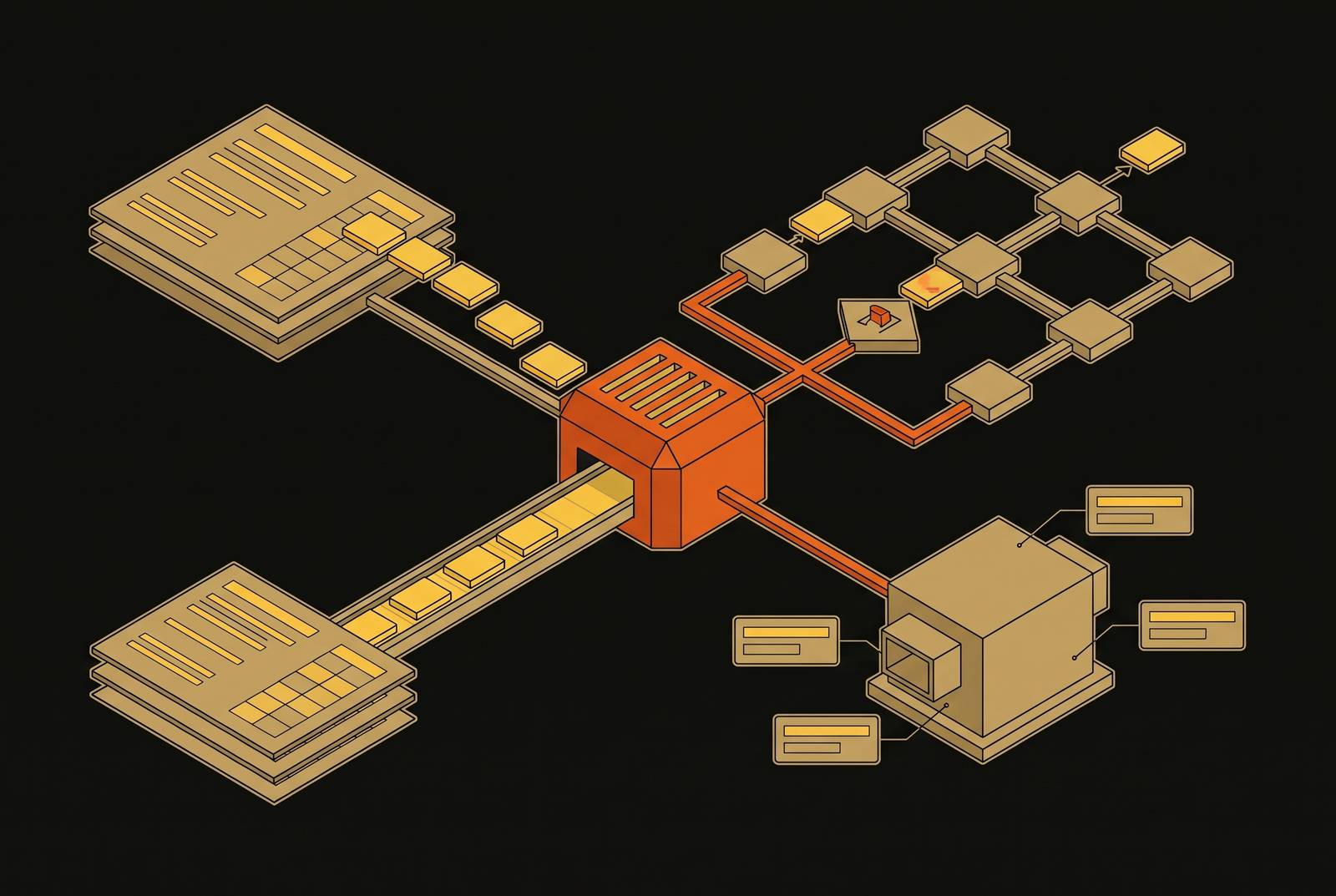
Automated spec extraction turns manufacturer PDFs and submittals into named equipment parameters that feed CPQ validation rules, BIM object properties, and operations records without manual rekeying. The foundation is one structured source for those parameters. Extraction makes product data usable, while encoded rules make it enforceable before an invalid equipment choice enters procurement or design.
Why manufacturer specs are engineering intelligence that most workflows never use
A PDF preserves how a specification looks. A voltage rating printed on page 14 of a submittal package is readable to an engineer, but it is not a typed input that a configuration engine can consume directly. The same applies to heat rejection, weight, clearance zones, and module compatibility. The engineering intelligence is already in the document. The missing step is turning that information into computable parameters.
Without that step, people become the connection between systems. Someone reads an electrical rating into a configuration tool, someone else types it into a model, and another person prepares it for operations handoff. Each transcription creates another chance for error or version drift, even when the original specification is correct. That repetition adds no new engineering knowledge. It simply charges the project again for translating the same product facts.
Isolated tools, inconsistent names, and disconnected product information management, configure-price-quote, and enterprise resource planning systems prevent reuse even when every team has the same PDF. A clearer document may help a person read faster, but it does not supply the shared data layer those systems lack. Better engineering by the manufacturer cannot make up for that missing data layer.
What structured extraction actually produces — and what it does not
Structured extraction produces named parameters with values, units, types, and classifications. Those parameters can enter a product information management system, supply a CPQ rule, or become a BIM object property. A searchable PDF helps someone find a cooling capacity value, while a structured parameter lets software use that value without someone typing it again.
Classification gives those parameters a shared meaning across systems. A cooling capacity extracted from a CRAH submittal needs to mean the same thing in an MEP model, a capacity planning spreadsheet, and a DCIM platform. A number and a unit alone do not establish that shared meaning. With that context, systems can reuse the parameters without mapping them again.
A voltage rating is a product fact on which a rule for rejecting an incompatible selection can be based. A clearance dimension likewise needs to be encoded into a spatial check before it can expose a conflict. Extraction and encoding are separate jobs with different outputs.
How extracted parameters become CPQ validation rules that prevent invalid configurations at the point of entry
A configure-price-quote engine can enforce engineering limits only when those limits exist in computable form. Encoding extracted ratings and compatibility data as constraints lets the engine evaluate an equipment choice before it generates a quote or order. For a UPS, busway segment, or CRAH unit, an invalid module combination or underspecified electrical rating is a design error, even if its price is correct.
Alert rules flag choices that need engineering review, and validation rules block the next step until an invalid choice is fixed. Selection rules show or hide options based on what was chosen earlier. Without the manufacturer parameters behind it, a CPQ system may enforce discounts and approval limits yet let a physically invalid configuration through.
Complex products also need more than sequential if-then checks. A UPS family with hundreds of valid and invalid module combinations calls for a constraint solver that evaluates the full option space together. Data center configuration compounds that problem because the product being configured is a system. Rack density, power topology, cooling capacity, and redundancy tier constrain one another, so a change in one can require changes in the others.
ArchiLabs provides an example of model-based CPQ that couples layout generation with configuration logic. Its approach joins spatial decisions to capacity planning rather than treating a quote as a collection of equipment prices. That connection gives the rules an engineering context. A rack choice can then be evaluated as part of the power and cooling system it depends on.
How do equipment specs from manufacturer PDFs become BIM properties without manual rekeying?
The same structured parameters that supply CPQ constraints can populate BIM object properties when an object is authored. That avoids a second manual translation of the manufacturer document during model assembly. CPQ evaluates a configuration, while BIM associates product facts with equipment in a model.
Geometry alone cannot provide those facts. A CRAH object can take up the right space yet have the wrong thermal capacity, the wrong electrical rating, or no clearance parameters. Its appearance does not expose the error. Performance data, installation requirements, and lifecycle parameters are what make the object useful for coordination, procurement, and handoff.
Valinejadshoubi et al.’s 2025 cloud BIM framework shows how parameter validation can protect the calculations that follow. Its rule-based Quantity Precision Check validates BIM data before automated quantity takeoff, so quantities derive from consistent and validated inputs. The study supports checking parameters as well as geometry. Errors in model data otherwise pass into cost estimates and procurement decisions even when the model looks plausible.
For data center models, encoded logic can also make components active participants in validation. A cooling unit object can calculate the thermal effect of adding a rack in its zone or alert when capacity is exceeded. Those checks run as the model is being built. To reach the tools where that work happens, extracted properties also need export paths into IFC, Revit, Archicad, and Allplan rather than remaining trapped in a manufacturer system.
Why fragmentation between extraction, CPQ, and BIM produces the specific failure modes that show up in data center delivery
When extraction, configuration, and object authoring have no shared source, an input error can pass through several reviews that seem separate. A wrongly transcribed manufacturer value can become a CPQ rule that permits an invalid equipment selection. If that wrong value also enters the BIM object, the model may fail to reveal a clearance conflict until field coordination. Commercial approval does not stop this engineering failure. The resulting RFI can trigger a submittal revision while procurement is already moving.
That cascade is especially disruptive when equipment has long lead times and multiple approval tiers. Generators, switchgear, UPS systems, CRAHs, and PDUs bring those dependencies into the same facility. A revision is therefore not just another document cycle. Even a low-dollar clarification can threaten the schedule if it blocks electrical energization or integrated systems testing.
When attributes are missing, things can go wrong in another, less visible way. Clash detection may show that a CRAH fits in its allocated space while missing that it is undersized for the thermal zone it serves. There is no geometric collision to find. The performance conflict can instead become visible during commissioning, after the opportunity to resolve it at equipment selection has passed.
The upstream cause is missing or disconnected structured specifications. Embedding validated parameters early allows compatibility questions to be resolved before they reach the field. Better manual coordination can help teams catch mistakes one by one, but teams still maintain the data along separate paths. A connected extraction pipeline addresses the point where those paths diverge.
The single-source extraction model — one pass that feeds CPQ rules, BIM properties, and operations handoff simultaneously
A single-source model maintains technical parameters, variants, and product rules centrally in a PIM or ERP. From there, parametric and rule-based generation can produce BIM objects, CAD models, drawings, data sheets, and CPQ constraint definitions. CPQ constraints no longer depend on a separately maintained interpretation of the equipment represented in BIM.
This structure also extends the value of extraction beyond design. If manufacturer parameters are encoded early, they can give operations the asset data it needs without anyone collecting it again at closeout. BMS uses environmental and mechanical parameters, EPMS uses electrical path parameters, and DCIM uses IT asset parameters. Their different purposes do not require independent transcription of the source specifications.
ArchiLabs Studio embodies the connected workflow through automation spanning rack layouts, power and cooling coordination, cable routing, specifications, RFIs, BIM documentation, validation, and DCIM-ready handoff. Its role is broader than a document parser. The relevant connection is between equipment parameters, layout and capacity decisions, and the records delivered to operations, so data does not need manual re-entry at each stage transition.
A manufacturer revision shows why this architecture is useful. If a UPS specification changes its module compatibility or clearance requirements, the shared source can propagate that change into CPQ constraints, BIM objects, and handoff data. In the fragmented model, each destination requires a separate correction. Missing one leaves a system working from a product definition that no longer matches the others.
Where AI and deterministic rules divide the extraction and encoding work
AI suits the part of the pipeline that has to make sense of different documents. Identifying whether a buried value describes maximum input voltage or an output rating requires language and context. Manufacturer layouts and field names vary. AI can help interpret that variation and map parameters to object property schemas when classification is ambiguous.
Encoding demands a different kind of precision. A rule that rejects a UPS module combination when total output exceeds rated capacity must do so every time that choice is made. Probabilistic inference is not a substitute for that check. Deterministic logic is also what establishes whether BIM parameters meet project requirements before they enter quantity takeoffs or cost estimates.
Using only fixed extraction rules requires extensive manual authoring for each new document format, which weakens the case for automation. Letting AI-generated constraints skip deterministic review brings a different risk. It makes the controls meant to prevent invalid engineering choices less certain.
The QPC framework illustrates the validation side of this boundary. Rules check the model data before it is used to produce quantities, without relying on a language model to judge whether the result seems reasonable. AI helps make sense of the source, and deterministic checks decide what passes. Neither step replaces the other.
What teams responsible for data center delivery should do differently at the spec-intake stage
The practical change is to treat spec intake as data structuring. When a submittal arrives, checking that it names the approved product is not enough. Teams should also ask whether its parameters are structured, classified, and connected to CPQ constraints, BIM properties, and operations records. This is where downstream validation gets its inputs. If teams wait until model review, equipment choices rely on data that has yet to be turned into enforceable rules.
Classification should happen during extraction, using a recognized standard such as ETIM, eClass, or OmniClass. That gives the parameters a common vocabulary before different tools consume them. Manufacturer BIM objects need attributes that systems can use as well as geometry. A CRAH should enter the model with its thermal capacity, electrical requirements, and clearance parameters available for constraint checking.
Teams should then cross-validate extracted parameters against CPQ rules during submittal review. Power draw mismatches, clearance conflicts, and module incompatibilities can be resolved there before installation or commissioning. The objective is an earlier engineering decision. Studio offers one concrete connected workflow for applying that approach across layouts, power and cooling coordination, documentation, and handoff.
Traceability makes those decisions defensible when the product changes. Every equipment parameter used to approve a UPS combination or specify a CRAH should lead back to the manufacturer specification that supports it. That connection makes the scope of a revision visible instead of leaving teams to discover affected decisions through an audit.