Choosing a BIM Handoff Platform That Outputs DCIM-Ready Asset Records Instead of Drawing Packages
Structured asset records and contractual alignment matter more than model format at handoff.
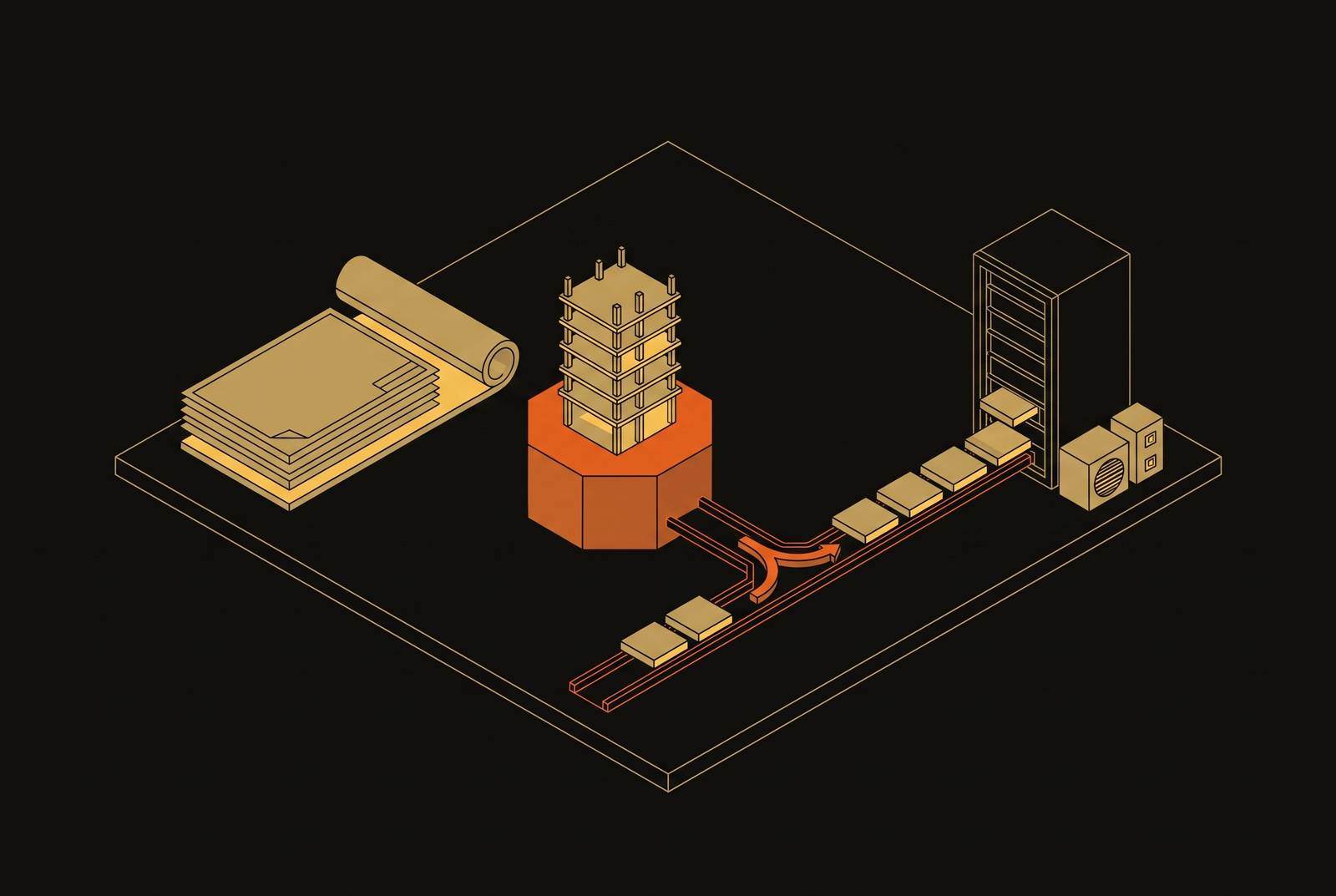
DCIM-ready BIM handoff requires structured asset records that match the operator’s system. Choosing a platform that delivers those records starts with contractual agreement on asset identifiers, required fields, and how construction changes reach operations. The software must enforce that agreement throughout delivery.
Why BIM handoff still produces drawing packages instead of operational asset records
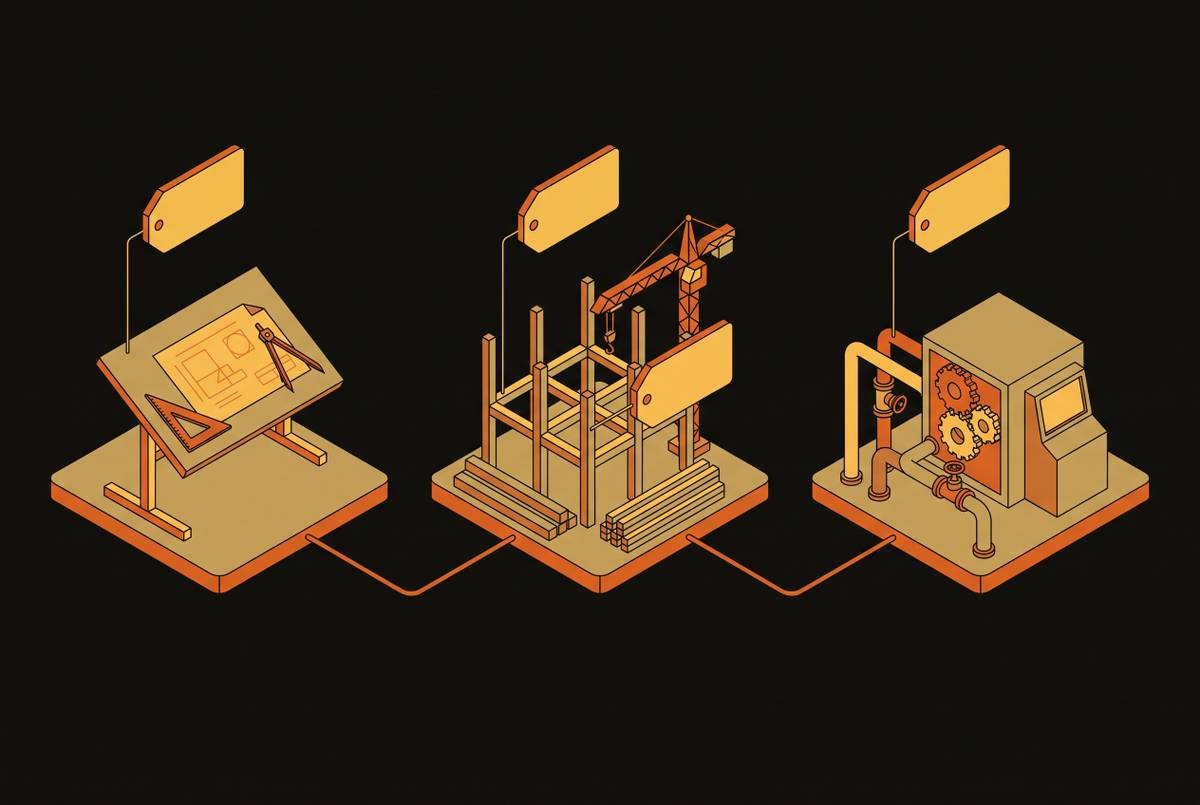
The operations team inherits a facility, opens the handover package, and discovers that DCIM has nothing useful to ingest. Drawings show where equipment belongs, manuals describe how it works, and equipment lists name what was purchased. None necessarily provides a complete, structured record of what was installed. The package closes out construction but leaves operations assembling its own asset database.
Delivering the BIM model does not automatically fix this. A model can describe design intent accurately while missing equipment substitutions, relocated racks, and rerouted circuits. Those differences separate a geometry reference from an operational asset. Without reconciliation against as-installed conditions, a digital twin is a visualization tool, however detailed it looks.
The underlying failure is contractual. If closeout requirements stop at drawings, manuals, and model delivery, they do not establish which asset fields operations must receive or how those fields map to DCIM. Model format, tagging structure, and the data requirements of the operator’s CMMS and DCIM systems need agreement at project kickoff. Once commissioning is done, software cannot recover data that no one on the project was required to collect.
How compressed schedules and rising density make a weak handoff more costly than it used to be
Fast-track construction leaves no time to fill gaps in records. At the same time, projects that once covered a single building now span multi-building campuses built in phases. Repeatable designs and careful sequencing become necessary at that scale. When construction and operations exchange fragmented information, the recovery work competes with delivery of the next phase.
Higher rack density also expands the asset record. As AI workloads enter production, cooling strategies move toward rear-door chillers and liquid-to-chip solutions. Connector type, thermal envelope, and liquid-circuit ID become part of the information operations needs from day one. A drawing package was never designed to supply those fields directly to DCIM.
Together, speed and complexity make the gap harder to absorb. Clashes between structure, MEP, and IT systems can already delay commissioning by months, while compressed schedules leave little room for rework. Gaps in handoff data add more work at startup. Operations teams can spend years reconstructing enterprise asset management data, leaving the DCIM investment with little operational return until the records become usable. The damage is not simply a larger backlog of documents, but a longer gap between taking responsibility for a facility and having the data to manage it.
What a DCIM-ready asset record actually contains, and why COBie alone does not deliver it
A DCIM-ready asset record has the equipment identity, where it is, what it connects to, and its operating parameters. It includes manufacturer, serial number, capacity, and maintenance schedules, but also rack-level spatial data, power topology, and network assignments. Its asset tag matches the operational system’s schema. The record must describe both the equipment and its place within the facility’s infrastructure.
COBie supplies an accepted open structure for building handover data. Its scope is broader than data center operations, so it does not mandate rack-unit position, power circuit, network port mapping, or IP addressing by default. Those are operational requirements. A COBie export may be a good base, but it can still lack fields that DCIM needs for capacity planning.
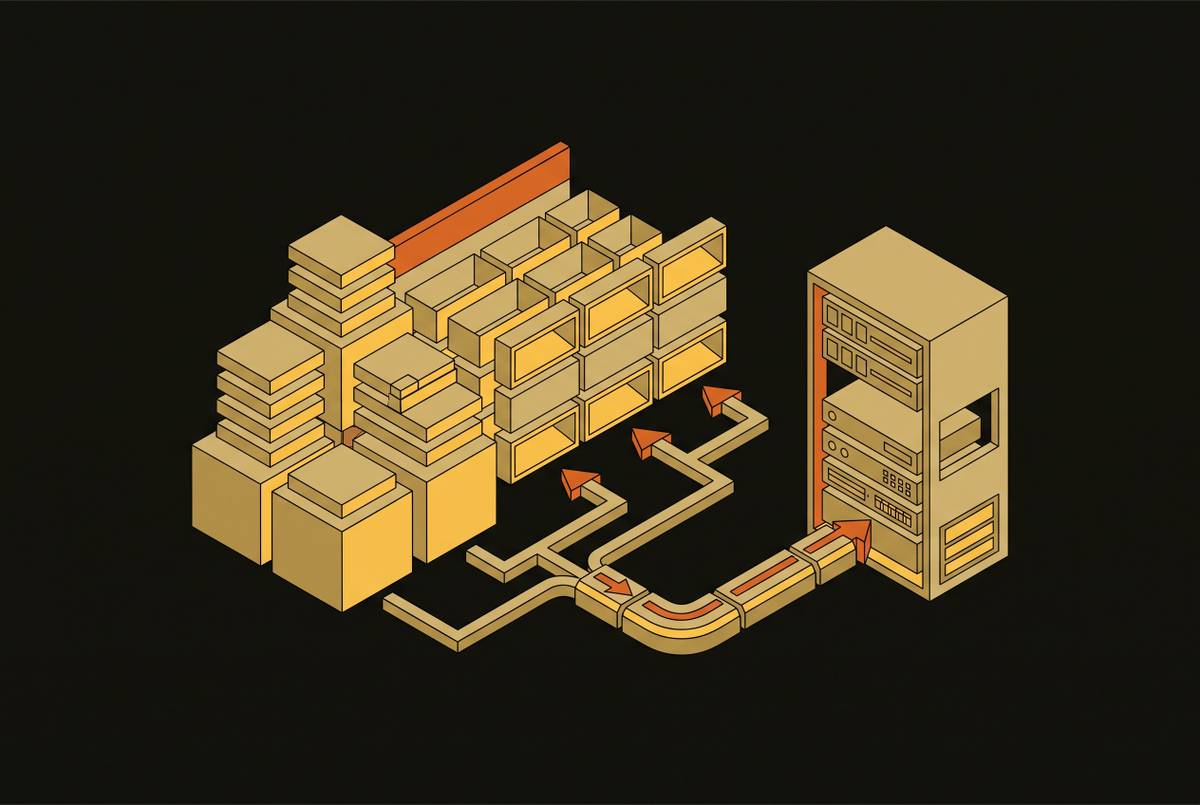
Manufacturer PDFs hold nameplate ratings, connector types, and thermal envelopes, but attaching the PDFs to a model does not populate the fields DCIM consumes. Spec extraction needs to put the data straight into those fields. Otherwise, someone must reopen the documents and re-enter the information at handoff, recreating the fragmentation that structured delivery was meant to remove.
Government and owner contracts may require a COBie deliverable, and producing it can satisfy that obligation. Operational readiness is a separate acceptance test. Treating contractual compliance as proof of DCIM readiness overlooks the additional fields and relationships the live system needs.
The schema and tag alignment work that must happen before platform selection
The data contract must be defined before software is evaluated. Before construction starts, it must set out the shared asset identifier, tag structure, required fields, and criteria for schema compatibility. These requirements determine what the project captures as work proceeds. Adding them at handover cannot make uncaptured information appear.
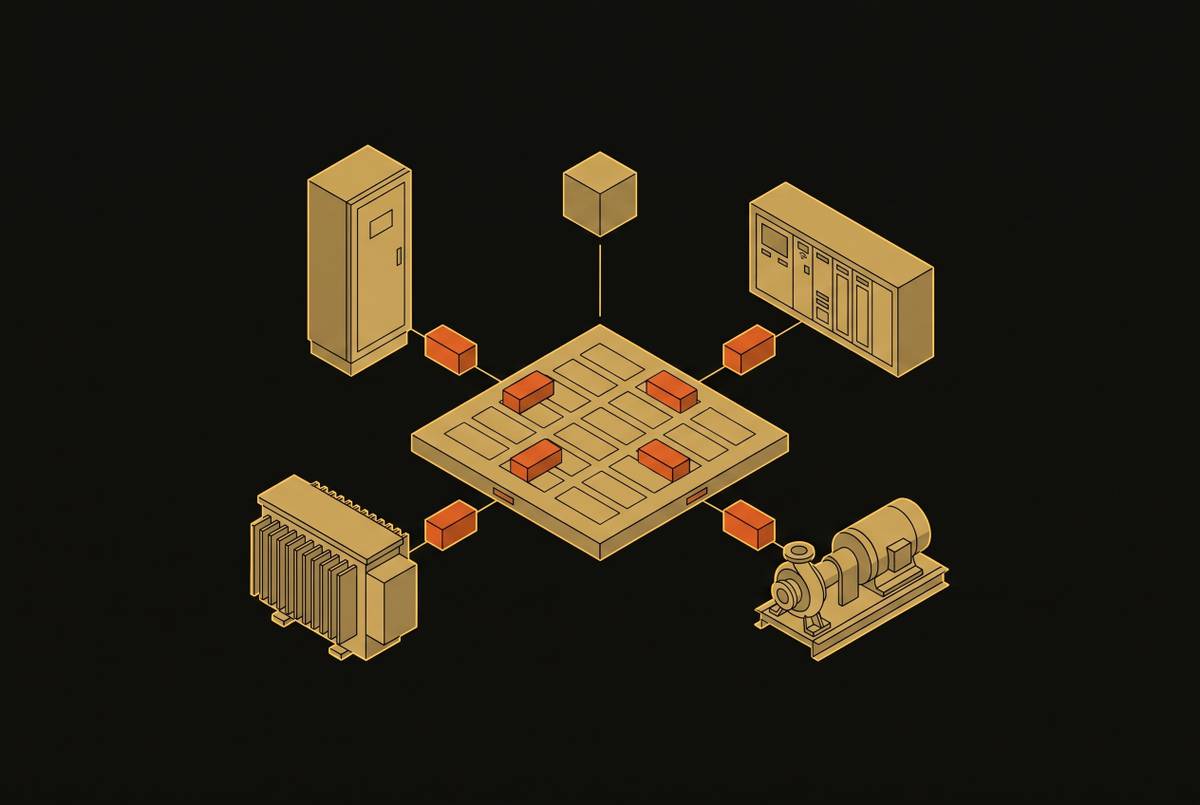
The architecture decision comes with that agreement. BIM, construction management, equipment submittals, DCIM, BMS, and power monitoring use different schemas, naming conventions, and levels of detail. The project must decide whether the digital twin federates live data from those systems or consolidates it into an authoritative repository. That choice establishes where records belong and how the systems relate, rather than leaving each discipline to define its own version of an asset.
For most builds, DCIM serves as the operational backbone for physical assets, spatial relationships, power topology, and environmental monitoring. BIM remains the design-of-record reference, while DCIM maintains the live operational record. Timing follows from that division of responsibility. DCIM must be provisioned and partly configured before construction finishes so that as-built conditions can be captured incrementally. Waiting until occupancy risks losing the construction team before the integration team has a working system in which to record those conditions.
The contract also needs an enforceable acceptance point. Transfer of Care, Custody, and Control (TCCC) criteria should include asset data accuracy and physical commissioning completion. The team can then choose a platform by testing whether it meets the contract, without asking vendors to decide what counts as a good handoff.
Four criteria for evaluating whether a handoff platform will produce DCIM-ready output
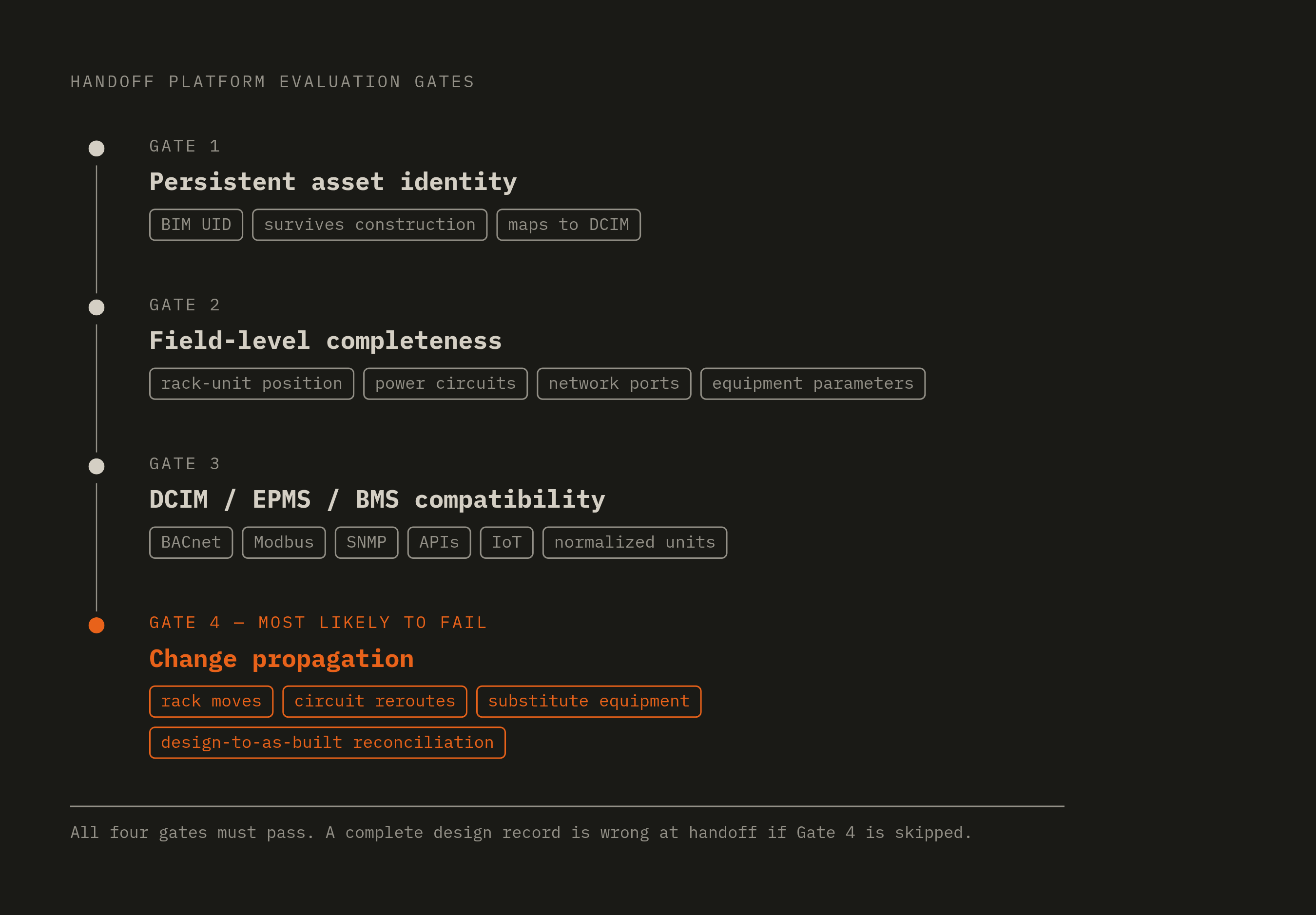
The first criterion is persistent asset identity. The platform must support a unique identifier created in BIM that survives construction and commissioning and maps directly to the DCIM record. A tag generated from drawings at closeout is not equivalent. The procurement document or scorecard should require a demonstration of that identity across the workflow, including its mapping to the target operational schema.
The second criterion is field-level completeness. An asset record should not count as complete merely because it exists or has documents attached. The required fields for rack-unit positions, power circuits, network ports, and equipment parameters must be filled in before the record is accepted. The test should check whether the platform enforces those requirements and maps data from manufacturer submittals into asset fields. A system that accepts records with gaps to fill later leaves operations with the same data-entry work under a new name.
The third criterion is compatibility with DCIM and connected EPMS and BMS systems. Matching field names is only part of this test. Units, spatial references, naming conventions, and timestamps also need normalization so that operational systems can correlate IT load with facility performance. DCIM-to-BMS integration must handle diverse protocols, including BACnet, Modbus, SNMP, APIs, and IoT. The platform’s export should be evaluated against the specific DCIM import schema before project kickoff, rather than leaving normalization work to the implementation team during commissioning.
The fourth criterion is construction-phase change propagation. The platform must update the handoff record when a rack moves, a circuit is rerouted, or substitute equipment is installed. The evaluation should test those changes against a formal design-to-as-built reconciliation workflow with defined acceptance criteria. Without that workflow, even a complete design record can be wrong by handoff.
Commissioning is the final test of that fourth criterion. As-built updates belong in the commissioning checklist, with DCIM model accuracy made a condition of closeout. Test results, sensor validation, and telemetry confirmation should stay in the asset record as permanent entries, with a link to the commissioning documents that hold them. Sensor and telemetry validation connect the static model to the live facility. The platform must support that link within delivery.
Where AI-assisted automation fits in the handoff workflow and where deterministic rules must govern it
AI can accelerate the work that turns documents into structured records. Spec extraction from manufacturer submittals, proposed field mappings, completeness checking, and change detection are useful handoff functions. They address work that otherwise consumes time across large asset sets. Their value depends on what happens before the resulting data is accepted.
The sequence must separate assistance from validation. AI reasoning can synthesize context and propose mappings, but power circuit identity, rack-unit position, and cooling loop assignment are operational facts. Deterministic rules must be used to check power path diversity, circuit assignments, and spatial completeness. Naming conventions, cable tray fill limits, and equipment clearances also need rule-based checks before a record can be released as complete.
AI-assisted tools may pull information from submittals and as-built scans, but the data must pass deterministic validation before it goes into the handoff record. Vendor evaluation must establish which handoff tasks AI accelerates and which rules govern acceptance of the result.
When data from automation goes unchecked, fields that DCIM treats as facts may be wrong. If the team cannot rely on circuit assignments or asset locations, it returns to checking and reconstructing records manually.
How a connected project platform changes the economics of producing DCIM-ready records
DCIM-ready records cost more to make when each discipline keeps its own piece. Layout, power, cooling, cable routing, documentation, and submittal data then have to be assembled manually into an operational record. A connected platform keeps the record up to date throughout delivery, so the team can skip that assembly step. The cost shifts from reconstructing decisions at closeout to keeping their effects aligned as they happen.
A rack move makes the difference concrete. In a disconnected workflow, it triggers manual rework across power, cooling, cable schedules, and sheets. In a connected workflow, the change propagates automatically into the related project information and handoff record. RFI answers and submittal approvals need the same connection because substitute equipment, routing revisions, and capacity adjustments often explain the gap between design intent and installed conditions.
ArchiLabs Studio is built around this connected architecture. It brings layouts, power and cooling coordination, cable routing, documentation, RFIs, and operations-ready handoff into one workflow. That makes it a relevant option for this evaluation. Its fit still rests on the agreed identifiers, required fields, import schema, and change-control requirements of the project.
Owner-operators and design firms should evaluate that connected structure. Structured handoff to DCIM, EPMS, and BMS should be the output of a project record prepared for operational use from the beginning. The exporter is only the last step. It cannot repair decisions and changes that were never linked to the asset record.
The final handoff must also transfer ownership of model accuracy. Documented responsibilities and a sustainment plan for ongoing change control should pass explicitly from the construction contractor to the operations team. The selected platform must support that transfer as a workflow event.