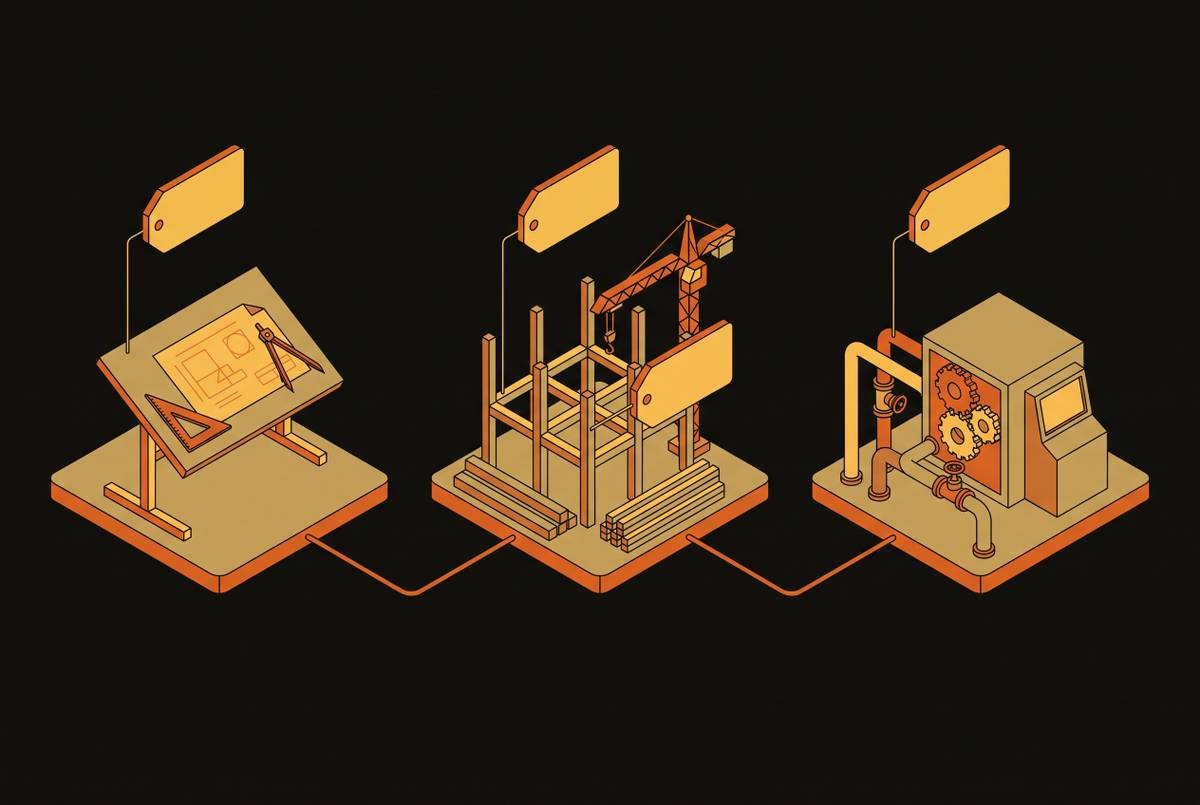
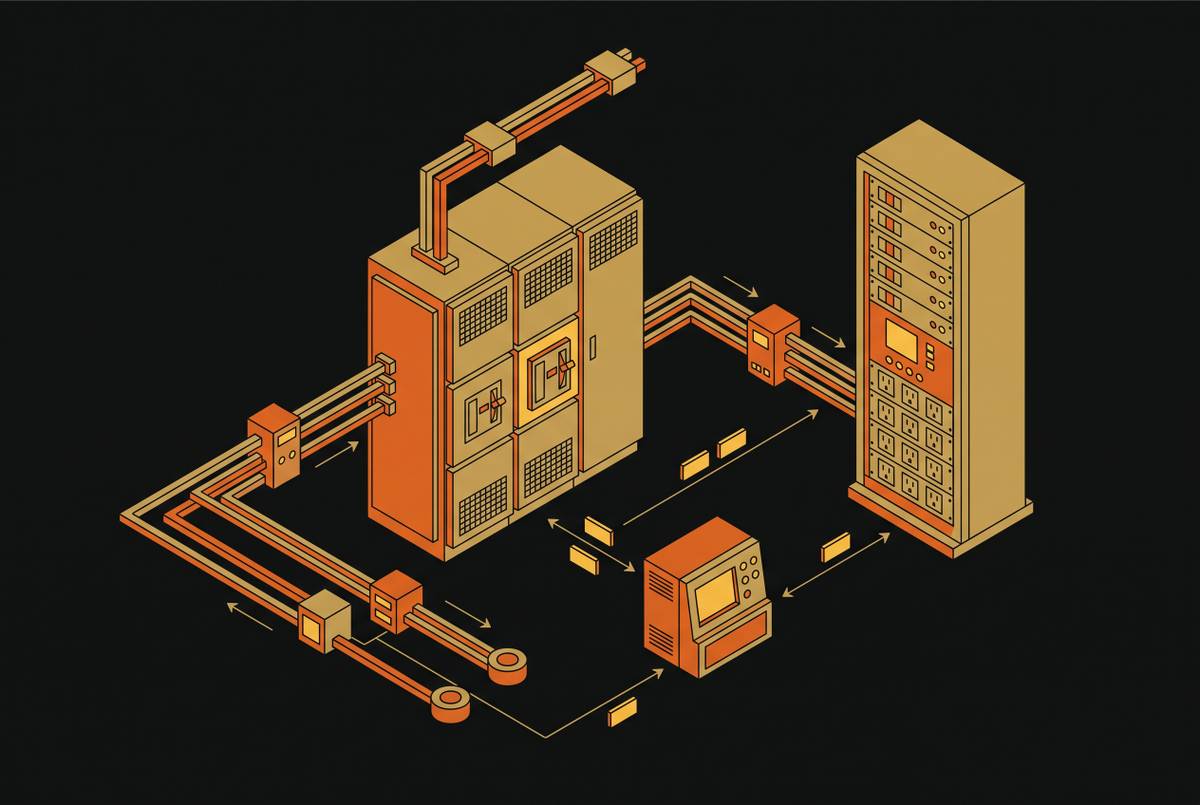
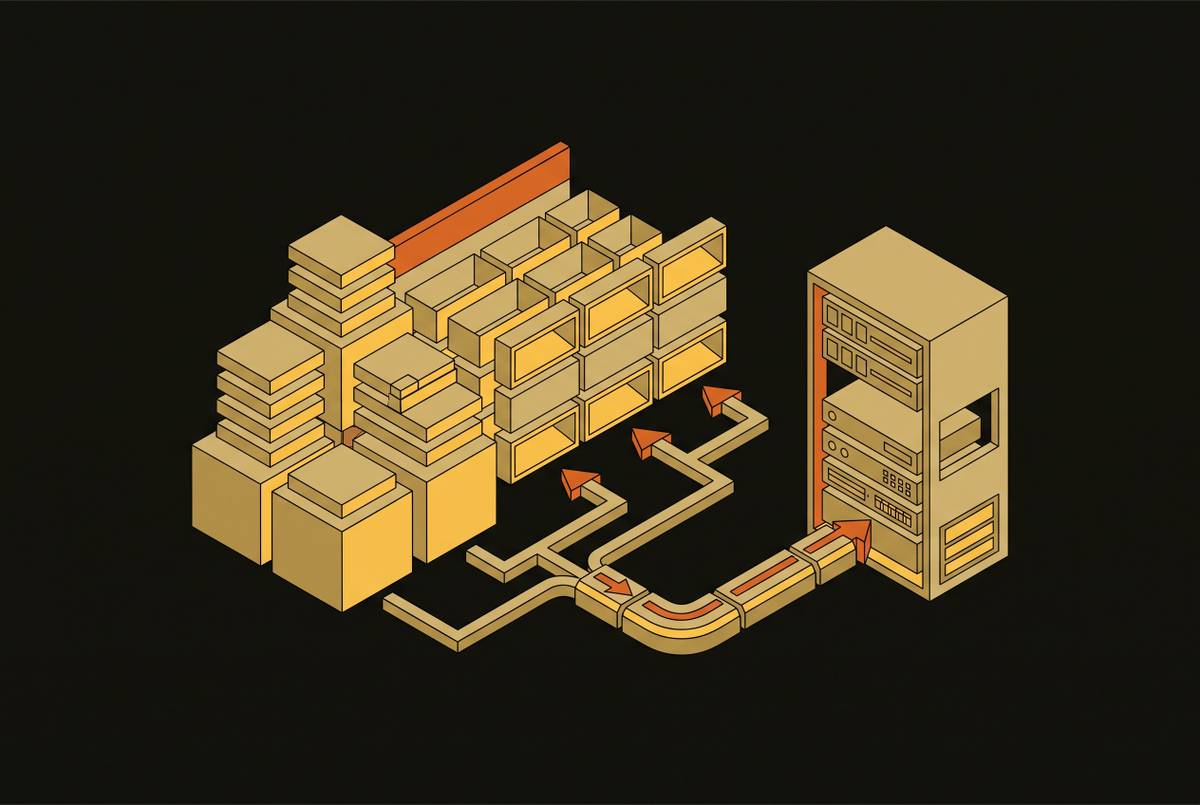
Vendor-Neutral Equipment Data Standards for Configurator Interoperability
Structured equipment data must flow from configurator to DCIM without manual remapping.
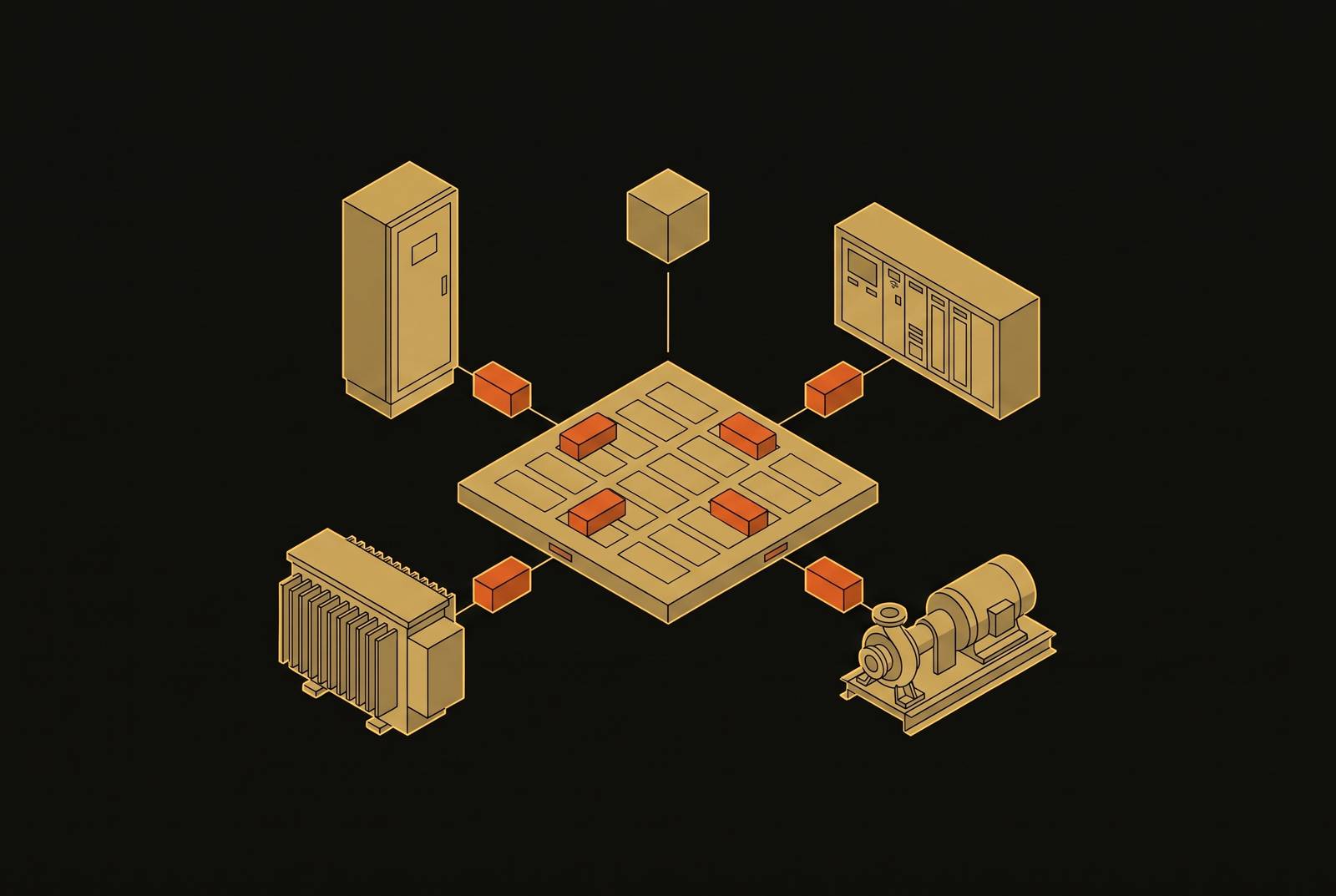
A DCIM-ready design-model handoff requires structured equipment records that map to DCIM asset fields, EPMS circuit identifiers, and BMS point addresses without manual reentry. Vendor-neutral equipment data standards must define those records at configuration to spare teams from reconstructing them at turnover. Structuring the data connects equipment selection to layout, power, cooling, and operations.
Why configurator outputs are the hidden interoperability gap
A major owner-developer has a GC running Procore and a project controls team running Autodesk Forma. The owner’s rep and commissioning agent each use their own environments, while MEP subcontractors use whatever their firms standardized years ago. Someone re-keys data every time it moves between them. The information exists, but the receiving tool cannot consume it as delivered. Each transfer becomes another translation job.
The break starts before those project systems send documents to each other. A vendor configurator produces equipment information that does not transfer as structured, machine-readable data into the next tool. The product chosen can thus reach the project without a record that tools can use to link its physical, electrical, and thermal requirements. Scale makes that weakness harder to absorb. Data halls within multi-hundred-megawatt campuses demand repeatable designs and sequencing beyond what toolchains built around 4–12 MW buildings were designed to support.
Why standards compliance does not solve the structural problem
A standard can set out how equipment should behave without saying how another system should read each field in its output. That distinction leaves room for compliant products whose records still require remapping. The systems exchanging data still need a shared definition of it.
IEEE’s March 2026 standards priorities document lists minimum interoperability requirements across multi-vendor systems as a separate addition to the standards already in place. It also notes that basic terms lack agreed definitions, including “data center load” and data center size, referred to as “capacity” in MW. If two tools mean different things by capacity, matching their field names does not make their calculations compatible. Standards activity is necessary, but it does not remove that structural ambiguity by itself.
What a common data model actually requires at the equipment layer
Consider how three systems describe the same equipment context. The BMS calls a unit CRAC-02-DH2, the EPMS calls its circuit DB-2A/14, and DCIM calls the space DH2-Row-C. These labels describe different things, but they need an explicit link to the same asset record. A shared asset naming convention agreed before configuration gives each system a stable reference without pretending that an asset, circuit, and space are interchangeable.
The equipment schema must also define what each field means, how it is typed, and how it maps to the receiving system. Required fields include physical dimensions, weight, power draw across load profiles, heat rejection curves, and electrical interfaces covering voltage, phase, and connector type. For liquid-cooled equipment, the fields must also include coolant connection type and flow rates. Nameplate power is not a substitute for operating behavior. When those details come from manufacturer PDFs, the data taken from them must flow into models, schedules, and validation rules instead of ending up in another disconnected document.
How OCP specifications are becoming the closest thing to a vendor-neutral hardware data language
The Open Compute Project is the closest working example of a vendor-neutral equipment specification that is being taken up at the hardware layer, especially for AI infrastructure. Its December 2025 alliance with Current/OS aims to create a vendor-neutral framework for DC-native data centers. The goal is to standardize power distribution components so different suppliers’ equipment can fit into a common architecture. That is a concrete step beyond exchanging documents. It gives manufacturers and configurator developers a shared hardware basis to work from.
Mount Diablo, approved as an OCP contribution, defines a 1 MW IT rack power architecture using a higher-voltage power sidecar rack to cut I²R losses. That specification is the kind of structured input a configurator could consume without remapping. NVIDIA’s MGX ecosystem and OCP’s work on busbars and liquid-cooled power shelves reinforce this direction. Hardware fit is still only one layer. OCP specifications do not yet cover the full operational asset schema, which includes the identity fields, thermal envelope curves, and maintenance parameters that downstream DCIM or EPMS systems need.
Why the BMS, EPMS, and DCIM boundary is where schema gaps become operational failures
The BMS monitors and controls mechanical and environmental plant, while the EPMS monitors the electrical path from utility incomer to rack. DCIM manages IT assets, rack space, and power capacity in the white space. It consumes data from the other two systems. It supplements them, so a usable handoff must include DCIM import and preserve the relationships between their records.
Krishna Chaitanya Sunkara’s 2025 DCIM framework paper proposes a Unified Device Connectivity Protocol as a vendor-neutral language that turns physical connections into digital records. The proposal addresses the gap between device telemetry and the layer of meaning needed to use it across system boundaries. This remains a proposed framework. Its purpose highlights what handoff often lacks. When MEP and liquid cooling information remains scattered across contractor spreadsheets, operations teams spend their first months scavenging for asset information because they lack a connected record.
How AI workload density breaks configurator assumptions baked into existing schemas
A neatly structured record can still encode the wrong assumptions. Traditional capacity planning assumes steady growth and relatively uniform resource use, while AI inference clusters cannot throttle gracefully during demand spikes without degrading performance. Once allocated, AI capacity is expected to provide consistent, uninterrupted throughput. A schema for those workloads needs load profile fields for burst behavior, sustained throughput, and thermal ramp rates alongside nameplate power.
IEEE’s priorities document names Oscillation Control as a Tier One priority and suggests the more specific description “AI / ML cycling control or suppression.” That distinction makes workload cyclicity a direct consideration in power modeling. OCP’s unified AI data center design specifications, developed with Google, Meta, NVIDIA, and AMD, focus on the 2027–2028 timeline. They provide guidance built for AI workloads. For configurator interoperability, this means agreement on field structure is insufficient unless the fields also describe the behavior that downstream power and cooling models must evaluate.
Where RFIs and submittals reveal the equipment data schema breaking in practice
A configured product’s submittal does not align with the specification template, or dimensional and electrical details differ across vendors’ proprietary sheets. Teams then need answers before they can go ahead. Finding missing information and coordination conflicts before documents reach the field can prevent a large share of RFIs. Reconstructing an answer from incompatible records adds to delivery costs.
A submittal change can also trigger a change order. Without a traceable link between the equipment record, RFI, submittal, and resulting decision, the project loses the reason for the change and its downstream consequences. ProjectReady’s WorkBridge addresses one part of this fragmentation through bidirectional synchronization between Procore and Autodesk Forma. It syncs submittals, RFIs, documents, issues, photos, sheets, and forms, with continuous or scheduled transfers. Synchronization, however, does not restructure proprietary equipment data. To trace those changes, teams need equipment records that stay in place and keep the specification reference, the affected parameter, and the context behind the decision.
How do structured equipment records support a DCIM-ready BIM handoff across the delivery chain?
A connected delivery chain runs on a data contract. That contract defines the schema configurator outputs must satisfy so layout generation, power and cooling sizing, documentation, and operations can consume the same equipment record. At layout, the record includes physical envelope, weight, center-of-gravity, floor loading, and mounting interface. These fields let deterministic rules enforce aisle containment, floor load limits, and redundancy topology without reentering vendor sheet data.
Power and cooling coordination extends that same record with load profile curves, heat rejection by operating mode, coolant type, connection geometry, and electrical interface. A rack move should then cascade into updated power branch calculations, cooling capacity checks, and cable schedules. The documents also need to keep the same asset identifier, specification reference, and decision log. At turnover, those records map directly to DCIM asset fields, EPMS circuit identifiers, and BMS point addresses. The mapping is defined during design rather than improvised from the finished design model.
Sunkara’s framework proposes a knowledge graph as the layer connecting raw telemetry and configuration to contextual understanding. That offers a semantic basis for linking design-time records to operations-time monitoring without a fresh translation step. Deterministic rules enforce floor load limits, power branch capacity, and coolant flow minimums, while AI accelerates equipment selection, layout iteration, and anomaly detection.
How ArchiLabs Studio approaches the schema problem in practice
ArchiLabs Studio is designed around a connected project workflow in which equipment data entered once flows through layout, power and cooling coordination, cable routing, RFI documentation, and operations handoff. The equipment record is the common thread. Connecting these steps is intended to prevent a rack move from leaving power calculations behind or a submittal from becoming detached from the equipment it changes.
Deterministic rules handle floor load enforcement, power branch capacity validation, and cooling adequacy checks, while AI supports equipment selection, layout iteration, and specification extraction from manufacturer documentation. For its structured handoff, teams agree on asset identifiers, circuit references, and point addresses at design time and keep them through turnover. This approach organizes the workflow. Its relevance to bridging design models and operations lies in connecting the record throughout delivery, rather than expecting the receiving DCIM system to repair missing structure at the end.
What project teams can do before vendor-neutral standards fully mature
For projects running now, the practical response is to define the data contract before configuring the receiving systems. Agree the asset naming convention at kickoff, including how equipment identity connects to BMS points, EPMS circuits, and DCIM locations. That is a low-cost decision with broad consequences. Put structured configurator outputs into procurement and submittal requirements, with typed fields for physical envelope, load profile, heat rejection, and electrical interface. PDF specification sheets alone should not meet the requirement for data that downstream tools need to read.
Apply the same discipline to project decisions. Link every RFI and submittal to the equipment record it modifies when it first appears, rather than reconstructing the thread after a change order dispute. Keep the information behind the decision attached to the parameter it affects. This is a workflow requirement as much as a software requirement, because moving an unlinked document faster does not establish its relationship to the design. For the handoff to work, those links must stay in place as equipment choices change.
Track the standards work against that project schema. OCP and Current/OS’s December 2025 announcement set early 2026 for a directional power distribution whitepaper, with the project organized into eight active workstreams. IEEE’s parallel work on performance requirements and interconnection data requirements is a likely source of shared definitions. Teams that follow or take part in those efforts will be ready to use ratified standards without having to rebuild their schema. For current procurement and turnover decisions, the acceptance test is concrete. Can the next tool read the equipment record without someone typing it again?