Multi-Phase Campus Configurations in Capital Equipment CPQ
Phased data center campuses demand CPQ systems built for multi-year scope, not single quotes.
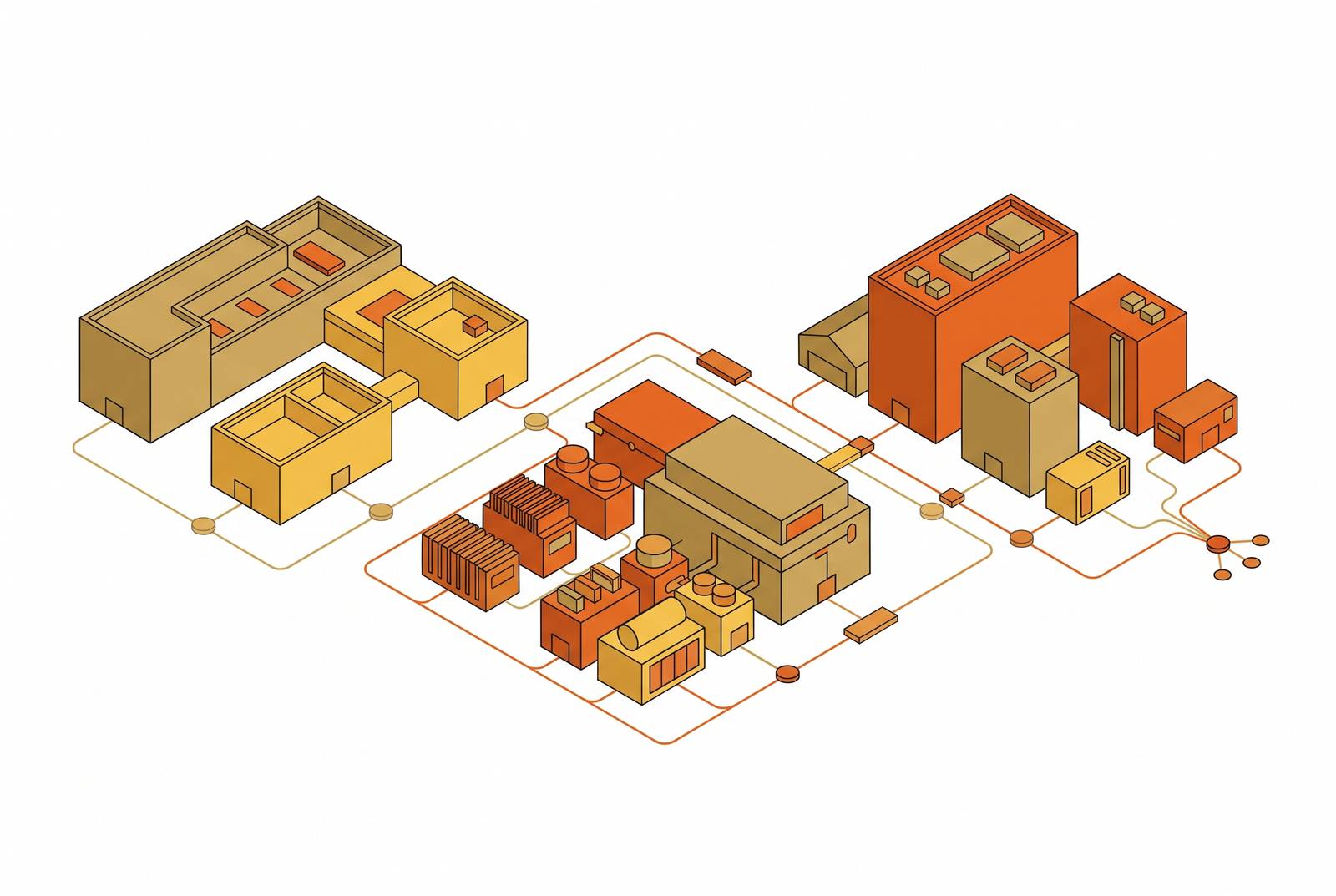
Multi-phase campus development breaks the basic assumption every capital equipment CPQ system was built on: that a quote describes a fixed scope, priced against what's being delivered right now. Campuses don't work that way anymore. A single master-planned site can span 8 to 12 data halls, roll out in phases that each add 50 to 100 MW, and reach 200 to 500 MW in total across holdings that run into the hundreds of acres. Pricing, configuration rules, and equipment interdependencies all have to account for capacity that doesn't exist yet, and no CPQ tool built for a single building was ever meant to hold that much.
What "capital equipment" means at campus scale
Capital equipment on a data center campus covers a wide range of gear: medium-voltage switchgear, transformers, UPS systems, PDUs, generators, busway distribution, cooling plant equipment (chillers, CDUs, dry coolers), liquid-cooling infrastructure, and the structured cabling and fiber pathways tying it all together. Each category runs on its own lead time, its own engineering dependencies, and its own configuration rules, and each gets bought in tranches that follow the phase schedule.
What's forcing the issue is density. Rack loads that sat at 5 to 8 kW five years ago now run 15 to 50 kW in new builds, with some designs pushing past 100 to 200 kW. GPU servers draw 700 to 1,200 watts apiece, so a rack holding ten of them clears 80 kW before anyone accounts for switches, storage, or cooling. Power and cooling equipment now has to be sized against workload assumptions that shift from one phase to the next. A quote locked to today's scope is already behind.
The four places where conventional CPQ logic fails when phases are involved
Configuration rules scoped to the current phase only. Standard CPQ checks whether the parts picked today work together today. It doesn't check whether Phase 1 choices leave room, physical, electrical, or mechanical, for Phase 2 and Phase 3. Switchgear bus ratings, transformer pad sizing, and generator paralleling capacity all need to be over-built in Phase 1 to carry future load. A rules engine with no view past the current phase reads that over-build as a mistake and flags it, or worse, reprices it down.
Pricing models tied to a single point in time. Conventional CPQ prices what's shipping, not what's being held. Multi-phase contracts routinely include equipment reservations, capacity holds, and option pricing that stretches across years, and none of that fits cleanly into a line-item quote for Phase 1 gear. Development modeling frameworks used in commercial real estate already account for phased ramp-up schedules and layered capital stacks. CPQ needs to reflect that same financial reality, and mostly doesn't. When pricing only exists at the phase level, the running cost of reservations, change orders, and configuration drift stays invisible until someone finds it during a budget review.
Equipment interdependencies that cross phase lines. Power path, cooling loop, and fiber backbone choices made in Phase 1 limit what's technically possible in Phases 2 and 3. High-voltage busway picked for Phase 1 has to extend cleanly into later phases, but a CPQ tool with no cross-phase data model can't enforce that, or even show it, at quoting time. Network infrastructure is a clear example of the risk: components specified for earlier-generation performance may not meet the demands of later phases once they come online years later. A quote that treats each phase as its own island never catches that conflict before it becomes a field problem.
Change cascades that run backward into prior quotes. A tenant raising its density target, or a cooling strategy shift between phases, rarely stays contained to the phase where it starts. A density increase in Phase 2 can force a resize of power distribution gear that's already been quoted, and sometimes already ordered, for Phase 1. Standard CPQ has no way to flag that; the Phase 1 quote just sits there, stale, with nobody told. Physical data centers run 15 to 20 years. AI accelerator generations turn over every 12 to 18 months. That gap makes re-design a routine part of the job, not an exception, and CPQ needs to treat it that way from the start.
Phased power and capacity planning compounds the quoting problem
A data center campus sells IT load, measured in kilowatts, not square footage. Every piece of capital equipment gets priced against a power delivery commitment. A phase-aware financial model has to track how power ramps over time, reflect rent billed by the kilowatt, account for ramp lag even on leases that are already signed, and tie capital cost to dollars per kilowatt delivered. CPQ has to produce quotes that match that structure, not fight it.
A phased schedule imposes power as a constraint at the campus level, visible in how equipment quotes must track it. Project LufKin, for one, starts at 175 MW grid-connected in 2026 and climbs to 1.1 GW by 2028, on a published schedule that equipment quotes have to track against, not guess at. And the schedule itself moves: Bloom Energy's 2026 Data Center Power Report found utilities projecting delivery timelines roughly 1.5 to 2 years longer than hyperscalers and colocation providers expect, with the gap widest in Northern Virginia, the Bay Area, and Atlanta. So the power assumptions baked into a Phase 1 quote can be wrong before Phase 2 equipment ever gets ordered.
What a phase-aware configuration model needs to do
Bolting a "phase" field onto an existing CPQ tool doesn't fix this. The whole data structure has to change, so configurations, rules, and pricing are all set against a phase timeline instead of a fixed, static scope.
Cross-phase rules enforcement means rules have to check forward compatibility with planned future phases, not just internal fit within the current one. Switchgear, transformer, and generator picks in Phase 1 need validation against the campus's total load envelope. Cooling strategy decisions, air versus direct-to-chip versus immersion, need a flag the moment they close off an option a later phase will need.
Option pricing and capacity reservations as real line items. A Phase 1 quote should be able to carry priced options on Phase 2 and Phase 3 equipment as structured line items, each with its own validity window and escalation terms. Layered capital stacks, equity, debt, mezzanine, often differ from one phase to the next, so the configuration model has to support that financial layering directly rather than treating every phase as one flat budget.
Change propagation that runs both directions. When something changes downstream, a new density target, a new cooling approach, a new tenant requirement, the system needs to push that impact backward into phases that are already quoted or already ordered. It's the same logic a connected design automation tool applies when moving one rack cascades through power, cooling, and cable schedules. CPQ needs the same reflex across phases.
Fragmented tooling turns phased quoting into a manual rework problem
In practice, most multi-phase campus work still runs across spreadsheets, PDFs, email threads, and separate CPQ instances, each one maintained on its own, with nothing linking them live. Equipment specs get pulled off manufacturer PDFs by hand and typed back into models and quote tools, and every retype is a chance for a typo, a dropped digit, or a version that quietly drifts from the source.
When a Phase 1 configuration changes, someone has to manually check every downstream document by hand, including the Phase 2 basis-of-design, the Phase 3 capacity model, and the financial underwriting currently in front of a lender. None of it updates on its own. The same numbers, rack count, power draw, cooling topology, equipment ratings, get rebuilt separately in the CPQ tool, the design model, the submittal package, and the DCIM asset import. Whether those four versions agree with each other comes down to how careful the person doing the copying happened to be that day.
Where deterministic rules and AI belong in a phase-aware CPQ workflow
There's a push right now to sell AI as the fix for all of this, on the theory that it can figure out configuration compatibility and pricing adjustments that a rules engine can't anticipate. That mixes together two kinds of decisions that carry very different tolerance for being wrong.
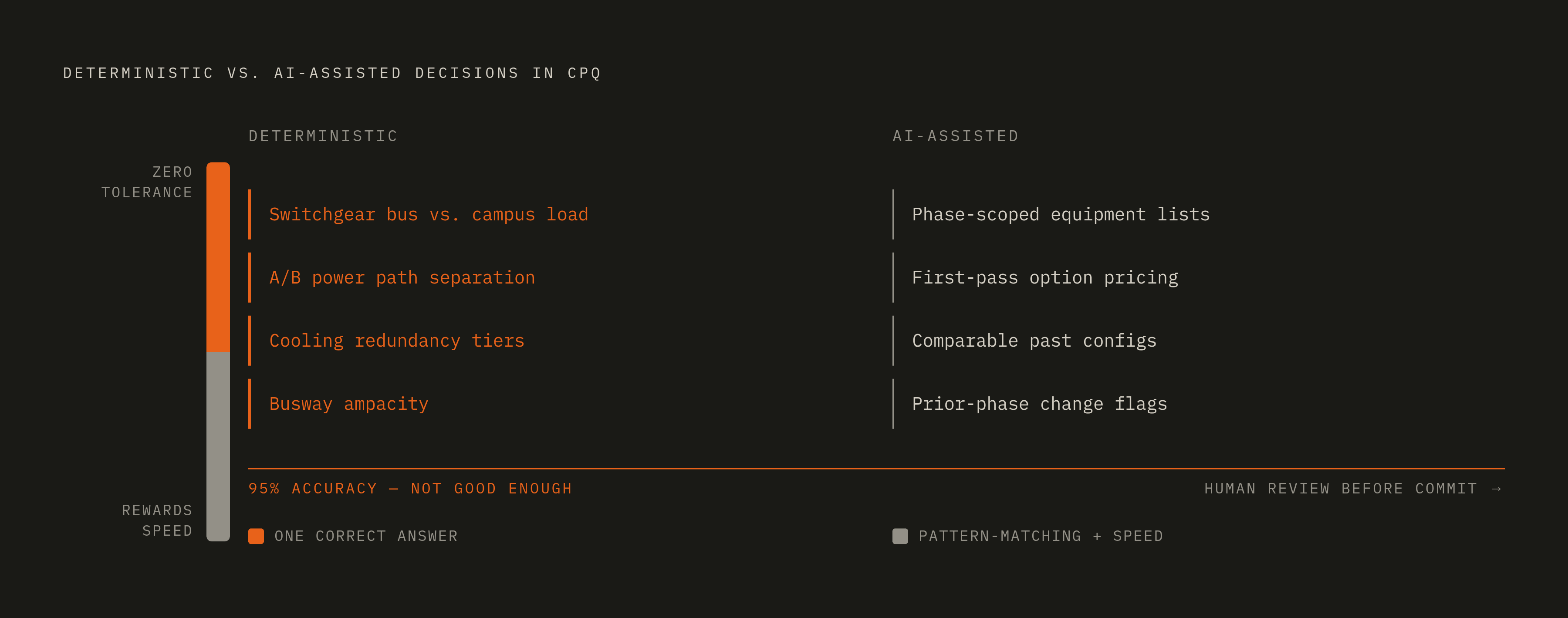
Some decisions have one correct answer and no room to guess. Switchgear bus ratings against total campus load, separation between A and B power paths, cooling redundancy tiers, busway ampacity against phase load: these are deterministic by nature. An AI model that's right 95% of the time is not good enough when the other 5% is an underspecified power path feeding a critical facility.
Other tasks are exactly where AI earns its place. Drafting an initial phase-scoped equipment list from a capacity brief, putting together a first pass at option pricing for someone to review, pulling up comparable configurations from past campus projects, flagging which prior-phase quotes a stated change is likely to touch: these reward speed and pattern-matching, with a person checking the output before it moves.
The workable setup splits the work along that line. Deterministic rules hold the hard line on cross-phase compatibility, load envelope checks, and regulatory minimums. AI takes on the language-heavy, pattern-heavy work: pulling specs out of manufacturer PDFs, summarizing what a change actually touches, suggesting a starting configuration from a brief. Both depend on structured data as the cause underneath: it is what allows AI's language-heavy work and a rules engine's enforcement to function, and without it neither can operate. AI can't infer cross-phase compatibility out of a stack of unstructured PDFs, and a rules engine can't enforce anything against numbers still sitting in somebody's spreadsheet.