API Versioning Strategies for Embedded Engineering Automation
Silent API breaks between power, cooling, and monitoring systems now threaten data center safety.
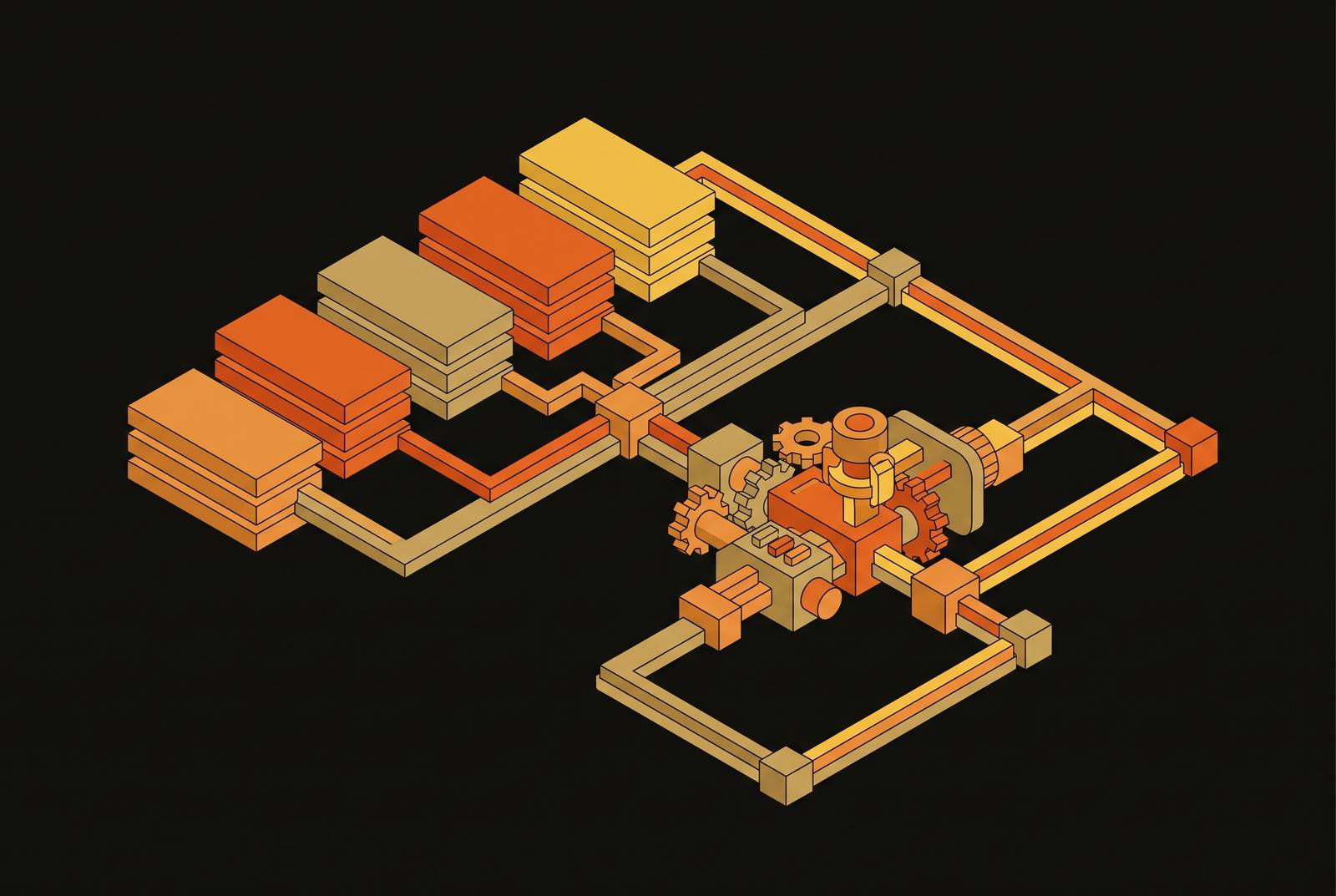
A version break between DCIM, EPMS, and BMS doesn't throw an error. A wrong capacity read, a miscalculated power cap, or a missed cooling constraint appears while every dashboard in the building keeps reporting green. The failure is silent by default, and the systems involved are the three that keep a data center alive. BMS handles the mechanical and environmental plant. EPMS covers the electrical path from the utility incomer down to the rack. The connections between these systems are usually protocol-level feeds, BACnet IP, Modbus TCP, or a vendor's own API, and a schema change on one side reaches the consumer quietly unless a versioning contract already exists.
The stakes aren't theoretical. Power is the leading cause of impactful outages for a majority of operators surveyed in the Uptime Institute's Annual Outage Analysis 2025, with cooling close behind as the second most common cause. Those systems carry the exposure to undetected version drift. Rack densities have climbed from the 7 to 15 kW range of older designs into the 40 to 100+ kW territory that AI training clusters now demand. At that density, the margin for bad data between power, cooling, and monitoring systems has mostly disappeared. Integration between those systems used to be a convenience. It's now a safety dependency; the API contracts holding it together deserve the same scrutiny as the mechanical and electrical design itself.
How the three operational systems create distinct API boundaries that must be versioned independently
The BMS-to-DCIM and EPMS-to-DCIM feeds aren't connections between equals. DCIM is supposed to receive a read-only feed from BMS for facility-side parameters that affect IT cooling capacity, and it shouldn't duplicate BMS alarm logic on its own. That makes the contract asymmetric: DCIM is a consumer, and it has no way to enforce a schema on the system producing the data. Every platform boundary in a typical deployment, an enterprise DCIM for asset management, a thermal optimization platform for cooling, an EPMS such as Eaton Brightlayer or Schneider EcoStruxure PME for power quality, is its own API boundary and needs its own explicit versioning contract. There's no single gateway where one versioning policy covers the whole stack.
The deeper a DCIM platform integrates into daily workflow, the more boundaries it creates. Nlyte, a Carrier Global company, synchronizes work orders and CMDB records with ServiceNow, carrying full asset context between the DCIM and ServiceNow. Every external system added to that ecosystem is another versioning dependency to track.
The design side of the pipeline adds a further layer. Tools that automate data hall layouts, coordinate power and cooling, route cable and fiber, and hand structured output to operations have to maintain versioned API contracts with DCIM, EPMS, and BMS too. The architecture makes the point on its own: versioning is a decision made at every boundary, not a single decision made at a gateway, and the number of boundaries grows every time a platform gets added to the stack.
What the Four Mainstream Versioning Strategies Trade Off
Most teams debate URL path versioning against header versioning as if the question were about taste, clean URLs versus hidden headers. What matters is how each approach behaves inside a CDN's cache; in a pipeline pulling power telemetry or cooling state at high frequency, a cache serving stale data is a safety problem.
URL path versioning puts the version straight into the endpoint, something like /v1/users. Because /v1 and /v2 are separate cache keys by default, it caches cleanly at the edge without any extra configuration, which is a big part of why it's the most common REST approach. Header versioning keeps the URL stable but breaks standard HTTP caching unless the response sets a Vary header naming the version header in use, whether that's X-API-Version or something else specific to the API. Skipping that step is the single most common mistake in header-based schemes, and it lets a CDN serve a v2 response to a client built for v1 without raising any alarm. Picture what that means for a DCIM client expecting a v1 power capacity payload: it receives a v2 response, parses it as if nothing changed, and reports a capacity number that's simply wrong, with no 4xx error anywhere in the chain to flag it.
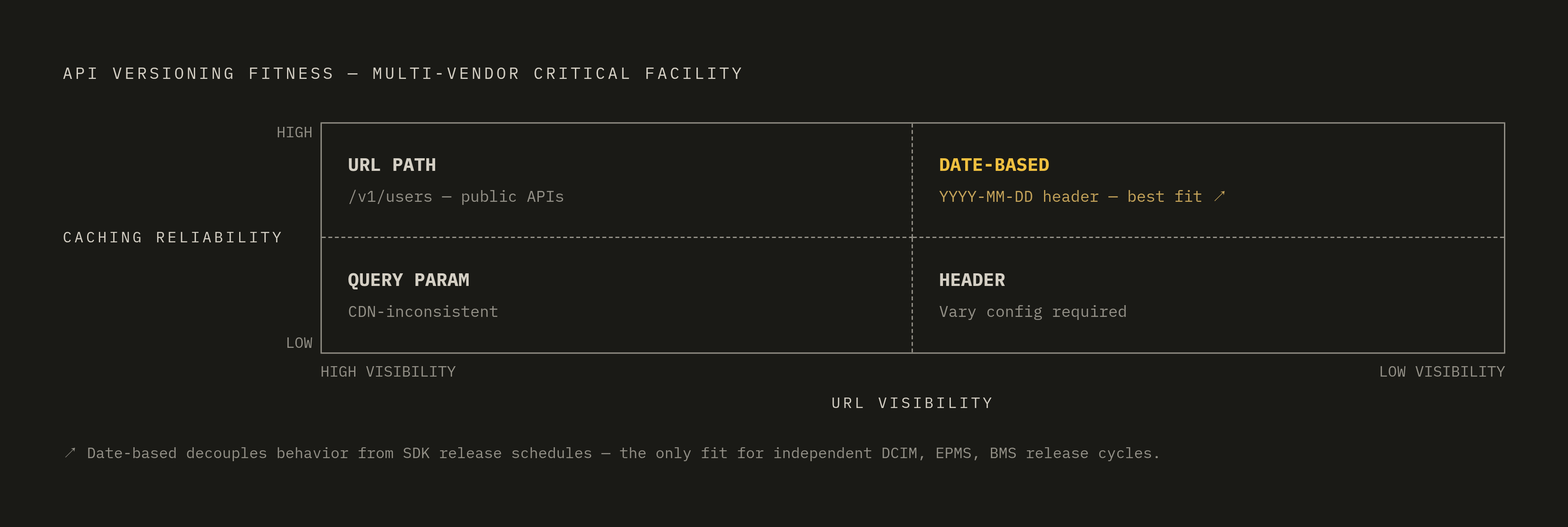
Query parameter versioning lands in between. Most HTTP caches treat distinct query strings as distinct cache keys, but some CDN providers strip or ignore query parameters when computing cache keys, so the behavior depends entirely on which CDN is in front of the API. Date-based versioning takes a different approach. GitHub uses an X-GitHub-Api-Version header with a YYYY-MM-DD value, and Stripe pins clients to a release date and transforms responses backward to match it. Both treat the version as an isolation contract rather than a release label, decoupling behavior changes from SDK release schedules and giving every change a precise, sortable identity. That's the model that fits a world where BMS, EPMS, and DCIM vendors each ship on their own independent calendar.
Lined up against each other, the trade-offs are concrete. URL path versioning offers high visibility, easy routing, and reliable caching with low implementation effort, which suits public APIs serving a wide range of consumers. Header-based versioning has low visibility and higher complexity, since it depends on correct Vary configuration, but fits enterprise integrations where the URL itself has to stay fixed as a contract requirement. Query parameter versioning gives medium visibility and inconsistent caching at low complexity, workable for internal APIs where the CDN's behavior is known and controlled. Date-based versioning delivers platform-grade isolation and decouples behavior from any SDK's release schedule, making it the best fit for multi-vendor environments with independent release cycles, precisely the topology that DCIM, EPMS, and BMS vendors already operate in.
The discipline gap between teams that version and teams that prevent version drift
Most API teams version their APIs. Far fewer use semantic versioning, and fewer still run contract tests before deploying a change. One logistics company cut integration failures by 40% simply by standardizing on semantic versioning with backward compatibility. The gap between teams that label their APIs with a version number and teams that actually enforce one is where production incidents in critical-facility pipelines come from.
Contract testing closes that gap. It checks that a consumer's expectations of a producer's schema hold true before anything ships, and without it, a schema change on the BMS or EPMS side reaches the DCIM consumer with nothing to catch it. A version number by itself isn't a contract. Stripe and GitHub both treat the version as an isolation guarantee, something that promises a pinned consumer a stable, transformed response no matter what changed underneath. Teams that build to that standard don't experience silent schema drift. Teams that stop at "the endpoint has a version number in it" do.
Retiring a version properly takes the same discipline. Deprecation and Sunset HTTP headers, a deprecated flag in the OpenAPI spec, a migration guide, and a final 410 Gone response are what separate an orderly retirement from an unplanned outage. Skipping that signaling on the EPMS side lets the DCIM's power capacity feed break without warning the moment the old version disappears. Source-level contracts, schema evolution rules, dead-letter queues, and idempotent reprocessing are the deterministic controls that keep an automation pipeline from silently corrupting itself, and none of this works without them. Anomaly detection built with AI only adds value once those controls are already in place, not instead of them.
Where deterministic versioning rules end and AI-assisted monitoring begins
In critical-facility API integrations, deterministic rules and AI-assisted monitoring aren't competing approaches. They work in sequence. Schema contracts and contract tests enforce the boundary itself; AI-assisted anomaly detection catches the behavioral drift that schema validation was never built to see.
Order matters here. Source-level contracts and schema evolution rules have to exist before anomaly detection gets layered on, because training a monitoring model on data that's already corrupted just teaches it to treat corruption as normal. Determinism has to come first, as a sequencing requirement rather than a stylistic preference.
AI earns its place after that foundation is solid, in the territory schema validation can't reach. Some data center trade-offs aren't binary: a compact layout can cut cost while making cooling harder, a service corridor can improve operations while cutting into spatial efficiency. Detecting when the data crossing an API boundary stops matching physical reality, because a sensor has drifted rather than because a schema broke, takes pattern recognition, not a validator checking field types. And some parts of data center management are going to keep resisting full automation for a long stretch: automation catches what a specification declares, but customer impact, timing, and migration guidance still need a person looking at them.
The working rule: use AI where the task is flexible and responsive, use deterministic rules where precision and compliance can't bend, and keep the underlying data structured everywhere. Applied to versioning, deterministic schema contracts and contract tests stay non-negotiable at every boundary between DCIM, EPMS, and BMS. AI-assisted drift detection sits on top of that foundation, watching for the kind of failure a contract test was never designed to catch, not standing in for the contract itself.
How versioning failures compound in the design-to-operations handoff
Versioning failures don't start at runtime. They start earlier, in the handoff from design tools into the systems that will run the building. BIM data that reaches operations incomplete, or disconnected from DCIM, EPMS, and BMS, is the design-phase version of a schema mismatch. Teams end up running load calculations and compliance checks in spreadsheets that live outside the BIM model entirely, so the model and the engineering data behind it drift apart: an update to one doesn't touch the other, and that gap reaches operations as a schema mismatch nobody flagged.
The worst version of this has no schema. Equipment data pulled from manufacturer PDFs and typed by hand into models, schedules, and DCIM asset records has no contract and no diff to check against, just manual transcription that introduces errors at every single handoff. Modern facility automation is built to replace that kind of siloed, manual handoff with policy-led orchestration across power, cooling, security, and AIOps, and platforms that coordinate EPMS, DCIM, and intelligent PDUs to enforce rack- and outlet-level power caps depend on that incoming data being structurally correct from the moment it enters the pipeline. The design tool generating that data has to output a versioned schema the operations systems can actually validate against, not just a drawing that looks right.
Skipping that step costs time on the schedule, not just accuracy in the data. A single RFI can trigger multiple resubmittals, and a full cycle, from the RFI itself through a revised submittal through a second round of review, runs five weeks or more. When the drawing conflicts generating those RFIs trace back to power, cooling, and layout data that was never aligned in the first place, that delay is a versioning failure, just measured in weeks instead of API error codes. A design pipeline that carries a versioned, structured handoff from the earliest layout through operations, linking power and cooling coordination, cable and fiber routing, and asset data to DCIM, EPMS, and BMS in a schema those systems can validate, turns that handoff from a lossy transcription step into an enforced contract, so a schema mismatch surfaces five weeks later as a stalled construction schedule only if the contract wasn't there to catch it before anyone broke ground.