Synchronous vs. Asynchronous API Patterns for Heavy Engineering Computations
When heavy computations become the bottleneck, async APIs prevent cascading system failures.
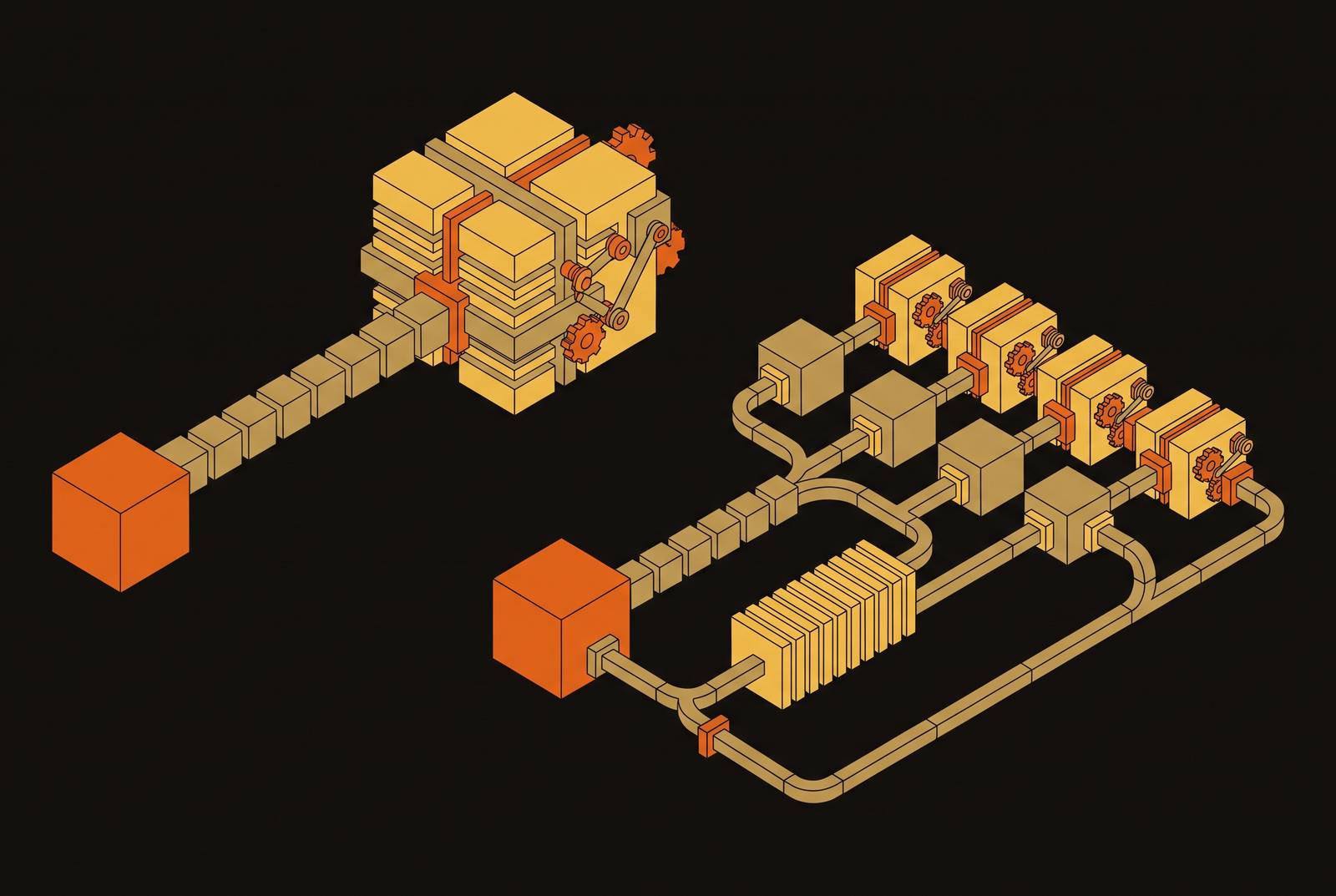
Sending a request to calculate a full data-hall power load requires something to hold that connection open while the math runs. A thread, a socket, and a client waiting on the other end are all tied to how long the computation actually takes, and that is the physical reality every architecture diagram represents. The standard API mental model, request goes in, response comes out, everybody moves on, works fine until the computation itself becomes the bottleneck. At that point the decision to block the calling thread or not stops being a matter of taste and starts being a matter of whether the system stays up under real usage.
This matters most for anyone building or evaluating APIs that sit in front of heavy engineering solvers, spatial layout generators, cable routing engines, power-path validators. None of what follows is a language tutorial. It's a structural decision framework for the specific problem of computation that takes longer than a network round trip is supposed to, and the consequences of getting it wrong compound the moment more than one engineer is using the platform at the same time.
Synchronous and Asynchronous API Patterns at the Thread Level
Start with the plain mechanics, because the vocabulary matters for everything downstream.
In a synchronous call, the client sends a request and the server thread handling it blocks: it does nothing else until the work finishes and the response goes back. That thread is unavailable for any other task during the entire window the computation runs.
Asynchronous works differently at the handoff point. The server validates the request, accepts it, and returns immediately, typically an HTTP 202 Accepted response with a job ID attached, then queues the actual work for a background process. The client isn't left guessing forever, though. There are two ways it finds out the job is done. Polling has the client check back periodically against a status endpoint until the result appears, a pull model. Callbacks, or webhooks, flip that around: the server pushes a notification to a URL the client supplied up front, once processing wraps.
None of this makes synchronous the wrong answer by default. For fast, short-lived operations, an authentication check, an equipment lookup already sitting in memory, pulling a saved rack schedule, synchronous is exactly right. Building queue infrastructure and job-status plumbing around a call that finishes in milliseconds adds overhead with no real payoff. The structural difference that actually matters is this: sync ties the caller's wait time directly to how long the computation takes, and async severs that link completely. Everything else in this piece follows from which side of that line a given workload falls on.
Placement of Engineering Computations on the Latency Spectrum
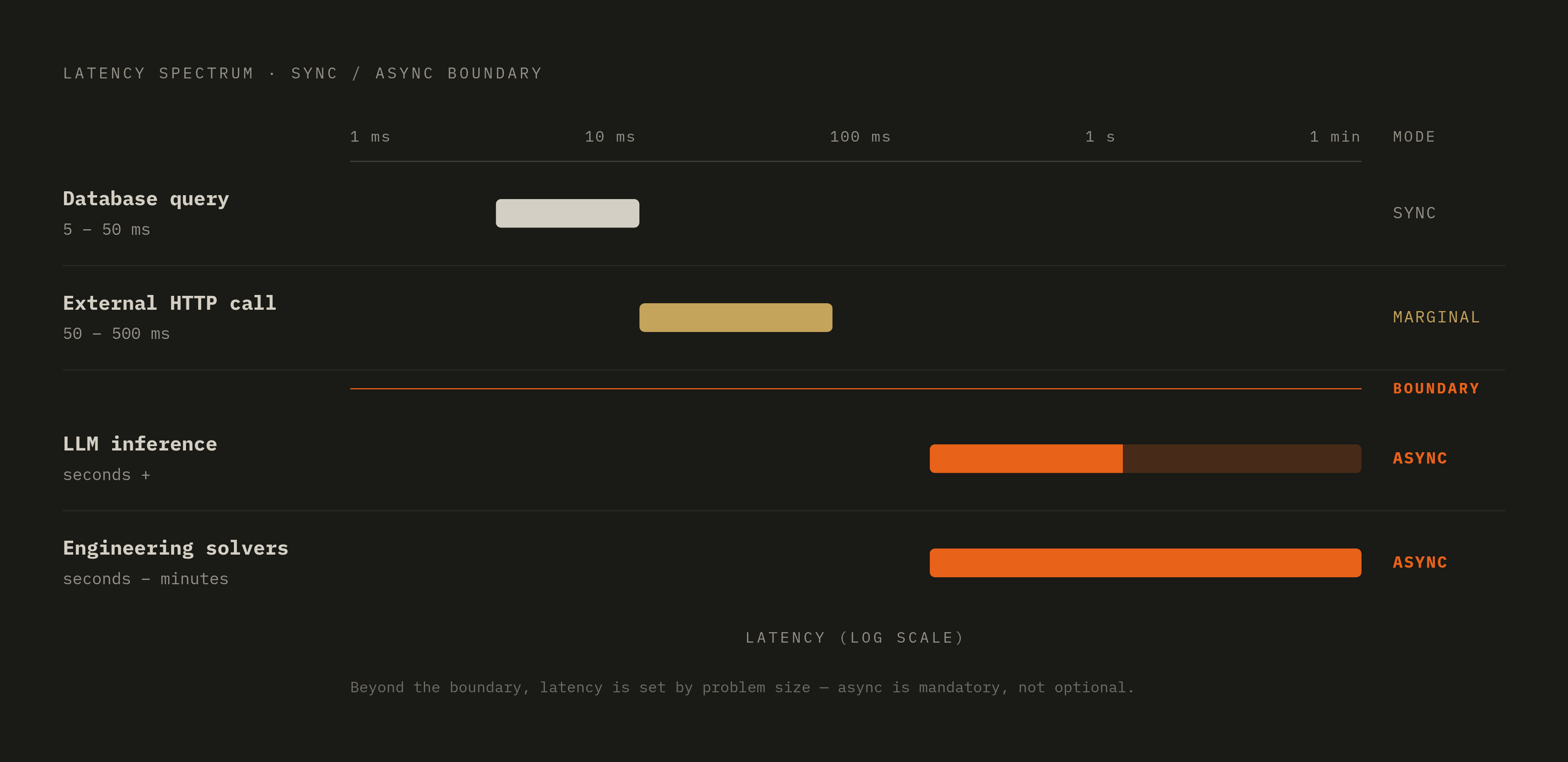
Lining up the tiers makes the picture concrete fast. LLM inference completion is a different animal entirely: highly variable, often stretching to several seconds or beyond, to the point that async isn't a nice-to-have, it's close to mandatory.
Engineering computation solvers live in that same tier, and often past it. LLM inference is many times slower than other I/O operations (engineering computation solvers sit in that same tier: spatial layout generation, cable tray fill analysis, power-path validation, CFD-adjacent cooling checks all operate in the multi-second-to-minutes range).
Running the thread math shows the ceiling appears fast. A server with 10 threads handling AI calls synchronously can only serve as many concurrent requests per second as those 10 threads divide across the seconds each call holds one hostage. This is a scaling problem for current, day-one load, not a hypothetical worry for some distant future load. It's the ceiling a synchronous architecture puts on day-one usage the moment a second person logs in and kicks off a solver run. Database query: 5–50 ms, synchronous is appropriate, thread is not held long. External HTTP API call: 50–500 ms, sync is marginal; async becomes worth considering at volume.
What breaks first when sync is used for heavy engineering computations
The failure doesn't arrive all at once. It appears in stages, and each stage makes the next one worse.
First comes plain degradation. A synchronous request has to finish every dependent step before it can respond, so one slow operation, a big file parse, a call out to a third-party solver, or a heavy graph traversal, drags out latency for every other request stacked up behind it on the same thread pool. Nothing has crashed yet. Everything is just getting slower, and slower compounds.
Then the timeouts start. HTTP connections carry limits, gateways enforce them, clients enforce them, and a long-running synchronous job routinely blows past both. The client gets an error and assumes the request failed. Meanwhile the server may still be grinding through the computation with no way left to deliver the answer once it's done, burning compute for a result nobody will ever see.
From there it cascades. Because the caller and the responder are tightly coupled on the same thread pool, one slow solver run doesn't just hurt itself, it starves capacity from endpoints that have nothing to do with it. A layout generation job chewing through threads can leave a simple rack-schedule read waiting behind it, even though the two have no logical connection. And if the server restarts mid-computation, there's no recovery path at all: the in-flight job just disappears, and the caller has no acknowledgment it was ever accepted in the first place, so it retries from zero.
The number that confirms all of this isn't guesswork. That gap is the compounding effect of every failure mode above, measured. A 2025 microservices benchmark demonstrated the throughput consequence: an asynchronous order-processing system using Kafka 3.3 scaled to handle 10× more transactions per second than its synchronous counterpart with minimal infrastructure changes.
Queue-Backed Async Pattern for the Same Workloads
Fix it in the same order it broke, and the pattern makes sense on its own terms rather than as an abstract best practice.
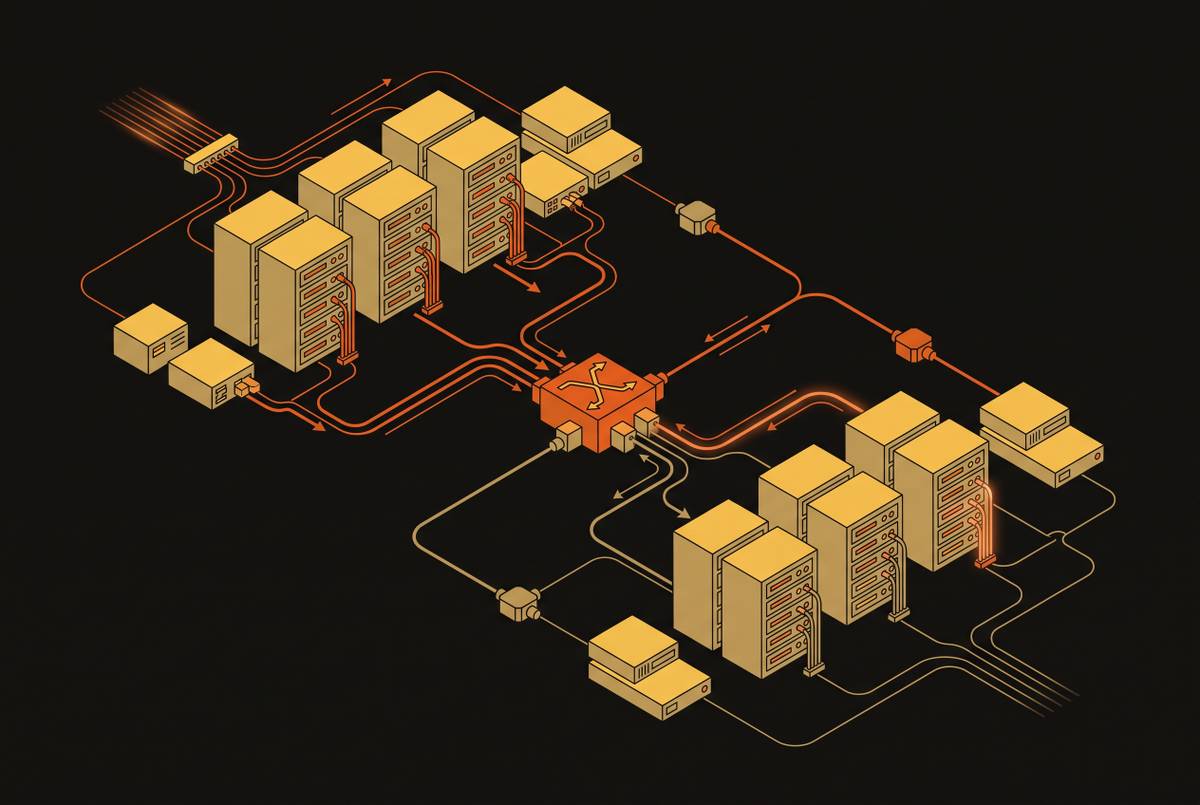
Timeout collapse gets solved at the front door. The API validates the request and returns a 202 Accepted immediately, so there's no timeout risk and the client is never left blocked on a connection. The job itself lands in a durable queue, backed by a message broker like Kafka, Amazon SQS, or RabbitMQ, where it persists independently of whatever process happened to accept it. One or more background workers then pull jobs off that queue at whatever pace they can manage, and the worker pool scales horizontally without touching the API surface at all.
Cascading failure gets solved by isolation, which falls naturally out of separating the accept-and-queue layer from the compute layer. Heavy solver jobs run on their own worker tier, so a long layout generation run has no path to starve threads that are just serving fast reads.
Durability is the piece sync never had an answer for, and queueing closes it directly. If a worker crashes mid-run, the message is still sitting in the queue, untouched. A replacement worker picks it back up, and the caller never even knows there was a hiccup.
None of that works without discipline, though. Queue depth, consumer lag, and dead-letter counts belong on a dashboard as first-class metrics, not an afterthought. A 2025 case study involving a financial services platform running Amazon EventBridge and SNS held up availability through a major outage precisely by queuing critical transactions instead of processing them inline, and that same durability argument carries over to engineering computation queues without much translation needed. Clear job boundaries and unique job IDs returned at accept time.

Applying the pattern to specific data center engineering computations
Take each solver on its own terms, because the reason async is required isn't identical across all of them.
It also has to keep up with hardware. GPU platforms are moving fast, Blackwell GB200 at 400G giving way to GB300 at 800G, with Vera Rubin and Rubin Ultra already mapped out for 2026 and 2027. Layout APIs need to be cheaply re-runnable against new equipment generations as a result. A synchronous architecture that holds a connection open through every one of those re-runs is a liability the moment hardware cadence outpaces it. Async handles it cleanly: submit the new equipment parameters, get a job ID back, retrieve the updated layout once it's ready, no connection sitting open through a 10-minute re-solve.
Power-path and load calculations carry a different kind of weight. Validating A/B power paths from the utility incomer through substation, switchgear, UPS, busbar, and PDU down to the rack means walking the entire electrical graph, and that walk scales with facility size and redundancy topology. At campus-scale sites targeting power envelopes north of 100 megawatts, these jobs are not fast, and running them synchronously would mean blocking the whole platform for every concurrent user, not just the one who kicked off the calculation. The rules governing these checks are deterministic, compliance on clearance, separation, power-path integrity doesn't tolerate approximation, so async here is strictly a transport decision. The correctness lives entirely in the rule engine.
Cable path solving is a constrained graph search: tray fill limits, bend radii, separation rules, service access, all competing for the same routing space. A single rack move can ripple into a full re-solve of every dependent cable path downstream of it. Running that re-solve synchronously blocks every engineer waiting on a status update until it finishes, even if their own work has nothing to do with that particular rack. Queue it instead, and the rack move triggers a background re-solve while engineers keep working, picking up the updated routing whenever it lands.
Cooling coordination checks round out the list, and they're getting heavier as densities climb. Once rack loads push past what air-cooling can handle, liquid cooling integration, direct-to-chip, immersion, adds plumbing routing, CDU flow management, and structural load checks into the same coordination problem. CFD-adjacent thermal checks and coolant distribution validation run multi-second to multi-minute, the same latency tier LLM inference sits in, and they need the same async treatment for exactly the same reason. Turning capacity targets, density requirements (rack power now commonly 15–50 kW, up from 5–8 kW five years ago), phasing, and redundancy constraints into coordinated rack and white-space options is a multi-variable spatial search, fundamentally unbounded in duration.
Sync Endpoints in an Engineering Platform's API Surface
None of this is an argument for putting everything behind a queue. Async machinery, the queue infrastructure, the job ID bookkeeping, the polling or webhook plumbing, carries real overhead, and that overhead isn't justified for anything that completes in database-query time.
Equipment lookups from a structured asset library, spec data already extracted from manufacturer documentation, belong on a sync endpoint. Saved rack schedule reads, pulling layout data that's already been computed and stored, same thing. Authentication checks, session validation, simple parameter checks before a job even gets accepted into a queue, and RFI status reads that retrieve stored decision records rather than recomputing anything, all of it stays synchronous, because forcing async onto a read that takes 10 milliseconds just adds latency and complexity for nothing.
Where a moderately expensive deterministic check can't be avoided but still needs to stay synchronous, caching closes most of the gap. Putting a layer like Redis in front of synchronous endpoints cut latency by 30% in a 2025 benchmark, and memoizing deterministic engineering checks, same equipment footprint, same clearance rule set, same result, applies directly here, skipping recomputation the system has already done once. Sync works for reads and validation; async works for any computation whose runtime is set by problem size rather than by how fast the infrastructure happens to respond.
Async Handling for AI Calls and Deterministic Solver Calls
Treating them identically once they're in the queue is where things start to go wrong.
Running the same input twice can produce a slightly different output, so retry logic has to account for that variance rather than assuming an identical result. The upside is that failure is genuinely recoverable: a failed LLM call can be re-queued with reasonable confidence it'll produce something useful the second time. Latency runs into multiple seconds on average, so async is mandatory, but relative to a complex solver, the job itself is short-lived.
Deterministic engineering solver calls play by a different rulebook. Power-path validation, cable tray fill, clearance rule checks, these have to produce the exact same output from the exact same input, every single time, with zero tolerance for drift. That's not a preference; it's a non-negotiable property tied to compliance and life safety. A crashed worker can pick the identical computation back up from checkpointed state, because there's no ambiguity about what the right answer looks like. None of this can be handed off to probabilistic AI as a shortcut, doing so risks a life-safety violation. Async handles the transport here; the rule engine is what guarantees the answer is right.
That difference has a direct architectural consequence: AI jobs and deterministic solver jobs shouldn't share a worker pool, and they shouldn't share dead-letter handling either. Connected platforms that coordinate layout generation, power and cooling, cable routing, documentation, and operations-ready handoff inside one workflow need that split built into the job dispatch layer from the start, because mixing AI and deterministic work in the same pool undermines the auditability and correctness guarantees the whole system depends on. Both LLM inference calls and deterministic engineering solver calls are long-running and async-appropriate, but their failure modes and retry semantics differ substantially.
What operations-ready
Operations-ready, in this context, means the API surface reflects what each computation actually is, not what's convenient to build first. Fast reads stay synchronous. Heavy solvers queue. AI extraction and deterministic validation run on separate tracks with separate failure handling, because they fail differently and recover differently. Get that structure right and a data center engineering platform can carry concurrent users, re-run layouts against new GPU generations without flinching, and survive a worker crash without losing a job. Get it wrong, and the first sign is a slow response. The second is a timeout. The third is an engineer re-submitting a job that was already running, because nothing ever told them it had been accepted.
Sources
- Async vs Sync Programming (2026): The Complete Guide with AI Inference Examples - Dualite - Build products and websites in minutes
- Synchronous vs Asynchronous Service Communication Patterns: A Comprehensive Comparison · Technical news about AI, coding and all
- Async API Design: Handling Long-Running Operations - DEV Community
- Patterns for Microservices — Sync vs. Async