Rate Limiting and Backpressure in High-Volume Configurator APIs
Four rate-limit dimensions must all be tracked simultaneously to prevent configurator API failures.

A batch job starts hammering a configurator API overnight. If it hits a rate limit partway through a floor-wide layout export, the call returns a partial result, and nobody notices until a rack row that was never placed turns up at a design review the next morning. That is the failure mode this piece is built around, and it happens because high-volume configurator APIs, the kind running layout generators, asset configurators, and BIM automation pipelines, are not uniform in cost. Counting requests per minute, the standard proxy for load on a conventional web API, produces a false picture of what a configurator system is actually doing under pressure.
A conventional REST API can get away with counting requests, because its endpoints all cost roughly the same. Research into AI agent APIs identifies three specific ways that assumption collapses: cost heterogeneity across request types, token variability within a single session, and recursive amplification, where one entry-point call cascades into dozens of downstream operations.
Configurator APIs reproduce all three patterns. A full-floor layout run touches placement, routing, and power distribution all at once, and it can trigger documentation generation behind it.
That difference in cost is compounded by how data center project delivery is organized. That kind of layered, multi-system design is common in the industry, and it means request bursts are not edge cases to plan around later. They are the normal operating condition the rate-limiting design has to assume from day one.
The four rate-limit dimensions that must all be tracked simultaneously
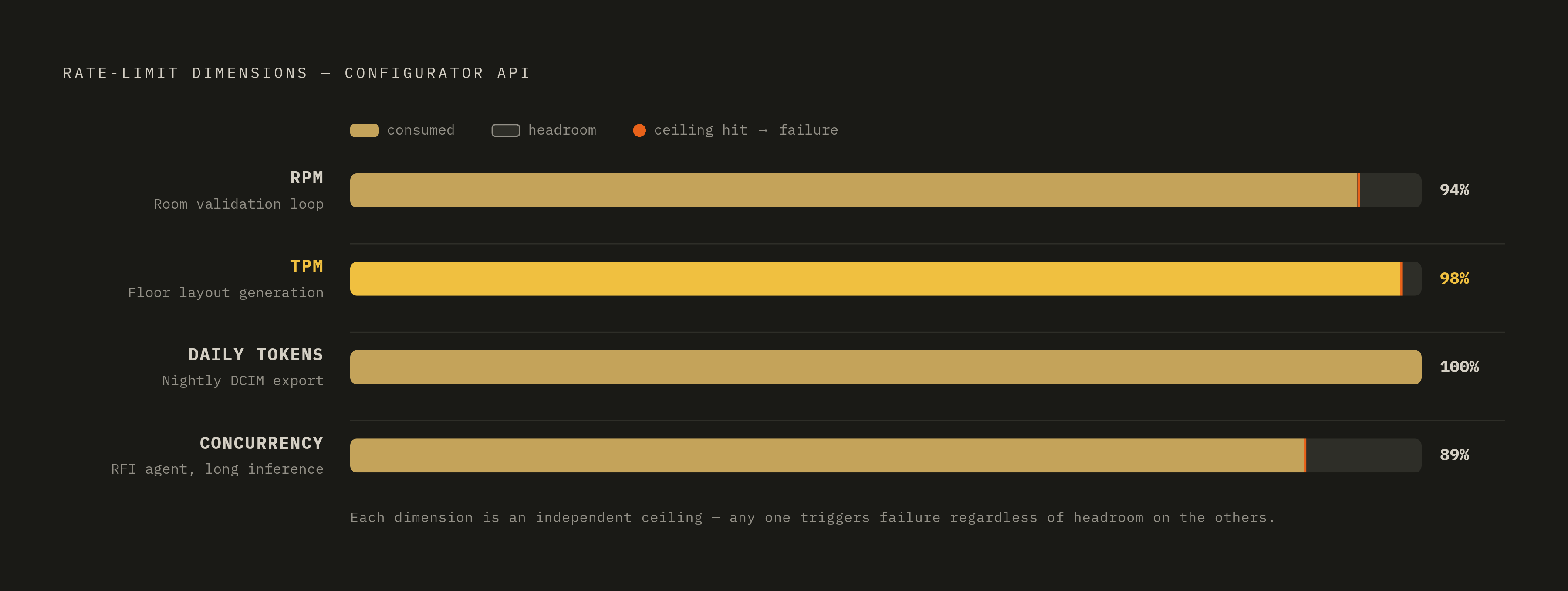
Tracking one rate-limit dimension and ignoring the rest leaves a system exposed exactly where it isn't looking. Hitting the ceiling on any single one of these causes failures, regardless of how much headroom exists on the other three.
- Requests per minute (RPM): a BIM validation script looping over every room in a floor plan can exhaust the request count fast, even though each individual call is cheap on its own. The volume is the problem, not the weight of any one call.
- Tokens per minute (TPM): a full-floor layout generation call runs infrequently but costs enormously when it runs. Its token weight is disproportionate to how often it appears in the request count, so a limiter watching only call frequency will miss it.
- Daily token budget: nightly DCIM handoff exports can burn through a tenant's full daily allocation before the first morning design session even opens. By the time designers log in, the budget is already gone.
- Concurrent requests: RFI-response agents, such as Datagrid's Deep Search Agent, which assembles responses by pulling from connected project files, specs, drawings, prior RFIs, approved submittals, and project records, can hold several long-running inference calls open at the same time. That stalls the concurrency slot even when there's plenty of RPM headroom left unused.
An algorithm has to catch these patterns without failing at its own boundaries. A sliding window counter fixes this: it interpolates between the current and previous window, so you get an O(1) memory cost per tenant without the overhead of maintaining a full sorted set of timestamps. That makes it practical to run per-tenant at scale.
None of these four dimensions should sit on fixed thresholds forever. Zuplo's guide to adaptive rate limiting describes adjusting limits in real time based on server load and response times as standard practice now. Static thresholds can't respond to what the system is experiencing at a given moment, so a configurator platform serving bursty, uneven traffic needs limits that move with real conditions, not numbers set once and left alone.
How to choose and combine algorithms for configurator traffic patterns
No single rate-limiting algorithm fits every part of a configurator pipeline, because the pipeline itself is not one workload. The practical design combines algorithms by what each one is good at, rather than picking a favorite and forcing every endpoint through it.
Token bucket's defining strength is that it allows controlled bursts. Leaky bucket works differently. It drains at a fixed rate no matter how work arrives, which suits downstream systems that have no burst headroom to spare, like a DCIM export API that can only absorb one write at a time regardless of how many requests are queued ahead of it.
Sliding window counter fills the gap between the two, reducing boundary-surge risk at that same O(1) memory cost per tenant, which is what makes it workable for per-tenant fairness enforcement running across many tenants at once.
A concrete pattern for enforcing all four dimensions at the same time looks like this: a semaphore manages concurrency, one token bucket governs RPM, a second token bucket governs TPM, and every incoming request has to clear all three gates before it gets admitted.
Shopify offers the clearest real-world precedent for treating endpoints unequally. Two different APIs, two different enforcement systems, matched to two different cost profiles. So a configurator platform can weight a cable-routing pass differently than an attribute lookup, rather than treating every call as one unit regardless of what it actually does. Envoy Proxy offers a parallel idea at the infrastructure layer: its circuit breaker sets upstream limits through max_connections and max_requests, each defaulting to 1024, giving a concrete example of how a widely used proxy enforces hard ceilings on concurrent load through connection limits.
Token-aware cost weighting for heterogeneous configurator endpoints
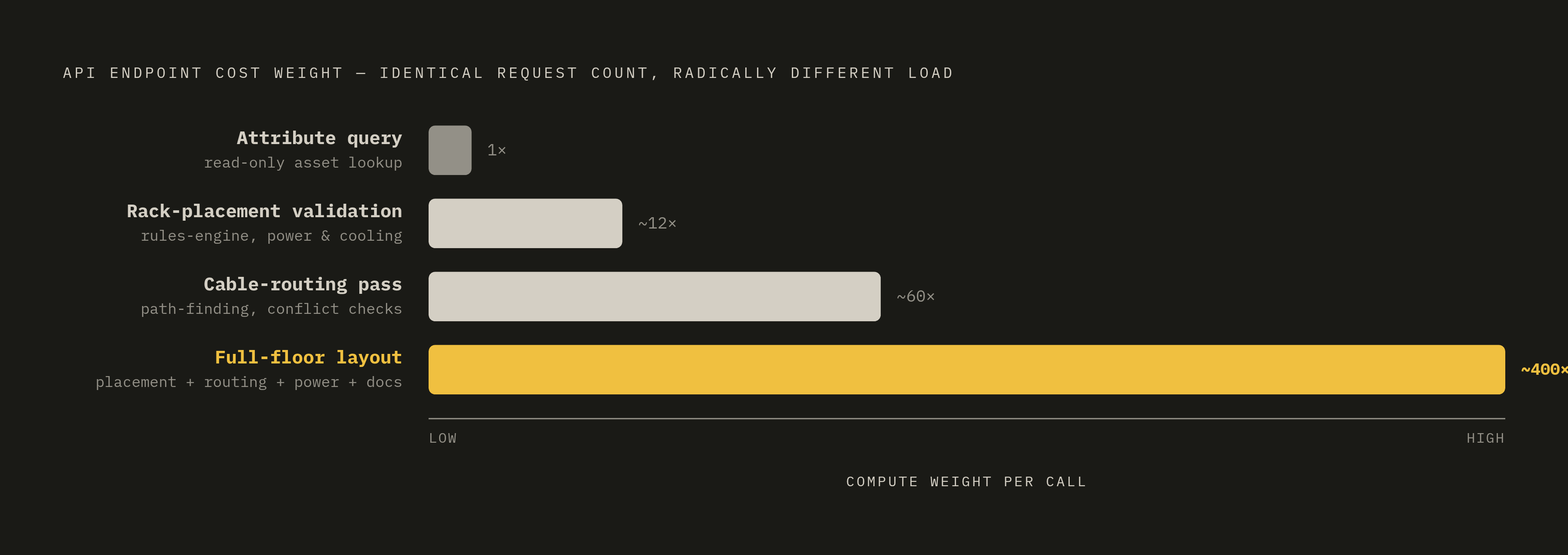
Normalizing every configurator call into a shared compute-unit currency is what turns these multi-dimensional limits from a good idea into something enforceable.
A workable cost hierarchy for a configurator API's endpoint types looks something like this:
- Attribute query (an asset property lookup): the lowest cost weight. It's fast, read-only, and triggers nothing downstream.
- Rack-placement validation: a moderate cost weight, since it runs a rules-engine evaluation against power and cooling constraints before it returns.
- Cable-routing pass: a higher cost weight, because it does path-finding across an entire floor topology and checks for conflicts along the way.
- Full-floor layout generation: the highest cost weight on the list. It orchestrates placement, routing, power distribution, and documentation output all inside one call.
Cost weighting closes that bypass by charging for what a call actually does.
The obvious objection is that cost weights assume you know a call's cost in advance, and generative layout calls don't behave that predictably, their output size varies run to run. To fix this, the system charges an estimated cost at admission time, then applies a correction debit once the call completes. Token buckets already support this pattern naturally: tokens get consumed up front, and any overage gets charged against the next window, letting the current call finish.
One category of traffic should be exempt from this weighting logic. A layout generator chewing through tokens overnight should never be able to delay a cooling constraint check.
Backpressure signaling: how upstream callers learn to slow down before the system collapses
If you just reject excess traffic with a flat rate-limit error, that isn't backpressure. Backpressure is the system actively telling callers how to behave differently, before a queue backs up far enough to take the whole pipeline down with it.
The retry cascade is the failure loop that backpressure exists to break. The operational definition of backpressure that matters here: when a downstream system can't process incoming requests at the rate they're arriving, it signals the upstream system to slow down or pause, keeping the whole chain stable instead of triggering retries that compound the load. Industry analysis puts the effect of implementing backpressure at a 70% reduction in server overload, a substantial gap between a system that signals clearly and one that just drops calls on the floor.
- HTTP 429 with a Retry-After header. This is the minimum viable signal: it tells the caller when to try again, which at least stops an immediate hammer-back against a system that just said no.
- Queue depth signal in response headers. This tells the caller how deep the backlog actually runs, so the client can decide for itself whether to wait or switch to a lighter polling mode.
- gRPC RESOURCE_EXHAUSTED status. This is the idiomatic backpressure signal for streaming configurator calls carried over gRPC.
- Adaptive client throttling. The server tells the client a target request rate to self-enforce, cutting down on round-trips to the gateway that would otherwise just get rejected anyway.
- Token-based admission hints. The server returns remaining budget alongside every response, letting the client pace its next batch of work before it runs into the wall.
Circuit breakers sit alongside these signals as a separate layer of protection. When a downstream DCIM export API is degraded, a circuit breaker opens and configurator calls to it fail fast instead of queuing up and tying down concurrency slots that other traffic needs.
For batch workloads specifically, queue-based backpressure, a controlled worker pool draining a defined queue, is cleaner than managing concurrency ad hoc. Three monitoring signals make this visible in practice: rate-limit hit rate, queue depth, and p95 latency measured as full wall-clock time from request to response, including time spent waiting in queue, not just the inference time once a request starts processing.
Multi-tenant fairness and protecting critical control-plane traffic from batch jobs
You have to make fairness between tenants, and between traffic classes, an explicit design decision. Left alone, it is not something a system arrives at by accident. If there's no explicit policy, whichever caller is loudest or fastest ends up consuming shared capacity at the expense of traffic that matters more, and in data center delivery specifically, that means a batch design job can starve out power and cooling coordination calls that need to run on schedule.
A single global limit, applied the same way to everyone, tends to punish the wrong group. So fairness as a design objective means you build a hierarchy of limits rather than one flat number:
- Organization level: total compute units per minute across every agent and user inside a tenant.
- Agent level: compute units per minute assigned to each autonomous agent individually, whether that's a layout generator, an RFI responder, or a DCIM export job.
- User level: requests per minute for each authenticated user running an interactive design session.
Internal control-plane traffic, power distribution validation, cooling constraint checks, fiber routing coordination, needs to sit in a protected tier with guaranteed throughput, shielded from design-automation batch jobs running on the same API surface. A lightweight attribute-read endpoint has no business sharing a limit policy with a CPU-heavy layout generation call or a full-floor export, because fairness requires you to model what a call actually costs, not just count how many came in.
The strongest objection to any of this adaptive machinery comes from the control-plane side specifically. The fix is to exempt power and cooling control-plane calls from adaptive throttling and place them on deterministic reserved channels with fixed, pre-allocated concurrency slots, so a control command never competes for capacity with a batch job.
ArchiLabs Studio's architecture illustrates why this distinction matters in practice. It connects layouts, power and cooling coordination, cable routing, documentation, RFIs, and operations-ready handoff inside a single workflow, which is exactly the kind of multi-class API surface where fairness policies have to be specified per traffic class. If a platform handles that many traffic types on one surface, it can't treat an RFI query and a cooling constraint check as equivalent competitors for the same pool of capacity.
What to design before the first request hits production
Rate-limiting problems that surface in production almost always trace back to decisions that were never made in design: limit dimensions never specified, cost weights never assigned, backpressure signals never defined before the first client was written. The architecture is won or lost at the design stage, not in the implementation details that come after.
A design sequence that front-loads the decisions with the biggest blast radius:
- Traffic taxonomy. Enumerate every endpoint type, assign each one a compute-unit cost weight, and classify it by traffic class, interactive, batch, or control-plane. This step feeds every decision that follows it.
- Limit specification. For each traffic class, define all four dimensions, RPM, TPM, daily budget, and concurrent slots, before any enforcement code gets written. Missing one dimension is how silent partial results happen.
- Algorithm selection per class. Token bucket suits interactive traffic and bursty batch workloads. Leaky bucket suits downstream APIs that have no burst headroom to give. Sliding window counter suits per-tenant fairness enforcement at low memory cost.
- Backpressure signal contract. Specify which signals the server will emit, Retry-After, queue depth headers, gRPC RESOURCE_EXHAUSTED, adaptive throttle hints, and what each client is required to do on receiving them. Document this as an API contract, not an implementation detail buried in a changelog.
- Fairness policy. Assign hierarchical limits across org, agent, and user levels. Define the protected tier for control-plane traffic. Configure weighted fair queuing for queues that mix priority levels.
- Observability baseline. Instrument rate-limit hit rate, queue depth, and p95 wall-clock latency including queuing delay, before go-live, not after the first incident.
Structured rate limiting produces a side effect that outlasts uptime itself. Every limit event, every queue depth spike, and every circuit break becomes a traceable record of what the system was doing at the moment it degraded. That traceability is the same discipline that makes BIM handoff to DCIM, EPMS, and BMS systems meaningful in the first place: structured data that survives the transition from design into operations. The cost of skipping this design work isn't abstract. Automated layout generation or DCIM handoff blocked by API throttling is a direct schedule risk, and in a domain where facility delays carry real financial consequences, that risk is one a design phase can close off before the first production request ever arrives.