Webhook vs. Polling Architecture for Configurator State Sync
Webhooks detect changes instantly but fail silently; polling always finds the truth, just slowly.
A rack move in a data center design is never just a rack move. If you shift one cabinet three feet, a power budget needs recalculating, a cooling zone assignment needs reviewing, a cable route needs rerouting, and a documentation package needs updating to match. Every one of those downstream systems is modeling the same physical reality from a different vantage point, and none of them automatically knows what the others now believe to be true. That makes the configurator a coordinator across multiple systems of record, not a single application with a user interface preference attached to it.
When one domain updates a value, every other system that depends on that value needs to find out correctly and soon enough to act on it, and two architectural answers exist for how. Polling has the consumer ask repeatedly whether anything changed. Webhooks have the source announce the change the moment it happens. These impose opposite burdens on the system, one on the requester and one on the publisher, and the choice between them is not a stylistic preference. It sets whether a rack move cascades automatically through power, cooling, cable, and documentation, or turns into manual rework across five disconnected tools.
The cost of polling rare events with high stakes
Polling has a built-in latency floor. The gap between when something actually changes and when the system finds out is set entirely by how often it checks. If you check every five seconds, the detection window shrinks, but the system has to burn through a huge number of calls that return nothing new. Checking every five minutes drops the call volume, but now a change can sit undetected for up to five minutes, an eternity when that change feeds a submittal package or a load calculation downstream.
Rate limits interrupt polling cycles constantly in production systems, and when that happens, the gaps in data have to be reconciled by hand. An automation that was supposed to run unattended turns into a recurring maintenance task, because someone has to check whether the last sync actually completed and patch the holes when it didn't.
In a data center configurator, that kind of staleness has consequences a general business application doesn't have to worry about. A cooling zone boundary gets updated, but the update arrives late because the polling interval hasn't caught up to it yet. If that delay outlasts the window before a submittal package gets assembled, the package goes out with a boundary that no longer matches reality. The timing gap generates the exact RFI that BIM coordination exists to prevent.
What webhooks deliver and assume
Webhooks flip the arrangement around. Instead of the consumer asking over and over whether anything changed, the source pushes the update the instant the event happens. The interval-driven latency window disappears, and every call that does arrive carries an actual payload. A webhook fires once per event, so server load scales with how often things actually happen rather than with how often someone checks, and that cuts infrastructure load dramatically in systems where changes are genuinely rare.
That efficiency comes with assumptions baked in, and you don't always see them until they fail. The first is reliable delivery. Webhook delivery is inherently unreliable in practice: the receiving endpoint can be down when the call arrives, a network timeout can exhaust the provider's retry attempts, or a managed platform's endpoint can reject the request outright under heavy load. When any of that happens, the record on the receiving end can sit permanently in a half-updated state with nothing flagging it.
The second assumption is ordering. A webhook that arrives 200 milliseconds after an event sounds fast, but if it delivers an earlier message after a later one has already landed, the resulting state is worse than if the system had simply polled and read the current authoritative value. Ordering guarantees depend entirely on the provider and can't be assumed as a property of webhooks in general.
The third assumption is delivery count. Nearly every webhook provider guarantees delivery at least once, but not exactly once. Without idempotency logic built into the receiver, the same rack-change event can get processed twice, producing a double-update that's often harder to catch than a missed update, because nothing about it looks like a failure on the surface.
Two-path sync architectures for critical facilities
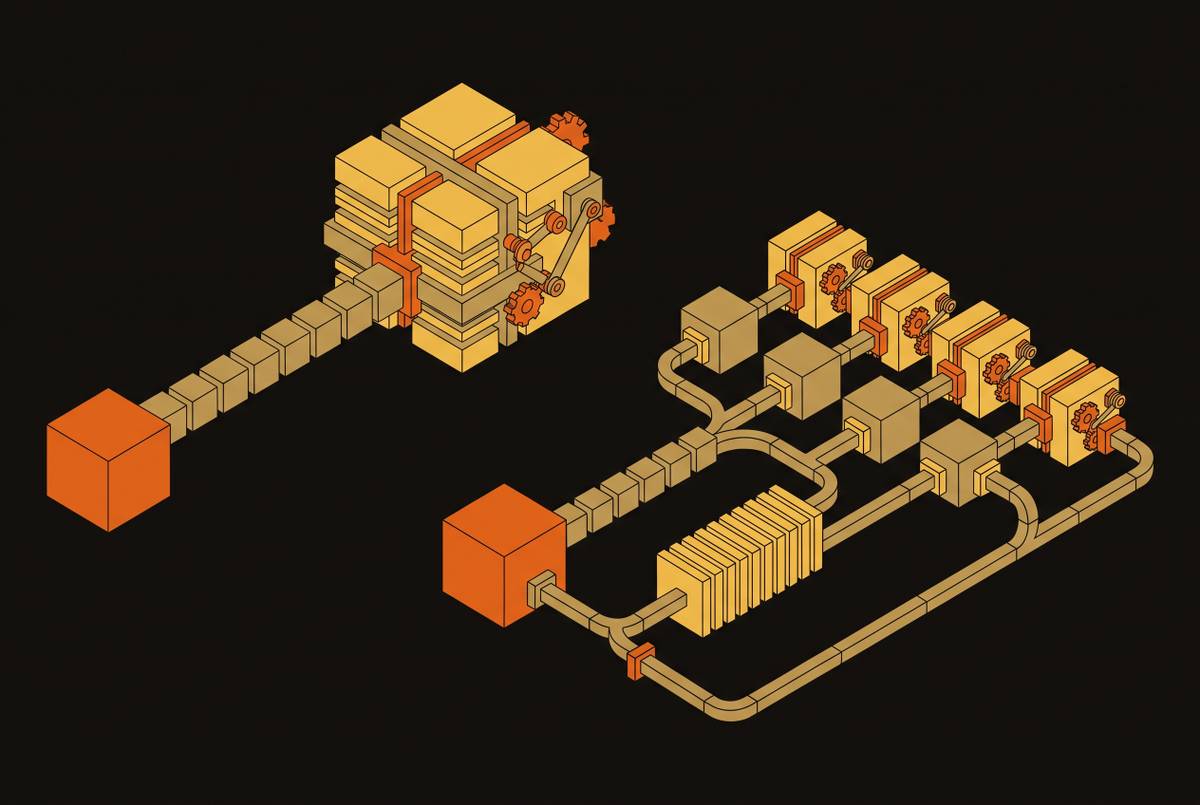
None of this means choosing between webhooks and polling. Production sync architectures for critical facilities run both: a primary real-time webhook path that handles the normal case, and a scheduled polling fallback that checks for records still stuck in a transitional status and queries the provider's API directly to pull the authoritative state when the webhook path has gone quiet.
The two paths have to land on the same correct state no matter which one acts first or whether both act on the same record. That convergence happens through idempotent upsert: a mechanism that writes the same correct result whether the webhook fires, the poll fires, or both fire on the same record in either order. Without that convergence logic, running two paths side by side creates race conditions that are worse than either path running alone. The upsert mechanism has to be designed before either path is built.
This is precisely the problem that data center design automation platforms like Archil Labs are built to address: when a rack move has to propagate correctly to power budgets, cooling assignments, cable routes, and documentation in one workflow, the sync architecture decides whether that cascade happens on its own or turns into manual rework spread across disconnected systems. Queuing the webhook endpoint so it acknowledges fast and processes the event asynchronously keeps the system resilient when a burst of changes hits at once. And the polling interval on the fallback side shouldn't be set to some fixed universal number. It should match the maximum staleness a given domain can tolerate: tight for a UPS alarm that cooling has to respond to in seconds, loose for a documentation package that won't be opened until the next morning review.
DCIM, EPMS, and BMS in the Sync Stack
A single UPS status event illustrates why one sync pattern can't serve every consumer equally. That event has three legitimate destinations, each with a different urgency. The alarm itself belongs on the BMS, because cooling needs to respond to it immediately. The detailed event record belongs on the EPMS, because it tracks power system history. The load figure belongs in DCIM's capacity model, because it cares about aggregate trends rather than the individual alarm. One device produces one event, and that event may need three separate sync paths, each tuned to how fast its consumer actually needs to know.
That layering has a structural rule behind it. DCIM sits above BMS at the facility layer, and it integrates with IT service management at the IT layer, reading from both BMS and EPMS over IP through a defined conduit. DCIM polling field devices directly is an anti-pattern: it recreates the exact fragmented, duplicated sync problem this layered architecture exists to solve, with DCIM reinventing a data path that BMS and EPMS already own.
None of this works without timestamp discipline, and that's a prerequisite the sync architecture itself can't provide. Event logs need accurate timestamps, and field devices feeding telemetry need their clocks synchronized to the same source DCIM uses. When timestamps drift across systems, it gets hard to reconstruct what actually happened after an event, and that can undermine compliance documentation that depends on a clear, ordered sequence of events.
Sync Architecture and BIM Data's Survival in Handoff
BIM data that arrives at turnover incomplete, or disconnected from how operations actually uses it, has failed at the one job BIM is meant to do. The model format, the asset tagging structure, and the data requirements of the operator's CMMS and DCIM need to get defined at project kickoff, not negotiated at handover, because the sync architecture that will eventually receive that data has to be built around those requirements from the start.
Standard BIM workflows make this harder than it needs to be. Data moving between authoring tools, coordination platforms, and document management systems loses information unless the exchange formats between them are actively managed. In a data center configurator, the cost of stale state compounds across domains: a polling-delayed update to a cooling zone that arrives after a submittal package has already been assembled generates the RFI that coordinated BIM handoff was supposed to prevent in the first place, which is why platforms integrating multiple downstream systems need to treat sync architecture as a critical-path decision for operations-ready delivery.
The handoff to operations is where the webhook-versus-polling decision turns into a BIM decision whether anyone intends it to or not. If the operational BIM arrives as a static export, a frozen snapshot handed over at the end of the project, the event-driven sync architecture waiting on the operations side has nothing live to consume. It needs a structured, live-linked dataset, not an archive. A connected design workflow has to answer that fragmentation honestly rather than paper over it with a cleaner-looking export.
AI and Deterministic Rules in the Sync Architecture
Deterministic rules and AI reasoning do different jobs in a critical-facility sync architecture, and conflating them is a mistake with real consequences. Rules belong wherever precision and compliance aren't negotiable. A shed command that has to arrive before a load threshold gets crossed is not a decision to hand off to a model weighing tradeoffs in real time. AI belongs where context synthesis and adaptability pay off, like capacity planning across mixed-density workloads, where the right answer depends on balancing many shifting variables.
Auditability is the sharpest objection practitioners raise against letting AI drive automation in critical facilities. Every design decision, every RFI answer, every equipment parameter has to trace back to the information that justifies it. A deterministic rule produces that trail by construction. An AI inference doesn't, unless the system has been explicitly built to preserve the reasoning behind it.
Both of these depend on the same foundation underneath them: event-driven sync. A deterministic shed rule firing off a UPS alarm event and an AI capacity model updating when a rack's power budget changes both need the triggering event to arrive fast and in the right order. Polling intervals open a window where a rule fires too late to matter or a model updates against data that's already gone stale. The two-path hybrid pattern mirrors that same principle: deterministic rules and structured data handoff where precision can't be compromised, paired with fallback logic that catches and corrects state inconsistencies before they spread downstream to DCIM, EPMS, or BMS.
Choosing the right sync pattern for a given integration point in a data center project
You don't choose the sync pattern for a project once and apply it everywhere. Each integration boundary, configurator to DCIM, BMS to EPMS, layout tool to documentation system, design model to operations handoff, carries its own latency requirement, its own tolerance for failure, and its own constraints based on what the source system can actually support, and the pattern chosen at each boundary should reflect those specifics.
Webhooks should be the primary path wherever the source system supports them and wherever a polling interval's latency window would produce a consequence the team can't accept, UPS alarms, rack power budget changes, cooling zone boundary updates, and anything that gates a downstream shed command or a compliance action all fall into that category. Polling still belongs in the architecture everywhere, as the fallback that recovers events the webhook path missed, and its interval should be read as the maximum staleness the system is willing to tolerate.
Idempotent upsert needs to be treated as a baseline requirement rather than a later optimization, since both paths have to converge on the same correct state regardless of which one executes first, and that convergence mechanism needs to be designed before either path gets built. Legacy OT environments are the honest exception to all of this: plenty of DCIM, BMS, and EPMS platforms expose only read APIs with no webhook support at all, and in those cases polling remains the only viable primary path. The design should state that latency constraint outright, not pretend it has been engineered away.
Sources
- Webhooks vs. polling · Logto blog
- Two-Path Status Verification for Outbound Enterprise Messaging Pipelines: Webhook and Scheduled Polling Fallback Architecture
- ArchiLabs | Your AI Teammate for Revit, AutoCAD & More
- Webhook vs Polling: When Each Makes Sense
- Architecture for data center infrastructure monitoring
- DCIM FAQ