Manufacturer Submittal Ingestion as a CPQ Rule-Population Event
AI extracts equipment specs into rule engines when manufacturers' designs gain approval.
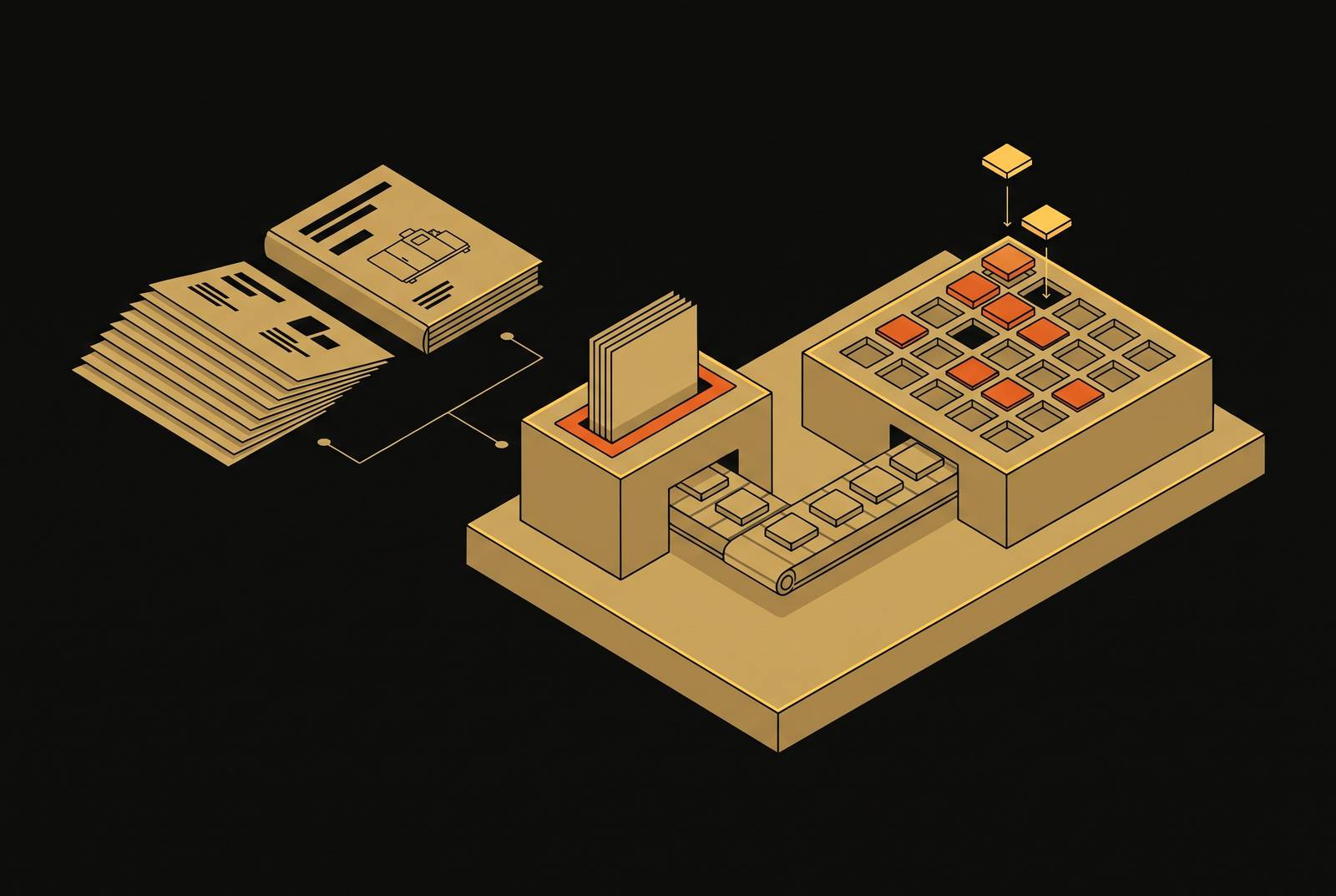
Automated spec extraction from manufacturer PDFs should feed data center design models through an approval-triggered workflow. AI extracts equipment parameters into structured records, and deterministic rules use the approved values to enforce power, cooling, space, and pricing constraints. Manufacturer submittal ingestion should therefore be a CPQ rule-population event that eliminates the need for engineers to retype the same data.
Why data center CPQ is structurally different from catalog-based quoting
A data center quote commits to a design. Rack layouts, power topology, cooling capacity, redundancy paths, and cabling routes must resolve before the price can be accurate. Configure-price-quote software, or CPQ, cannot do that work just by choosing part numbers that work together. A product can be valid in a catalog and still be wrong for the space, electrical system, or cooling arrangement in which it will operate.
That distinction becomes sharper with high-density AI clusters. A static configurator cannot resolve all the conditional rules and spatial constraints involved, while a model-based CPQ system generates a design model as part of the quote. The model must account for how equipment fits and works together, rather than merely whether it can be ordered together.
The constraints are also changing beneath the configuration process. AI workloads tie power availability, cooling technology, grid interconnection, and GPU supply-chain readiness into a single system-level bottleneck. Design loads above 100–200 kW per rack are being requested more often, and each new generation of equipment that is qualified for use can change what counts as a valid configuration. Rule accuracy is an engineering concern. If the rule set must remain accurate and current, where do its inputs come from, and how do they stay updated?
What a manufacturer submittal actually contains and why that data is structurally identical to CPQ rule inputs
When a UPS, switchgear lineup, or CDU reaches approval, its documentation supplies electrical ratings, dimensional footprint, clearance requirements, heat-rejection figures, and weight. Those are not merely facts to file for compliance. A design-automation engine uses these values to check configuration validity. Other attributes, including operating temperatures, enclosure ratings, and electrical certifications, further constrain the equipment’s use.
For a UPS, the mapping is direct. Its footprint and required clearance envelope constrain placement in the layout, while its electrical rating sets the maximum permitted circuit loading. For a CDU, its footprint and clearance requirements constrain where it can fit, while its heat-rejection capacity feeds the cooling-capacity rule. The document supplies the equipment-specific values against which the engineering rule operates, turning a general constraint into a check against the selected equipment.
This connection is especially important when capacity planning asks both how much high-density compute a facility can support and how much space it needs. Layout, power, and cooling must resolve together. In a critical facility, power or cooling equipment cannot be released for fabrication until its submittal clears approval. Within the RFI–submittal–change order process, that approval establishes the authoritative equipment parameters at the procurement decision. That approval can also set which values the downstream configuration rules should use.
How the two workflows are currently disconnected and what that costs in practice
Approving a submittal and updating the configuration are often separate tasks. Submittal software, BIM models, DCIM, EPMS, and BMS hold overlapping product data, but a change in one does not automatically propagate to the others in the disconnected workflow. An approved document can therefore be current while the design model is not. The gap is structural. It exists because approval closes one task without necessarily opening or completing the corresponding data update.
A UPS substitution exposes the failure clearly. The revised submittal can approve a different model while the CPQ rule set still has the old footprint or electrical profile. Downstream quotes and layouts then pass checks against stale parameters, even though those checks no longer describe the approved equipment. No one needs to make an obvious calculation error. Each tool can work correctly with its own data even when the results do not agree.
Teams iterate layouts in Revit, check power and cooling in Excel spreadsheets, then return to CAD to make adjustments. Each time the equipment changes, teams must move the changes between those tools again. Tacton’s 2026 State of Manufacturing found that only a small fraction of manufacturers define configuration rules once and reuse them everywhere. The same report found that the critical margin erosion rate was nearly double for manufacturers whose teams work from separate data compared with those that use a shared system.
The cost also reaches beyond the quote. Under fast-track schedules, fragmented asset information reaches operations at handover, leaving teams to reconstruct data during startup. Teams have to type in data that was already in a manufacturer document.
Why CPQ rule-model maintenance is the underestimated problem that submittal ingestion directly solves
Faster quoting is visible. Rule maintenance is less so. Yet the configuration engine can check the design only as long as its constraints match the equipment approved for use. When a product changes, someone must translate that change into every affected rule model. If systems do not share those inputs, someone has to carry the same engineering decision into each system by hand.
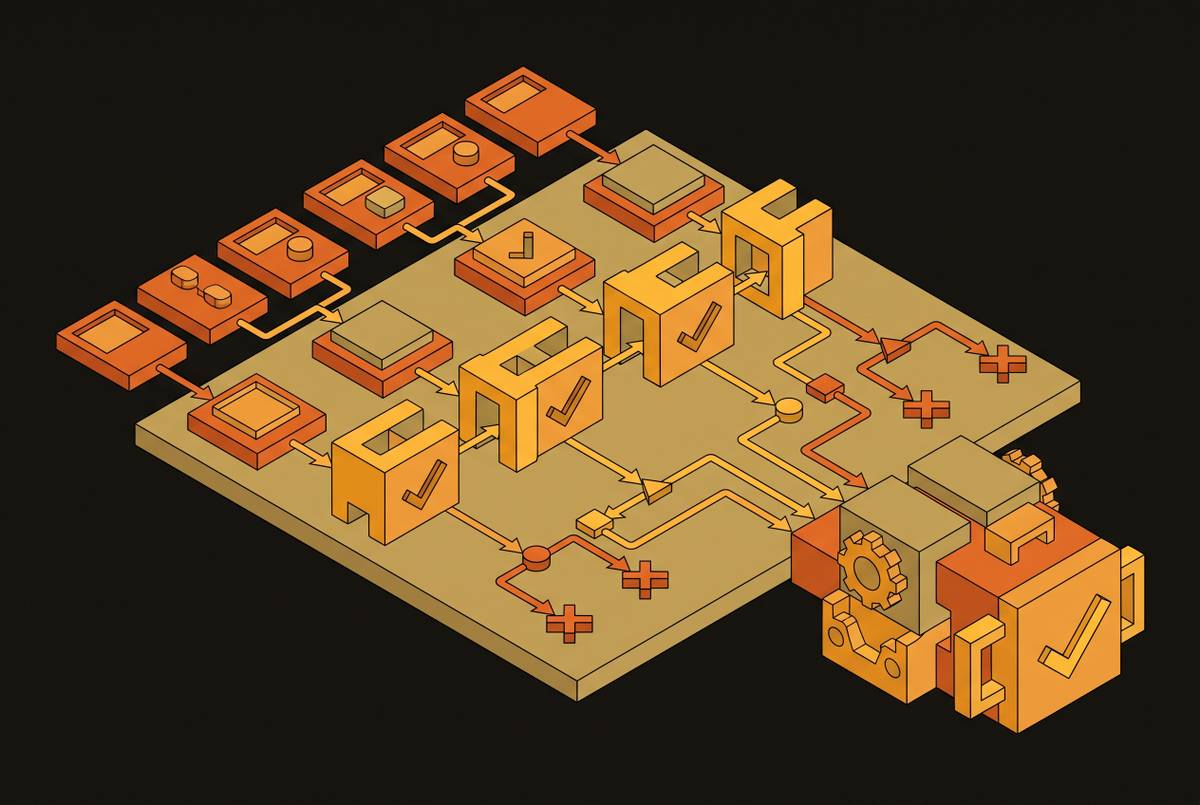
Equipment changes trigger manual updates when they could trigger data propagation. In the connected workflow, approval of the manufacturer submittal becomes the authoritative event that populates the rule model. Engineers no longer have to start a separate transcription task to make an approved rating available to the engine. The approval decision and the update of its downstream inputs become one connected process.
Manufacturing CPQ already provides a useful comparison. Structured product data feeds enforced constraints, and a configured order can seed a production bill of materials. A verified submittal that has electrical, mechanical, and dimensional specifications can do much the same for data center configuration. An ingestion pathway is missing between the approved document and the rules that depend on it.
Approval is the dividing line between provisional equipment data and confirmed inputs. That distinction turns maintenance into a controlled update event rather than an automatic response to any newly received PDF. Those values must move out of the document and into the rule engine without letting uncertainty in document parsing become uncertainty in engineering enforcement.
How do equipment specs get from manufacturer PDFs into design models without manual rekeying?
At the extraction layer, a language model parses the manufacturer’s PDF, identifies fields such as electrical ratings, dimensions, and heat-rejection figures, and normalizes them into a structured record. This replaces the reading-and-retyping step while preserving the engineering approval decision. The source document may be unstructured, but the record sent downstream must give the rule engine equipment parameters it can use.
Receipt of a submittal is too early because its values remain provisional. In the proposed workflow, the approval event makes the approved values available to the design model and its configuration rules. A footprint can then constrain layout generation, and an electrical rating can constrain loading. The status of the equipment decision triggers the update.
Deterministic rules take over at that boundary. Once the confirmed electrical profile is loaded, the circuit-loading constraint must enforce the rating reliably, without a probabilistic judgment about whether an exception seems reasonable. AI is useful for interpreting variable document formats. It is not a substitute for auditable enforcement of safety-critical limits, and an LLM-generated configuration cannot provide that assurance by itself.
The workflow must also reflect a reopened decision. If an RFI reopens the submittal, the connected process marks downstream rules as pending rather than leaving them silently tied to an approval that is no longer settled. That distinction is consequential when procurement lead times are measured in months. This keeps the configuration state in step with the approval state, so design and procurement work from the same assumptions.
What changes downstream when rule population is connected to the approval event
An approved equipment substitution should update more than an asset record. Its parameters should cascade through power-loading rules, cooling-capacity constraints, cable requirements, clearance checks, and the pricing model. A rack move changes a different part of the configuration, but it likewise needs to reach the rules affected by its new position. This removes the separate task of finding and re-entering each affected value.
For the design team, that changes the daily loop. Instead of copying a rating into a spreadsheet, changing a footprint in CAD, and separately reconciling the quote, the team works from a model whose rules use the approved equipment data. Layout generation can then test footprint, clearance, and power-density constraints together. The resulting layout is valid against those inputs, rather than awaiting a later comparison with a disconnected submittal. Errors caused by that particular mismatch need not survive until commissioning.
ArchiLabs Studio Mode takes this model-based approach. It connects layout generation, capacity planning, and pricing within a single workflow that uses engineering rules. That is the relevant comparison with disconnected CAD-and-spreadsheet iteration. A shared live rule set allows the design model and commercial model to respond to the same equipment parameters.
Connecting updates to approval also gives changes a clear origin. In this workflow, each rule update is timestamped to an approval event, and each rule state links to the submittal that authorized it. A change order arising from a revision then has a data trail that eliminates the need to reconstruct a paper trail later. Those same structured equipment records can remain available at turnover, extending the benefit beyond design and pricing into operations.
Why structured handoff to DCIM, EPMS, and BMS depends on getting the ingestion right upstream
If manufacturer parameters remain trapped in PDFs while the BIM model contains incomplete or provisional attributes, a downstream export inherits those gaps. Moving the handover date or changing the export format does not supply the missing equipment values.
COBie provides a structured exchange format for moving assets, spaces, warranties, and maintenance schedules from design into CMMS and DCIM. It does not repair incomplete source records. A COBie export can transfer confirmed asset parameters only if those parameters were formally ingested upstream. Otherwise, operations gets design-intent placeholders or gaps that someone must check against the source documents.
The same dependency applies to DCIM, EPMS, and BMS. These systems need equipment data in a usable structure. Open, vendor-neutral standards support that exchange, but fragmented workflows and incompatible schemas still obstruct it. Structuring the data at approval establishes the source record from which the handoff can proceed without re-entry. It removes the need to rediscover the manufacturer’s parameters at each boundary.
ArchiLabs’ position of connecting submittals, design rules, and operations handoff within a single workflow fits this lifecycle requirement. The design-to-quote model is useful beyond delivery only when its equipment records remain usable by the teams that operate the facility. Approval is therefore the point at which document control can become a lasting data asset. Teams that treat it only as a document-management event will keep reconstructing equipment data at every handoff. Teams that treat it as a structured data-population event can pass those approved values forward without re-entry.