Training Data Scarcity for AI in Niche Engineering Domains
Proprietary engineering records and fragmented workflows block AI training in critical facilities.

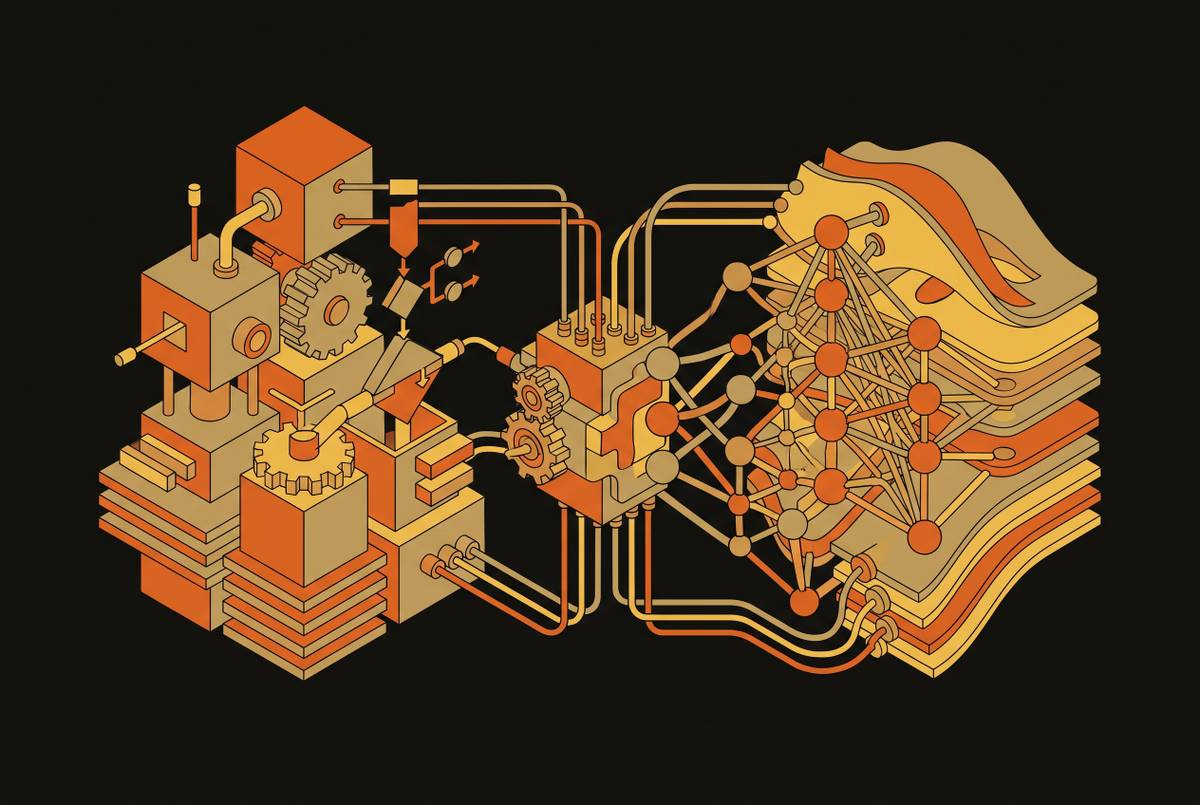
Training data scarcity for AI in niche engineering domains is not a shortage that more web crawling will fix. In data center engineering, the missing material is a connected record of what was designed, built, changed, and proven in the field. That distinction sets the boundary for automation. AI can help read documents and make sense of patterns, but deterministic rules must do safety-critical work when there is no reliable training data.
Why training data scarcity is structural in critical-facility engineering, not a temporary gap
Supply-lag scarcity means there are not enough usable examples yet. More collection and labeling can help close that gap. Structural scarcity is different because the work itself does not produce examples in a form that models can learn from. Critical-facility engineering has this second problem. Its most valuable artifacts are proprietary, non-standard, and often absent from any machine-consumable record.
The missing training material includes clash-free BIM models, as-built cable schedules, EPMS point lists, commissioning scripts, and RFI logs cross-referenced to design decisions. These artifacts barely exist in interoperable formats, even when individual documents are available. Much of the judgment behind them stays with experienced engineers who know which cable tray routes clash and why. A marked-up PDF may show a correction without recording why it was made as structured data.
How the physical demands of critical facilities guarantee sparse, non-interoperable data
The problem begins with the physical systems. High power density means cable trays, cooling circuits, and fiber pathways must be planned closely together. To become useful training material, those relationships must be captured as structured data rather than left as geometry or separate calculations. Yet critical calculations and validations routinely happen outside BIM tools. Load calculations, cost estimates, and compliance checks sit in spreadsheets that are not linked to the model they help justify.
MEP systems account for 60–70% of total project cost, and electrical coordination is where clashes are most frequent and most expensive. Even teams nominally sharing a model can work from different assumptions. An architect may adjust a layout while the MEP team still uses older dimensions, allowing misalignment to build into rework across multiple systems. The resulting record contains fragments of the design without a consistent account of how its parts fit together.
That distinction matters for learning. A model needs more than an example of a cable route to learn from a successful coordination decision. It also needs the constraints and relationships that made that route acceptable. When those are scattered across incompatible formats, the training-data gap already exists before construction begins.
Why the DCIM, EPMS, and BMS integration layer is where training data disappears
The break between design and operations makes that early fragmentation worse. BMS monitors and controls mechanical and environmental plant, while EPMS monitors the electrical path from utility incomer to rack. DCIM manages IT assets, rack space, power capacity, and network connectivity, consuming data from the other two systems. Their integration should connect the physical facility to its operational record. Instead, different schemas mean the handoffs are almost always bridged manually.
The same problem extends to thermal optimization platforms and ITSM integrations for change and incident workflows. Each system holds part of the picture, but their connections do not automatically create a reusable engineering record. At turnover, DCIM and BMS systems are frequently populated from scratch using paper submittals and manual field surveys. This means doing the documentation work again without keeping a machine-readable path from what was designed to how the facility runs. The operational knowledge is separated from the decisions that produced the facility.
Leading owners are beginning to address this through capital orchestration, maintaining a digital thread from the first RFI through Day 2 operations. But that practice is far from standard. Without it, each new project reproduces the same break at the point where design data should become operational knowledge.
How RFI and submittal fragmentation destroys the project record before it can become training data
Turnover exposes the break, but construction workflows actively create it. RFIs and submittals are the closest thing these projects have to a structured decision log. For these records to be useful, questions, answers, approvals, and the changes they lead to must stay linked. When those records move between disconnected platforms, the connection weakens.
Consider an owner-developer whose GC uses Procore for submittals, RFIs, daily reports, and change management. A key mechanical subcontractor manages its work in a separate platform. Without a connection, someone manually re-keys data whenever information moves between them, creating divergent records.
A single facility can involve thousands of submittals for equipment including generators, switchgear, UPS systems, CRAHs, and PDUs. Long lead times and multiple approval tiers make those records important to project control. Meanwhile, the judgment about which RFIs threaten schedule, cost, or turnover often remains in someone's head. By turnover, PDFs, email threads, and platform exports are too scattered to give a clear account of why decisions were made. The project has produced documentation, but not a reliable training corpus.
Why the AI workload surge is widening the gap faster than the industry can close it
Construction growth compounds this loss because more projects do not necessarily produce more usable examples. JLL's 2026 Global Data Center Outlook projects global data center capacity to nearly double to 200 GW by 2030, driven by hyperscale demand and AI workload growth. That pace demands documentation and automation practices the industry does not yet have. If delivery stays fragmented, additional facilities multiply disconnected records.
U.S. data center construction starts have surged in 2026, and average project costs have risen sharply from the year before. The projects where reliable training data would be most valuable are becoming more expensive to get wrong. At the same time, AI workloads impose unpredictable demand profiles on compute, storage, power, and cooling. Historical operational data may not generalize to these facilities, compounding the shortage of examples with a shortage of relevant ones.
The shortage of skilled engineers adds another constraint. The practitioners carrying implicit engineering knowledge are not producing structured records at the pace the industry needs. Construction demand is therefore stretching both the people who hold the knowledge and the systems meant to preserve it.
What the research community has tried as workarounds, and where each falls short in engineering contexts
Transfer learning, few-shot learning, and synthetic data can help when there is little data to work with. They do not, however, remove the need for a real-world foundation. Transfer learning depends on the source and target domains sharing enough structure for learned patterns to carry across. That works reasonably well for language tasks. It works poorly as a substitute for knowledge of a specific campus's cable routing, cooling architecture, and power distribution.
Few-shot learning also needs examples to start with and cannot supply engineering facts that are missing. Synthetic data can augment known distributions, but it cannot stand in for field-verified, clash-resolved, as-built records. A synthetic cable schedule is not equivalent to one walked, verified, and corrected against physical reality. Simulation faces the same boundary when its output is offered as a substitute for field-validated ground truth. More generated examples do not establish that the underlying representation matches the site.
These limits do not make the techniques useless. General language models can help parse equipment submittals, extract specifications, and classify RFI urgency without learning the physical topology of a campus. The boundary appears when a task requires dependable reasoning about physical consequences. Thermal runaway, cascading UPS failure, and clash detection cannot be handed to transferred or synthetic representations without field-validated ground truth.
Where AI genuinely helps in critical-facility delivery despite the data gap
Document processing is useful territory because the information often exists but is trapped in the wrong form. Manufacturer PDFs and equipment submittals hold specifications, weights, clearance requirements, and electrical parameters. AI can extract those parameters into models, schedules, and validation rules without a domain-specific training corpus. Here, the task is limited to reading and organizing supplied information.
RFI triage offers another bounded use. Classifying which questions threaten schedule, cost, or turnover draws on patterns in text and metadata. AI assistance can reduce the cognitive load on project managers without taking responsibility for the engineering answer. The distinction is between helping people direct attention and establishing a physical fact. Probabilistic judgment has room to help when failure is recoverable.
Operations can also provide the feedback that one-time design tasks lack. Cooling optimization can draw on continuous chiller, CRAH, and rack thermal data from a specific facility. That feedback allows a model to develop a site-specific representation that grows more accurate over time. The case for AI is strongest where the task is linguistic, feedback is available, or uncertainty is acceptable. None of those conditions gives it a general license to make safety-critical decisions.
Why deterministic, rules-based automation must carry the load where AI cannot train reliably
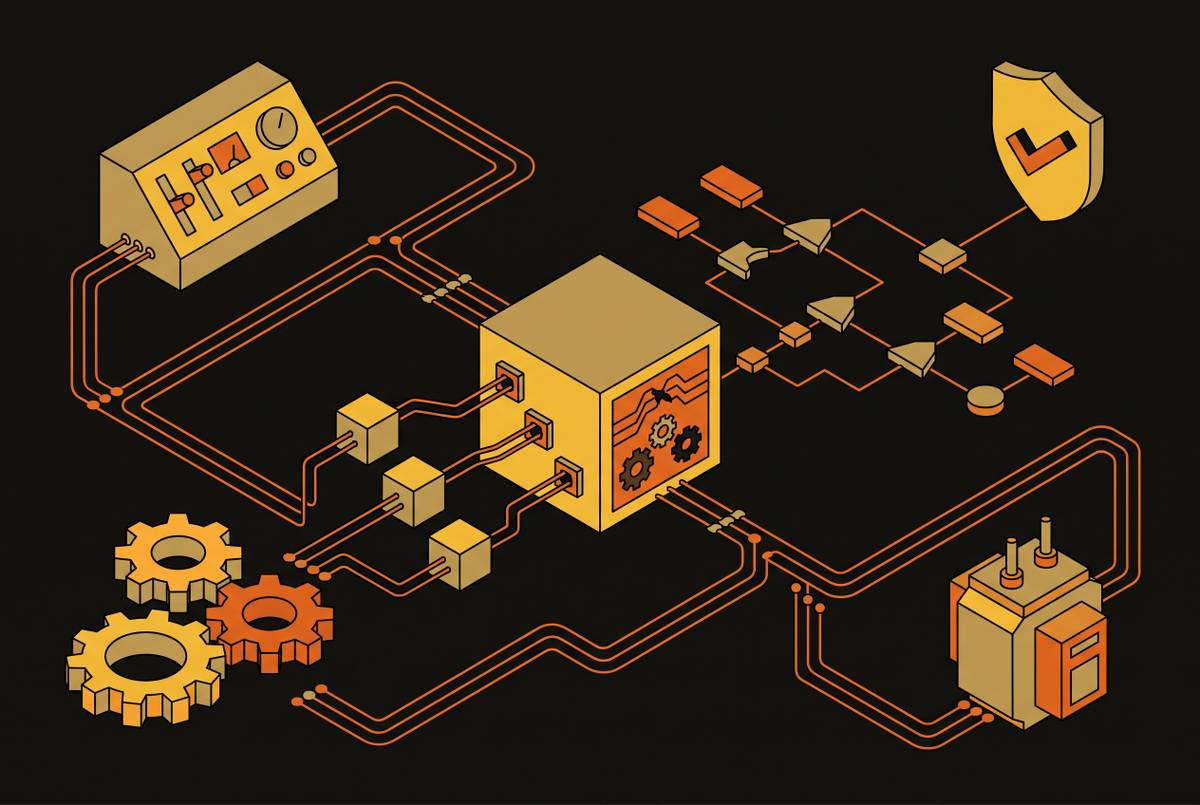
A learned model infers from examples, while a deterministic rule encodes a known constraint. Trusting the model requires enough reliable evidence that its learned behavior applies to the physical system at hand. Most facilities do not have the rich, fault-annotated training sets needed to be sure of that. Rules are therefore not a primitive fallback but the appropriate tool for requirements that are already known.
A rack must not draw more power than its circuit is rated for. A cable tray must not pass through a clearance zone. A cooling unit's airflow must not reverse without triggering an alarm. These are specifications. Their validity does not depend on assembling a large training corpus.
The distinction becomes concrete when a rack moves. Its power circuit, cooling allocation, cable routing, asset record, and documentation must all update consistently. A rules engine can cascade that change automatically and verifiably. An AI system trained on sparse, non-standard project records cannot guarantee the same consistency. An audit based on a rule's logic chain also differs from one based on a probabilistic model's reasoning.
Unpredictable AI demand makes this distinction more consequential. Forecasting plus manual curtailment creates tail risks of overload and cascading failures at gigawatt-class AI campuses. Physical safety must rest on explicit engineering constraints.
What a connected project workflow does to close the data gap over time
A durable answer must change how projects produce data. The blind handover at turnover follows from treating documentation as a separate workstream. A connected workflow instead holds layouts, critical-systems engineering, cable routing, documentation, RFI responses, and equipment parameters together. Changes can then cascade through the connected record rather than requiring separate updates to disconnected files. Structured data becomes an output of delivery.
Putting extracted parameters into models, schedules, and validation rules makes a submittal part of the structured record and connects it to the rest of the project. Keeping RFI responses connected to design decisions preserves the reason for a change as well as its result. Rules-based automation keeps the links in place, while AI helps get information out of unstructured sources.
Structured handoff to DCIM, EPMS, and BMS then becomes the point where the design record joins operations. Operational data can be continuously validated against physical reality and connected back to the facility's design history. That addresses the fragmentation that prevents reuse even within projects and organizations. Connected delivery is how the field builds the reliable training corpus it currently lacks.
Sources
- The Future of Artificial Intelligence in the Face of Data Scarcity - ScienceDirect
- Towards Addressing Training Data Scarcity Challenge in Emerging Radio Access Networks: A Survey and Framework
- Memory Scarcity, Open Models, and the Restructuring of the AI Industry, 2026-2030 -- A quantitative scenario analysis of inference economics, training-cost divergence, and infrastructure solvency
- AI Data Centers Face Skilled Worker Shortage - IEEE Spectrum
- Why AI’s next phase will likely demand more computational power, not less