IFC Schema Limitations for Critical-Systems Data in Data Center BIM
IFC lacks native objects for data center power, cooling, and cabling critical to operations handoff.

DCIM-ready BIM handoff from design models to operations requires shared asset identifiers, explicit schema alignment, and structured power, cooling, and connectivity data that does not depend on IFC alone. IFC’s building-first schema lacks the native objects and consistent meanings needed for critical systems. Teams therefore need to plan for operations during design instead of trying to fix an IFC export after commissioning.
Why IFC was built for buildings, not data halls
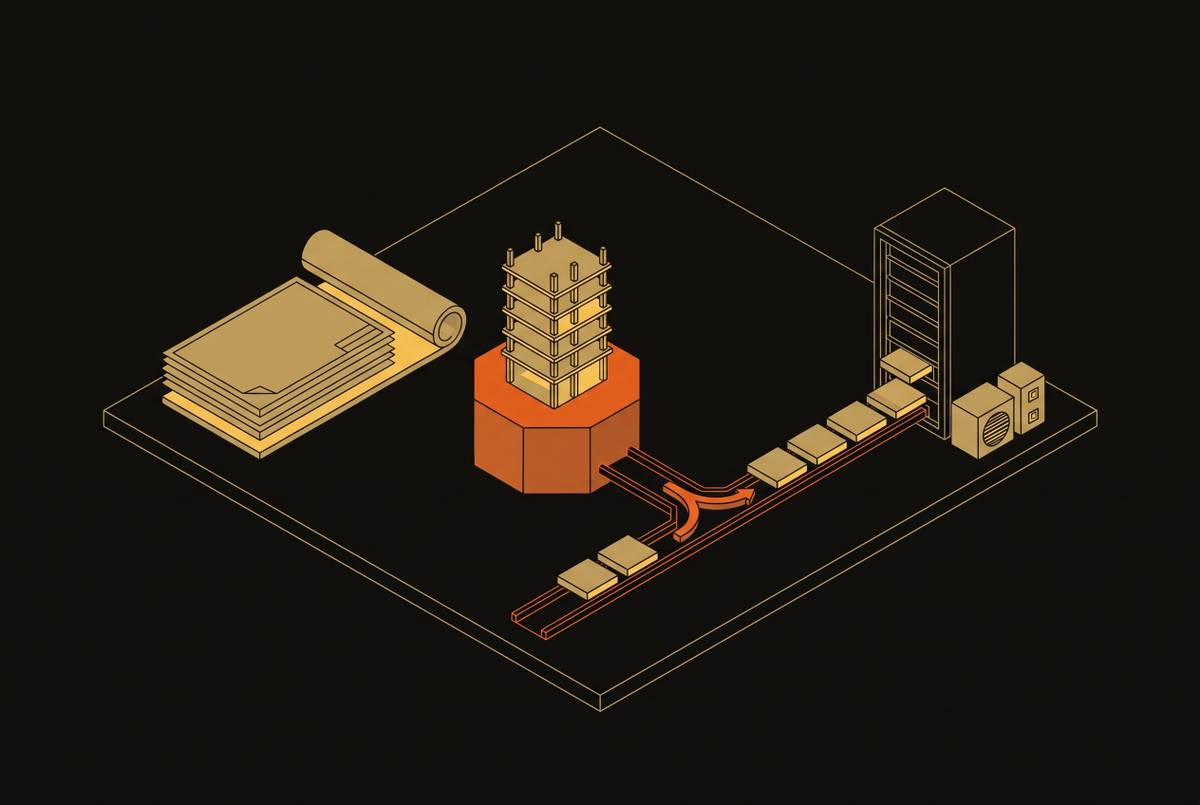
IFC began in architecture, with an object model built around rooms, walls, doors, and structural members. Structural, MEP, and infrastructure support came later. Those additions broadened its reach without giving data center power chains, cooling loops, and fiber routes first-class status in the schema. Adding domains requires buildingSMART committee review and alignment with ISO procedures, a process measured in years.
Yu et al.’s systematic review of IFC schema extensions over two decades found that most cases dealt with infrastructure, while work on operation and maintenance had only recently grown. Critical-systems infrastructure did not appear as a primary domain.
How the EXPRESS-based schema creates rigidity that newer data center use cases cannot work around
EXPRESS is the modeling language that defines which objects IFC recognizes and how their information fits together. Standards built on EXPRESS and STEP Physical File make it hard to update part of a model, filter out large amounts of data, or exchange it quickly. Connecting that structure to the APIs used by DCIM, EPMS, and BMS platforms is therefore more than a configuration task.
Aragón et al.’s 2025 analysis of EPD data integration identified twenty distinct gaps for automated incorporation and proposed eleven actions to improve IFC 4.3. That study covers environmental product data rather than data center systems, but it shows hard boundaries on what specialized information the schema can take in. Better authoring cannot erase those boundaries. The Model View Definition mechanism can pick a subset of data to exchange, but it cannot add an entity class that the schema does not have.
For critical-systems information outside that vocabulary, teams fall back on custom property sets or separate spreadsheets and PDFs. These routes keep the information, but they may lose the shared, machine-readable meaning that goes with it. The receiving system needs more than an export setting to understand them.
The three specific schema gaps that cripple data center critical-systems modeling
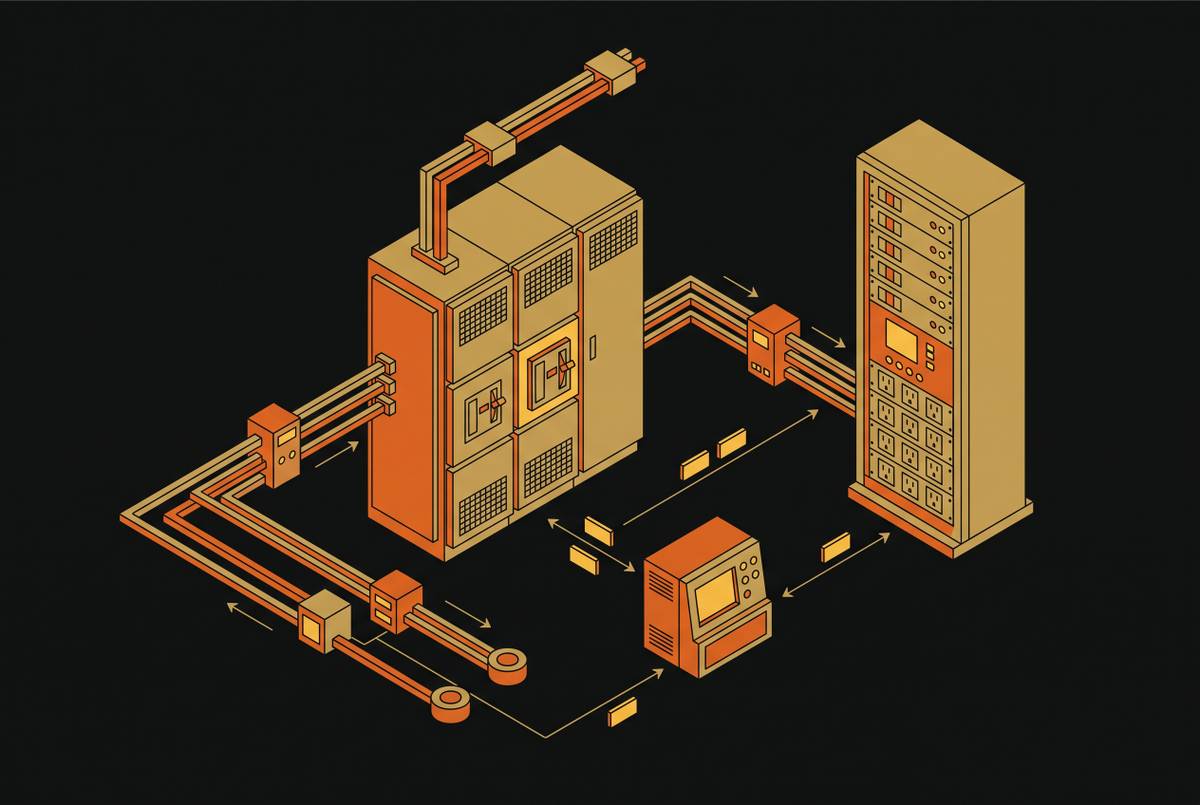
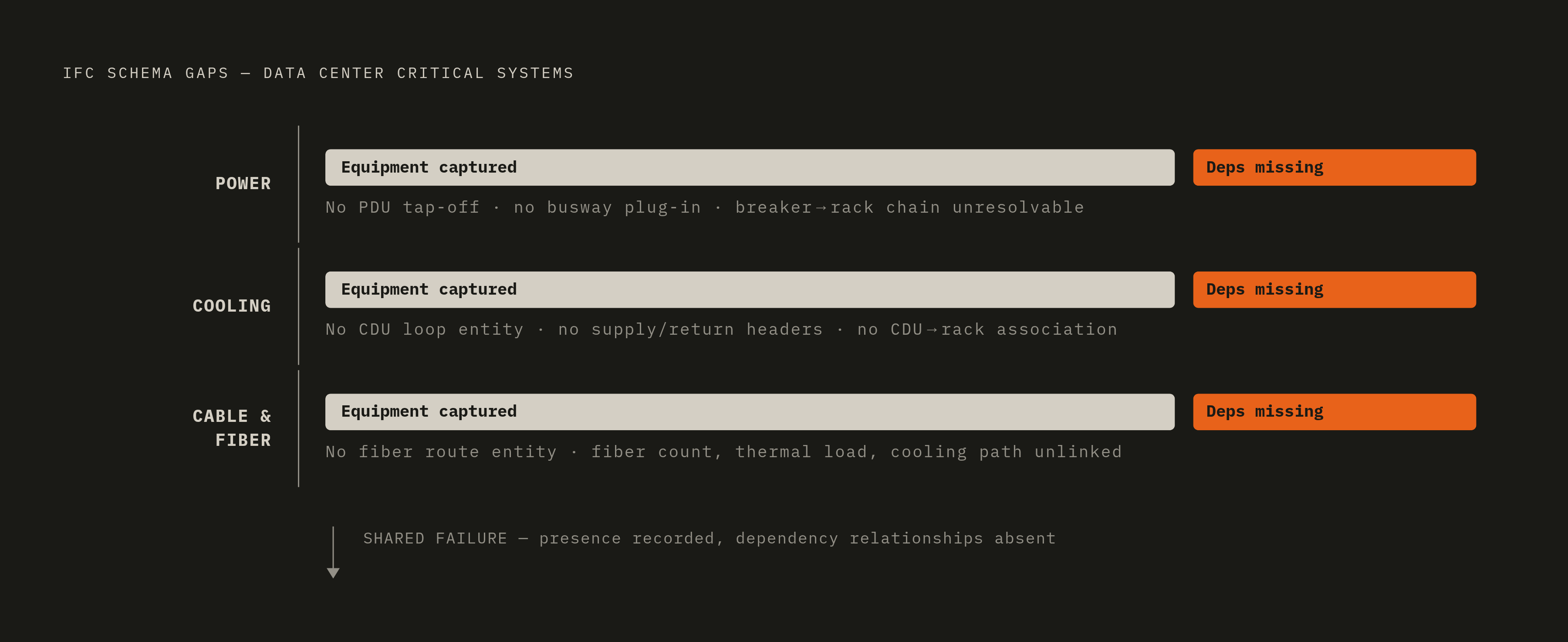
Power is the first gap. IFC has no native entity class for a PDU tap-off or busway plug-in unit, leaving key parts of distribution topology without a standard representation. A model may show where electrical equipment is without reliably showing the chain from breaker to rack. Equipment presence is not the same as dependency data.
Cooling is the second gap, because a coolant distribution unit, or CDU, loop has no corresponding native entity. The missing representation includes supply and return headers, flow rates, and the association between a CDU and the racks it serves. Liquid and hybrid cooling make that omission harder to work around. A collection of components does not by itself define the loop.
Cable and fiber form the third gap. IFC has no single machine-readable object that links fiber count, thermal load, and cooling path, and it has no native fiber route entity. The practical test is to export a current data center model and ask the file alone which breaker feeds which rack, which CDU serves which row, and how many fiber strands pass through a given cable tray. A standard IFC export needs more data and agreed conventions to answer those questions reliably.
Why semantic inconsistency across authoring tools makes the gaps worse in practice
Even where IFC provides MEP coverage, authoring tools do not always give the same information the same meaning. One tool may put a power attribute in a named property set, while another uses a different key or omits it. Both can claim IFC compliance even when the data they produce differs. Classification errors and uneven software support widen that mismatch.
The variation is partly permitted by the standard. IFC accommodates different modeling approaches across major BIM vendors, rather than enforcing one canonical representation for all critical-systems information. When disciplines contribute exports to a federated model, incompatible property-set conventions accumulate. The team that brings the exports together must sort out those differences before downstream software can read them in the same way.
Hellin et al.’s 2026 benchmark at TU Munich tested BIM information extraction on ifc-bench v2, with tasks drawn across 37 IFC models. Adaptive exploration outperformed static query generation across all configurations. The result shows why a fixed query approach is less effective at navigating heterogeneous BIM information.
How do design models become a DCIM-ready handoff without manual re-entry?
Handoff fails when the operations platform gets equipment records but lacks the power topology, cooling assignments, and port-level connectivity it needs to use them. The missing relationships become closeout work. Capacity planning, change management, and dependency mapping then depend on how completely the team reconstructs those records. Retrofitting integration after handover is more expensive and rarely complete.
Chatsuwan et al.’s 2025 critical review found that static IFC and COBie exchanges are insufficient for real-time facility management, continuous updates, and dynamic integration. Schneider Electric’s EcoStruxure IT Advisor illustrates the receiving side of that problem. Its data center digital twin covers assets, racks, power, cooling, and dependencies, so it needs structured information that IFC exports do not reliably supply without remediation. A connected delivery workflow, such as the approach offered by Archil Labs, addresses a different part of the chain by moving structured asset data into DCIM and EPMS at turnover, avoiding manual reconciliation.
The distinction is between an operations model and the workflow that feeds it. Even with a detailed design model and a capable DCIM platform, the data exchanged between them may be incomplete. Bessemer Venture Partners’ Atlas reports 190 GW of announced hyperscale data center capacity across hundreds of projects as of early 2026. That buildout multiplies the exposure to the same underlying handoff gaps.
How higher rack densities make the schema gap a physical coordination problem, not just a data problem
At higher density, system models that are kept separate put construction at risk. Deploying them in a legacy facility without redesign can trip breakers, overwhelm cooling, and violate fire suppression ratings. Power, cooling, and cabling can no longer be treated as independent workstreams.
Liquid and hybrid cooling, together with multi-megawatt power blocks, constrain where cable trays, overhead raceways, and underfloor pathways can run. A high-density rack may need hundreds of fiber connections for east-west links, uplinks, storage fabrics, and redundancy. Those bundles take up physical space. Poorly managed bundles obstruct airflow and make high-wattage racks harder to cool and service, yet IFC cannot express that whole dependency as a unified, machine-checkable object.
Chen et al.’s FDD-ON ontology work at Oak Ridge National Laboratory provides a contrast with IFC by showing what explicit HVAC semantics involve, including cause-fault-symptom-impact relations, controlled vocabulary, and machine-interpretable links. Without a structure like that for data hall cooling relationships, people must review separate documents to coordinate the work. Conflicts found during construction have direct cost consequences, particularly when electrical distribution accounts for a substantial portion of the GMP on 2026 data center bids.
Why custom property sets and schema extensions do not close the gap
The obvious workaround is to add the missing information through custom property sets or an ad hoc schema extension. That can preserve a project’s data. It does not make the data intelligible to a receiving tool that has no agreed definition for those properties. A CDU loop property set remains unusable to an ingestion pipeline or validation rule unless that system has been taught its meaning.
Yu et al.’s review found that ad hoc extensions were limited to products and processes for particular sectors and called for a more organized approach. The EPD study likewise found that available incorporation mechanisms required significant simplifications, obstructing machine interpretation without human intervention. These are not merely naming problems. Different authoring teams can define overlapping or conflicting sets, reproducing the same fragmentation that affects the base schema.
Information Delivery Specification v1.0 and bSDD provide partial mitigation through machine-checkable deliverables and a controlled dictionary, but they do not create missing entity types. Archil Labs takes the data center-native authoring approach of encoding critical-systems entities and routing logic in the delivery workflow before export. A genuine solution needs an agreed data model that receiving systems can interpret.
What IFC 5 proposes, and what it does not yet resolve for critical systems
IFC 5’s USD-influenced layering model offers a useful architectural change. Universal Scene Description, originally developed by Pixar, treats information as composed layers that can be modified independently. With building data, that approach could keep structural systems, mechanical equipment, and sensor information separate so that a change in one domain need not affect them all. It directly addresses the difficulty of partial updates and filtering.
Layers alone do not add native classes for CDU loops, busway plug-in units, PDU tap-off circuits, or fiber routes. Those objects still require explicit domain work. Moving toward API-friendly serializations can improve communication with operations platforms while leaving the meaning of the exchanged information unresolved.
The available sources do not establish when those critical-systems entities will reach ratified status. Their inclusion before the current buildout cycle peaks remains unconfirmed. For teams delivering facilities now, the practical implication is to design handoff around available structured data capabilities, rather than make completion depend on an unratified schema version.
Why AI-assisted BIM extraction does not substitute for schema completeness
AI can navigate inconsistent BIM information more flexibly than a static query. The Hellin benchmark supports that use. Its best-tested LLM configuration nevertheless remained insufficiently accurate for unsupervised deployment in safety-critical workflows. Better extraction performance does not establish that an output is dependable enough to support energizing a switchboard.
The useful boundary is between flexibility and precision. AI suits tasks such as RFI classification, layout option generation, and specification extraction from manufacturer PDFs, where most of the work deals with language and inputs in many forms. Deterministic rules fit power topology validation, cooling loop completeness checks, and commissioning script alignment. Those checks need yes-or-no answers that can be audited against defined relationships.
IFC’s rigidity has a useful side here. A fixed schema with enforced semantics gives rules a stable basis for checking data if it has the entities and relationships they need. When structure is missing, that basis is weaker, however well an AI tool searches the file.
What a team delivering operations-ready handoff actually needs from its BIM strategy
The lesson for project teams is to define handoff requirements before construction begins. That means explicit schema alignment, shared asset identifiers, and a parallel structured data layer for information IFC cannot natively represent. The layer complements BIM. Its records need to include port-level connectivity, power circuit topology, cooling loop assignments, and fiber routes in forms that DCIM and EPMS ingestion pipelines can consume without manual remediation.
Medium-voltage switchgear has 22-month lead times on 2026 orders, so a submittal error or unresolved data gap can freeze procurement or force a field workaround that becomes visible at commissioning. The risk grows when equipment parameters are trapped in manufacturer PDFs. Connecting those parameters to models and validation rules makes them usable before the handoff deadline arrives.
Among the approaches built around this architecture, ArchiLabs Studio links layouts, critical-systems engineering, cable routing, documentation, RFIs, and operations-ready handoff in a connected workflow. Its structured data layer is designed to connect to DCIM, EPMS, and BMS at turnover. The evaluation criterion for such a platform is whether each RFI answer, design decision, and equipment parameter remains traceable to its supporting information, with the system relationships intact when operations takes responsibility.
Sources
- A Systematic Review of the Trends and Advances in IFC Schema Extensions for BIM Interoperability
- BIM Information Extraction Through LLM-based Adaptive Exploration
- BIM–FM Interoperability Through Open Standards: A Critical Literature Review
- Bridging Interoperability Gaps Between LCA and BIM: Analysis of Limitations for the Integration of EPD Data in IFC
- Development of FDD-ON: an Ontology for VAV HVAC System Fault Detection and Diagnostics